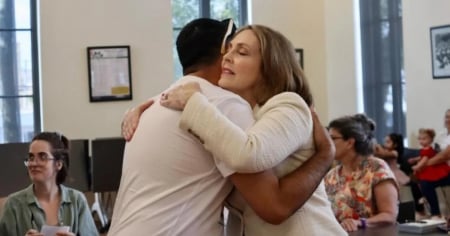
Alían Méndez Aguilar, a young Cuban who lived in North Miami, was deported on April 24 amid a migration process that has abruptly separated him from his family in the United States, despite having no criminal record or having committed any offense.
The case, shared online by the Univisión journalist Javier Díaz, has caused shock due to its family circumstances: he is married and is the father of a three-year-old girl, and he is also responsible for his wife's older son, who suffers from a severe physical and mental disability.
Méndez, 28 years old, arrived in the United States with the hope of rebuilding his life away from the authoritarianism in Cuba. He applied for political asylum, but his request was denied by immigration authorities.
In 2020, a deportation order was issued against him, which was not carried out at that time because the Cuban government refused to accept him. The law stipulates that if 90 days pass after an attempt at repatriation without it being executed, the migrant may be released under supervision. This was the case for him.
"I lived for five years, I built my family, I never had a criminal record, I never had anything to do with the law," he assured.
During that time, he started a family with a woman with whom he had a daughter, and he also took on a vital role as both an economic and emotional support for his wife's eldest son, a minor with severe physical and mental disabilities.
He recounted that his asylum application was a exhausting experience, marked by what he sees as a lack of understanding of the Cuban reality by judges and prosecutors.
From stable life to forced exile
The sudden deportation of Méndez, who was the primary provider for his household, has shaken the life of his family in Florida.
His wife and daughter were able to travel to Cuba shortly after to visit him and spend a few days with him, but they had to return immediately due to the condition of their oldest son, whose health requires special care and constant attention.
The young man now faces an uncertain life in Cuba, with no immediate prospects of legally reuniting with his loved ones.
Journalist Javier Díaz explained that he will need to initiate a complex legal process to request re-entry to the country, which includes a petition for forgiveness that may take between five and ten years, if the government grants it.
In a video, Méndez made a desperate plea: "I need advice, what should I do? I've been told that I need two waivers, one for the deportation and the other for the illegal time I spent in the United States in order to return legally."
A common story amid uncertain politics
The story of Alían Méndez is not an isolated case.
With the rising wave of Cuban migration, thousands of people are facing a U.S. asylum system that has tightened its criteria and often denies protection to those fleeing authoritarian regimes unless they can demonstrate individual persecution.
In practice, this leaves out many applicants who flee repressive contexts but lack specific evidence or appropriate legal advice.
The case also highlights the diplomatic tensions between Washington and Havana, particularly regarding deportations.
Cuba has agreed to repatriate a number of citizens, which creates uncertainty for those with pending deportation orders. In previous years, the lack of enforcement of repatriations allowed many migrants to settle and build a life in the country, albeit with a precarious status.
Now deportations have surged in frequency, and each flight to Havana signifies a human separation behind every case file.
Separation, pain, and the struggle for a shared future
From Cuba, Méndez now faces a reality for which he was not prepared. In addition to the pain of separation, he is worried about his daughter's future and the well-being of a family that depends on him.
Javier Díaz regrets that there are many like him, who did not commit any crime, only asked for a chance, and today are separated from their families.
In a country where immigration policy changes with each administration, the story of Alían Méndez reminds us once again that behind every statistic lies an interrupted life, a fragmented home, and a human being who simply seeks the dignity of living without fear.
Frequently Asked Questions about Alían Méndez's Deportation and U.S. Immigration Policy.
Why was Alían Méndez deported to Cuba?
Alían Méndez was deported to Cuba because his request for political asylum was rejected by U.S. immigration authorities. Although he had no criminal record and had formed a family in the U.S., his immigration status was not regularized, which led to his deportation. His case highlights the challenges faced by many Cuban migrants in an increasingly strict asylum system.
What steps should Alían Méndez take to return to the United States?
Alían Méndez will need to initiate a complex legal process to request reentry into the United States, which includes the application for two immigration waivers: one for deportation and another for the illegal time he spent in the country. This process could take between five and ten years, depending on the approval of these waivers by the U.S. government.
How does Alían Méndez's deportation affect his family in the U.S.?
The deportation of Alían Méndez has left his family in a precarious situation in Florida. As the primary breadwinner, his absence has impacted the economic and emotional stability of his wife and children, especially the eldest son with a disability. Although his wife and daughter were able to visit him briefly in Cuba, their return was necessary due to the special needs of the child.
What challenges do Cuban migrants face in the U.S. asylum system?
Cuban migrants are facing a U.S. asylum system that has tightened its criteria, requiring specific evidence of individualized persecution. This excludes many applicants who are fleeing repressive contexts but are unable to demonstrate direct persecution or have access to adequate legal counsel. The increasing wave of Cuban migration and the diplomatic tensions between the U.S. and Cuba further complicate these situations.
Filed under: