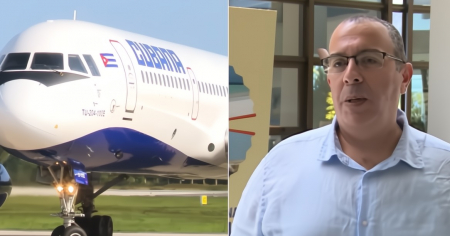
The Cuban regime announced the implementation of an ambitious investment program for the country's airport infrastructure, under the direction of the Civil Aviation Corporation, in an attempt to revitalize a sector marked by deterioration, operational inefficiency, and criticism from national and international travelers.
According to a report broadcasted by Televisión Cubana, rehabilitation and expansion works have already begun at Vilo Acuña International Airport in Cayo Largo del Sur, where new runways have been constructed, terminals have been repaired, and other construction activities have been carried out.
These works are also being carried out at the airports of Cayo Coco, Havana, and Varadero, which are the main hubs for international tourism.
“We are improving the terminals in Holguín and Camagüey, and we will enhance the terminal in Santiago de Cuba,” declared Joel Beltrán Arches, president of the Civil Aviation Corporation S.A., affiliated with the Ministry of Transport.
The official stated that more than 98% of the tourists arriving in Cuba do so by air, making civil transportation a strategic pillar for the national economy and the attraction of foreign currency.
Despite the crisis in the tourism sector, Cubana de Aviación will expand its operations in Europe in November with flights to Germany and Spain.
They will prioritize investments for the movement of cargo from abroad
The government's investments in civil aviation aim not only to enhance passenger service but also to optimize cargo handling, a critical aspect given the increasing reliance on imports to meet the basic needs of the population.
In this regard, improvements will be prioritized at the airports in Holguín and Cienfuegos, through which a significant amount of cargo from abroad enters, often via charter or cargo flights.
In light of the impact of frequent blackouts affecting the island, Beltrán Arches noted that efforts are underway to ensure the operability of airports through the installation of generators and energy reserves. "The blackouts have taught us important lessons," he acknowledged.
Although the authorities assert that the program responds to "the demands of the people," the emphasis on tourism and international logistics highlights that the regime's focus remains on the sector that generates foreign currency, while Cubans face travel restrictions, long lines, canceled flights, and inadequate services.
Frequently Asked Questions about the Aviation and Tourism Crisis in Cuba
What is the objective of the investment program in civil aviation in Cuba?
The goal of the investment program in civil aviation in Cuba is to revitalize the air sector by improving airport infrastructure, especially in the airports of Havana, Varadero, Cayo Largo del Sur, and Cayo Coco, to boost tourism and efficiency in cargo handling. However, this plan faces challenges such as frequent power outages and a decrease in the number of international flights.
How does the energy crisis affect airports in Cuba?
The energy crisis in Cuba has led to the implementation of backup energy systems at airports to maintain operations during widespread blackouts. Although this enables airports to continue functioning, the situation is precarious and relies on temporary solutions, adding challenges to air connectivity and tourism on the island.
Why are airlines canceling flights to Cuba?
Airlines are canceling flights to Cuba due to a decrease in passenger demand and issues with local infrastructure, such as power outages and shortages. This has negatively impacted the travel experience and has led airlines like Edelweiss Air and Cóndor to suspend their routes to the island.
What impact does the decline in tourism have on the Cuban economy?
The decline of tourism in Cuba has a significant negative impact on the economy, as tourism is one of the main sources of foreign income for the country. The drop in the number of international visitors, exacerbated by energy and logistical issues, has resulted in a "lost decade" for the tourism sector, according to experts.
Filed under: