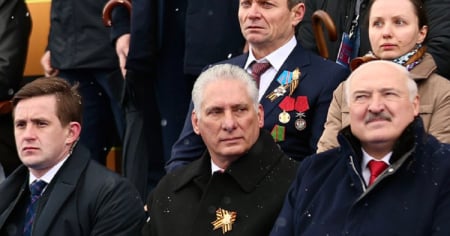
The Cuban leader Miguel Díaz-Canel met on Monday with the governor of St. Petersburg, Alexandr Beglov, to discuss the launch of direct flights between Havana and that Russian city.
The parties discussed the increase in tourist exchange, which could be facilitated by the inauguration of new direct flights, reads a dispatch from the official TASS agency.
Díaz-Canel also expressed gratitude in the meeting for Russia's support for his government and condemned the embargo. Conversely, he criticized the measures taken by the NATO bloc against Russia following the invasion of Putin in Ukraine.
“Pleased to reconnect with the esteemed friend Alexander Beglov, Governor of Saint Petersburg, and hold a productive meeting. We discussed the historic friendship between our nations and the progress in the economic-commercial and cooperation areas,” the leader wrote about the meeting on his X account.
The account of the Presidency of Cuba also reported on the meeting.
"Upon arrival, he placed flowers at the statue of Lenin, founder of the first socialist state and leader of the working class," he tweeted about it, without mentioning the negotiations regarding the flights.
The Cuban leader arrived on Sunday in Saint Petersburg as part of an official visit to Russia, invited by his counterpart Vladimir Putin.
The Cuban delegation is composed of the Minister of Foreign Affairs Bruno Rodríguez Parrilla; Emilio Lozada García, head of the Department of International Relations of the Central Committee of the Communist Party of Cuba; and Oscar Pérez-Oliva, Minister of Foreign Trade and Foreign Investment, among other high-ranking officials.
According to information from the Presidency of Cuba, the visit's program includes tours of scientific centers linked to strategic sectors such as biotechnology, energy, and artificial intelligence, with an agenda aimed at strengthening bilateral cooperation in key areas for the development of the Island.
Russia is one of the main sources of tourists to the struggling Cuban economy.
Between January and March 2025, Cuba received only 571,772 international visitors, far below official targets and pre-pandemic levels. Russia has been one of the few countries that has maintained a steady flow of tourists to Cuba, although it has also reduced its numbers in recent months.
On Saturday, it was revealed that the Cuban regime has sealed a new agreement with the Russian agency Rus Cuba Dive to promote diving tourism in the Ciénaga de Zapata, as announced during the International Tourism Fair (FITCuba 2025).
Frequently Asked Questions about the Cuba-Russia Relationship and Díaz-Canel's Visit
Why is Miguel Díaz-Canel seeking to open direct flights between Havana and St. Petersburg?
Díaz-Canel seeks to open direct flights to increase tourist exchange between Cuba and Russia. This measure could boost the arrival of Russian tourists to the island, a vital flow for the Cuban economy that has seen a decline in international visitors in recent months.
What is the significance of the economic relationship between Cuba and Russia?
The economic relationship between Cuba and Russia is crucial for the island due to its dependence on key sectors such as energy and tourism. Russia has provided significant credits and technical assistance to help Cuba tackle its energy crisis and is an important trading partner in the region.
How is the Cuban regime reinforcing its dependence on Russia?
The Cuban regime strengthens its dependence on Russia through economic and political agreements, which include the acceptance of Russian credits, alignment with its international policies, and the granting of preferential conditions to Russian companies in strategic sectors such as transportation and energy.
What are the criticisms of Cuba's stance on the Russian invasion of Ukraine?
Cuba has been criticized for not condemning the Russian invasion of Ukraine and, instead, has supported Moscow in international organizations. This stance has been viewed as a reflection of its dependence on Russia and its alignment with the Kremlin, despite the sovereignty violations represented by the invasion.
Filed under: