
Related videos:
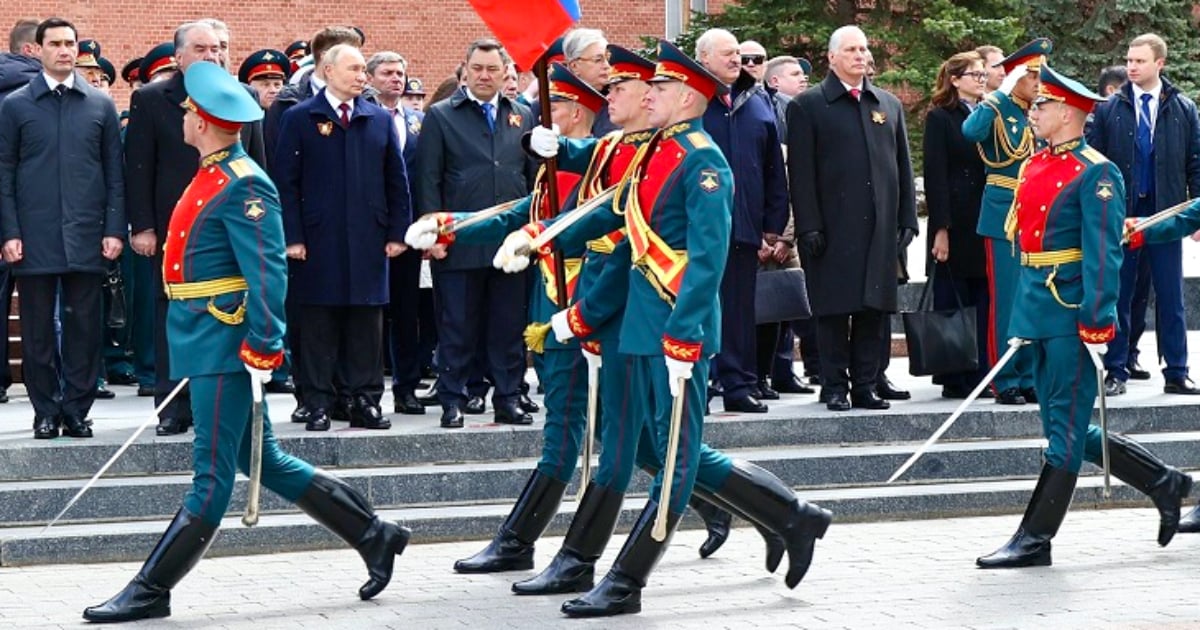
The Cuban leader, Miguel Díaz-Canel, confirmed his attendance at the Victory Day military parade, which will take place on May 9 in Moscow's Red Square, under the leadership of Vladimir Putin, to commemorate the 80th anniversary of the Soviet victory over Nazi Germany.
This edition carries a significant symbolic and political weight, not only due to the context of the war in Ukraine, but also because of the ideological alignment of the leaders who will accompany the Russian president at the event, a list of which was made public by rbc.ru.
This year's commemorative event, which marks the eight decades since the end of World War II in Europe, takes place against a backdrop of heightened geopolitical tension.
To ensure the successful execution of the parade, the Kremlin has announced a unilateral truce from May 8 to 11 on the battlefield in Ukraine, aimed at preventing attacks during the festivities. However, there remains concern that the celebration could be disrupted by a Ukrainian drone attack on Moscow or its surroundings, as has happened in previous months.
Security has been reinforced to the highest level, and a carefully calculated military demonstration is expected, combining historical symbolism with current displays of power. This may include a parade of North Korean soldiers, openly acknowledging their presence on the front in the Kursk region and the close alliance of both regimes.
A parade with geopolitical significance
More than 20 heads of state and government have confirmed their attendance in the Russian capital, including the Chinese Xi Jinping, the Venezuelan Nicolás Maduro, the Brazilian Luiz Inácio Lula da Silva, the Belarusian Aleksandr Lukashenko, the Serbian Aleksandar Vučić, the Palestinian Mahmud Abbás, and other leaders from countries such as Kyrgyzstan, Armenia, Vietnam, Laos, Uzbekistan, Tajikistan, Turkmenistan, and Burkina Faso.
This conglomerate of leaders represents an alliance of authoritarian regimes or hybrid governance, mostly distanced from liberal democratic standards, and that share a narrative opposing Western democracies, NATO, and the political values that underpin the international order established since the end of World War II.
Cuba and Russia: A Renewed Strategic Alliance
Díaz-Canel's presence at this event is not merely ceremonial. It reflects a deepening of strategic relations between Moscow and Havana, which has included everything from the reactivation of commercial flights to investment projects in key sectors of the Cuban economy such as energy, agriculture, and transportation.
In the past two years, both governments have signed more than a dozen agreements, which include everything from the supply of oil and wheat to the use of the ruble as a currency for trade.
La Habana has also received technical assistance and military advice from Russia, in addition to strengthening collaboration in cybersecurity and political propaganda.
One of the most controversial aspects of this relationship has been the presence of Cuban mercenaries on the war front in Ukraine, fighting on the Russian side.
Although the Cuban regime has claimed that it is a "human trafficking network" that has been dismantled, multiple testimonies and news reports have confirmed that young Cubans were recruited to fight in the conflict, some of them aware of the military objective, in exchange for promises of Russian citizenship or financial compensation.
This situation reveals a darker dimension of the relationship between both regimes: the use of Cuban labor as cannon fodder in foreign wars, alongside the decline in living standards on the island and the desperation of thousands of citizens seeking a way out of the country.
An ascending illiberal bloc
The Victory Day parade has become a showcase where Putin displays his network of allies in an increasingly fragmented world.
Confronted with the diplomatic isolation that Russia faces in international forums due to its invasion of Ukraine, Moscow is working hard to project an image of global support for its revisionist crusade of the international order.
Díaz-Canel, who has visited Moscow several times since the beginning of his term, is once again emerging as a key figure in the authoritarian axis that the Kremlin promotes in Latin America, alongside Maduro and Daniel Ortega.
This strategy seeks to challenge Western hegemony by offering an alternative form of cooperation (the BRICS) that is distinct from democratic values, rooted in economic exchange, political support, and shared authoritarianism.
With his participation in the May 9 parade, the Cuban president not only reinforces his dependence on the Kremlin but also his commitment to an international order where human rights, democracy, and respect for international law are subordinated to the interests of authoritarian powers.
Filed under: