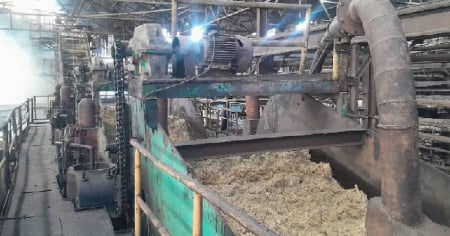
Cuba is experiencing one of the worst sugar harvests in its recent history and, despite speeches of "creative resistance" and tours by political authorities to the mills, the numbers do not lie: several key sugar mills have produced less than 15% of their plan, others barely survive amid blackouts, the machinery is outdated, and sugarcane is scarce.
In Calimete, Matanzas, the Jesús Sablón Moreno sugar mill has just completed 100 days of harvest without yet achieving the target of 16,700 tons, with 5,000 tons still to be produced, and it all depends on “whether the weather conditions allow it,” acknowledged the official newspaper Girón.
The newspaper pointed out that, just a few weeks before the campaign's conclusion, the routine is a daily struggle against frequent power outages, equipment breakdowns, shortages of spare parts, and urgent repairs. The human effort, although significant, does not compensate for the wear and tear of a production system in critical condition.
The situation is even more serious in Santiago de Cuba, where the Dos Ríos mill, the only one operating in the province, had produced only 13% of the plan (about 3,000 tons of 20,811) after 73 days of the campaign.
Local authorities acknowledge that the sugar harvest is in crisis, but they insist on “producing more sugar, saving the harvest and the industry, both in the agricultural and industrial sectors,” as recently urged by the first secretary of the Provincial Party Committee, Beatriz Johnson Urrutia.
Las Tunas is not lagging behind in the disaster. The Antonio Guiteras sugar mill, the largest in the country, was barely reaching 11% of its production plan by mid-April. During a visit to the mill, the Deputy Prime Minister Jorge Luis Tapia Fonseca “called for an extraordinary effort from the workers to achieve a turnaround,” according to the provincial newspaper 26.
Even the first secretary of the Communist Party in that province, Osbel Lorenzo Rodríguez, publicly admitted that "sugar production will hit historic lows" during a recent analysis of the economic performance in the region for the first three months of 2025.
In the midst of this debacle, the official press highlighted on April 30 that Sancti Spíritus had become the first province in the country to meet the sugar production plan.
The official newspaper Escambray "celebrated" the indicators of the Melanio Hernández mill in Taguasco, which it deemed outstanding for "exceeding all its industrial performance parameters, optimizing the use of the sugarcane's potential, ensuring the production of high-quality grain for consumption, and contributing over 4,000 MW/h to the National Electroenergetic System."
However, the media did not report how many tons were actually produced, which raises doubts about the magnitude of this supposed achievement. This is a striking silence considering that, according to previous reports, the target was over 19,000 tons, to be met before March 11. Not only are the numbers not being made transparent, but a significant portion of the sugarcane used came from the neighboring central Uruguay and from the “Heriberto Duquesne” in Villa Clara, which diminishes the local merit.
In January, the sugar harvest in Cuba was going through one of its worst crises: out of the 14 mills planned for the campaign, only six were operational.
This critical situation was attributed to the late start and the failure to incorporate eight sugar mills at that time, which accounted for 75% of the sector's productive debt.
The preparation of industries for the start of milling was severely affected by the lack of resources. The energy crisis delayed repairs in power plants, machining workshops, and cleaning centers, in addition to limiting the production of necessary parts and components for the machinery.
The 2022-2023 sugar harvest, with its 350,000 tons of sugar, became the worst harvest since 1898, when, during the height of the War of Independence, Cuba's sugar mills produced 300,000 tons.
The data confirms the brutal setback of a sector that once positioned the island among the world’s leading sugar exporters.
In December 2023, the government acknowledged that it is "shameful" for the country, traditionally one of the main producers of sugar in Latin America, to be forced to import this product.
More than a sugar harvest, what Cuba is experiencing in 2025 is the slow and official burial of its sugar industry. The issue is no longer about meeting a plan; rather, each surviving mill seems to do so by miracle. And sugar, which once sweetened the country's economy, is now another symbol of its decline.
Frequently Asked Questions about the Sugar Harvest Crisis in Cuba
Why is the sugar harvest in Cuba collapsing in 2025?
The sugar harvest in Cuba is collapsing due to structural problems such as outdated machinery, lack of investment, scarcity of resources and fuel, and frequent power outages. These factors have drastically reduced the country's sugar production capacity.
What is the situation of the sugar mills in Cuba during the 2025 harvest?
During the 2025 sugar harvest, many sugar mills in Cuba are operating well below their planned capacities. Some, like the Dos Ríos mill in Santiago de Cuba, have only achieved 13% of their production plan, while others are facing similar problems due to a lack of resources and adverse weather conditions.
What impact does the sugar crisis have on the Cuban economy and population?
The sugar crisis has significantly impacted the Cuban economy, a sector that was once strategic for the country. The shortage of sugar has forced Cuba to import this product, which is considered "shameful" given its historical role as one of the leading sugar producers in Latin America. Furthermore, the lack of production affects the availability of sugar for domestic consumption.
Filed under: