
Related videos:
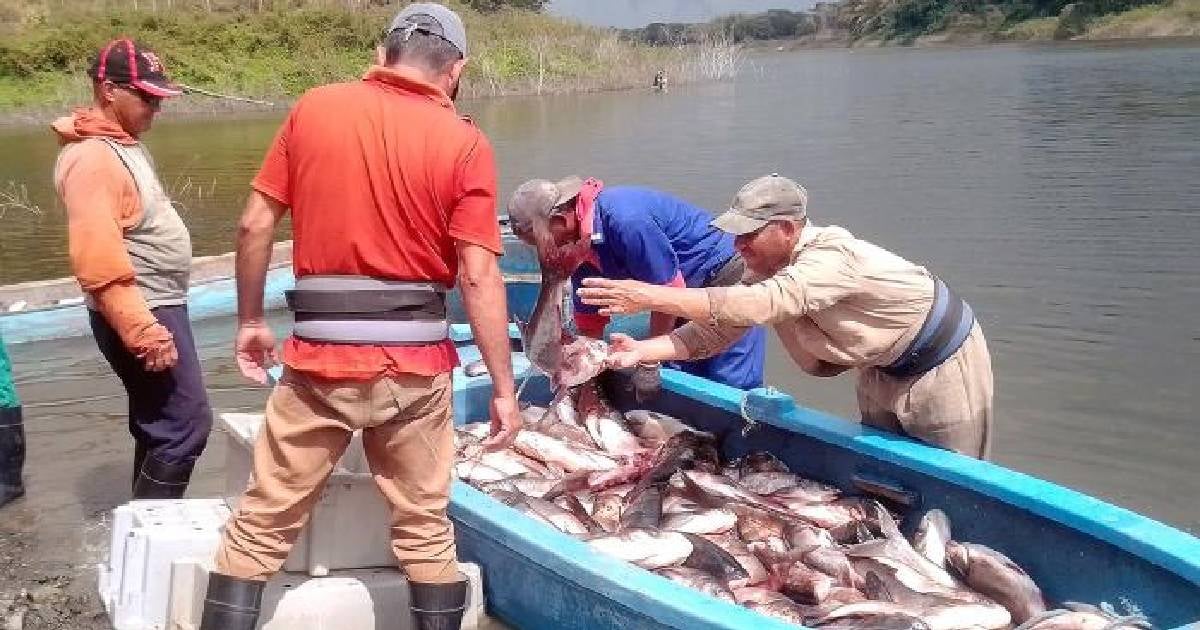
The fish production in the Zaza reservoir, the largest dam in Cuba, is experiencing a severe crisis: fish are scarce, plans are being unmet, and the authorities' response has been to blame poor weather and the low "manifestation" of species like cyprinids (carp).
According to the official newspaper Escambray, as of April only 72.2% of the planned target was achieved, leaving over 250 tons of fish unprocessed out of the 914 expected.
The Fishing Company of Sancti Spíritus (Pescaspir) claims that the cold temperatures at the beginning of the year, followed by strong winds and the breakdown of boats and tractors, have limited extractions. However, behind this narrative lies a structural reality that is rarely mentioned: a chronic shortage of oil, spare parts, and means of transportation.
According to Marelys Montelongo Álvarez, a specialist from Pescaspir, they are "recovering fishing days" and uniting teams, although she did not hide the fact that they operate with serious material limitations. Despite this, the company is holding on to an optimistic goal: to end 2025 with 3,035 tons, 28 more than the previous year.
Currently, Pescaspir has 13 active brigades - three using nets, two with seine nets, and the rest with gill nets - working under minimal conditions and facing a complex situation: the reservoir is covered by an invasive plant.
The "novelty" this year —said Montelongo— is that, after a period without intervening in other dams in the province, such as Lebrije and Felicidad, located in Jatibonico, significant capture operations are underway there. He added that work is also being done on several micro-dams like Tres Palmas, La Larga, and Higuanojo, where the goal is to take advantage of "the presence of biomass with commercial size."
In November 2022, it was revealed that, despite continuing to stock fingerlings, there were "fewer species in the aquaculture systems," particularly in the Zaza reservoir, and that the aquaculture sector in Sancti Spíritus was failing to meet the fish capture plan in the region's reservoirs.
Sancti Spíritus contributes about 30% of the freshwater fish caught in Cuba, and in 2024, it exceeded 3,000 tons. However, this food is hardly seen in retail outlets or on the tables of its residents, just as is the case elsewhere in the country.
While the people of Sancti Spíritus wonder why fish is not sold regularly or disappears as soon as it arrives, the authorities claim that it is being distributed, but the demand is so high that it runs out immediately, as stated weeks ago by the official newspaper Granma.
The newspaper stated that poaching also reduces the availability of the product and mentioned the implementation of operations and increased surveillance in reservoirs to curb an "illegal" practice that persists and drives up the price of fish in the informal market.
In March, the national coordinator of the Committees for the Defense of the Revolution (CDR), Gerardo Hernández Nordelo, publicly praised a Cuban resident of El Cornito, Las Tunas, who raises fish in his backyard as a means of subsistence amidst the food crisis affecting the country.
Hernández avoided mentioning the reasons why most Cubans have gone for years without consuming fish, except for the few who can buy it on the black market.
“Cuba is a country surrounded by the sea, but the waters do not have the levels of fish needed to meet the population's demand, to satisfy this growing demand,” justified in 2023 authorities from the Food Industry.
Fishing in Cuba, like the sectors of housing construction, sugar production, agriculture, and others, fails to meet its production targets due to multiple factors, among which the government mentions a shortage of resources, energy, boats, and equipment, as well as poaching; however, it prioritizes exports and tourism over domestic consumption.
Meanwhile, the government continues to rely on unsupported plans, blaming the weather and evading the underlying debate: overexploitation, poor planning, and the neglect of the industry.
Frequently Asked Questions about the Fishing Crisis at Zaza Dam, Cuba
Why is there a scarcity of fish in the Zaza reservoir in Sancti Spíritus?
The shortage of fish in the Zaza dam is attributed to adverse weather conditions, such as cold temperatures at the beginning of the year and strong winds. However, there are also significant structural issues such as the lack of oil, spare parts, and means of transportation, which affect the ability of the state-owned company Pescaspir to meet its extraction plans.
What is the impact of illegal fishing on the availability of fish in Cuba?
Illegal fishing significantly reduces the availability of fish in Cuba, according to the government. Despite operations and increased surveillance in reservoirs, this illegal practice continues and raises the price of fish in the informal market. This affects both production levels and distribution to the population.
Why does the Cuban population face a shortage of fish despite production efforts?
Although efforts are being made to increase fish production, shortages persist due to high demand, illegal fishing, and government priorities focused on export and tourism. This leaves the Cuban population with limited access to fishery products, despite Cuba being an island surrounded by the sea.
What measures is Pescaspir taking to improve fish production?
Pescaspir is trying to recover fishing days and uniting brigades to optimize available resources. Additionally, catches are being made in other reservoirs in the province such as Lebrije and Felicidad, as well as in micro-reservoirs, to take advantage of the commercially sized biomass available in those areas.
How does Cuban export policy affect domestic fish consumption?
The export policy prioritizes international sales over domestic consumption, which limits the access of the Cuban population to fish and seafood. This is due to the government's need to generate income through exports, which leads to products such as lobster not reaching Cuban tables.
Filed under: