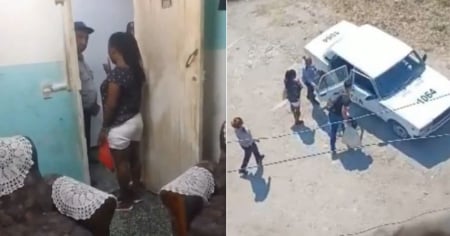
The non-governmental organization Cubalex reported on a growing pattern of repression in Cuba that not only affects political opponents, but also deliberately extends to their families as a form of punishment and intimidation.
Based on the recent cases of José Daniel Ferrer and Félix Navarro, the organization documented systematic violations of the right to privacy, family integrity, and freedom of religion.
Family harassment: from the home to the children
On April 29, agents from State Security raided the home of José Daniel Ferrer in Santiago de Cuba and, after arbitrarily detaining him, expelled his wife, Nelva Ortega, and their minor son from the home. Both were taken to an alleged "protection house" without minimum conditions, which Cubalex describes as an act of covert harassment masked in legal appearances, with implicit threats of losing custody of the child.
This pattern —Cubalex warns— uses the new Family Code as a tool of coercion, turning minors into leverage for political pressure against their parents.
While reasons of protection are cited, the State instrumentalizes children in acts of repudiation and ideological displays, as happened with schoolchildren forced to shout slogans in front of Ferrer's home after his arrest.
The Navarro case: emotional repression and medical surveillance
On the same day, Félix Navarro was arrested in Matanzas on a carefully chosen date to prevent a prison visit from his daughter, who is also a political prisoner. In the weeks prior, he had been arrested for seven consecutive Sundays while attempting to attend Mass, highlighting a pattern of religious persecution.
In this regard, Cubalex denounces the arbitrary use of surveillance cameras by Security agents, as well as the presence of unsolicited medical personnel during detentions, allegedly to "take blood pressure."
This practice, far from having humanitarian purposes, reinforces psychological control and humiliates the detainee, in a context where medical resources are scarce for the rest of the population.
Impact on the most vulnerable
Navarro's wife, Sonia Álvarez, has also suffered the effects of state punishment. She has been denied the right to visit her daughter, Saylí Navarro, in prison on six consecutive occasions, solely for wearing white, in reference to her activism with the Ladies in White.
It is worth remembering, in addition, that Zoila Esther Chávez, the mother of the political prisoner José Gabriel Barrenechea, passed away on Sunday, May 4 without being able to say goodbye to her son.
The 84-year-old woman had lost her speech and exhibited faint breathing. Her body did not hold out. And, despite her pleas, the dictatorship did not allow her to see her son again while he was alive.
Cubalex emphasizes that these acts of emotional retaliation aim to fracture family ties as a tool for political deterrence. The family ceases to be a protected space and becomes a direct target of institutional violence.
Systematic violations of human rights
These actions violate fundamental principles enshrined in international instruments such as the International Covenant on Civil and Political Rights and the Universal Declaration of Human Rights, which prohibit arbitrary interference in family life and guarantee the right to freedom of worship and protection against state intimidation.
Cubalex warns that the international community can no longer ignore this pattern of structural repression, where violence is no longer limited to activists but is inflicted upon their closest emotional circles: children, spouses, and parents, in an attempt to break their resistance through emotional harm.
Frequently asked questions about political repression and harassment in Cuba
What does family repression in Cuba consist of according to Cubalex?
Cubalex has alerted about a pattern of repression in Cuba that extends to the families of political opponents, serving as a form of punishment and intimidation. The organization documents violations of the right to privacy and family integrity, using the new Family Code as a tool of coercion, turning minors into instruments of political pressure against their parents.
How does Cuban repression affect children?
The Cuban state instrumentalizes children in acts of repudiation and ideological displays. This is evidenced by the use of schoolchildren who are forced to shout slogans outside the homes of opponents such as José Daniel Ferrer. Cubalex emphasizes that these actions violate children's rights and are part of a systematic pattern of indoctrination in Cuban schools.
What international actions are being taken against repression in Cuba?
Dozens of international organizations have demanded the immediate and unconditional release of political prisoners in Cuba, especially opponents such as José Daniel Ferrer and Félix Navarro. Democratic governments and multilateral organizations have also been urged to openly condemn these violations and exert coordinated political and diplomatic pressure to put an end to the repression. The United States, for example, has publicly condemned these detentions and the treatment received by pro-democracy activists.
Why is the harassment against José Daniel Ferrer intensifying?
José Daniel Ferrer has been the target of an increasing repressive siege due to his political and humanitarian work. Since his release, he has repeatedly reported the harassment and threats he faces from the Cuban authorities, who seek to hinder his solidarity efforts in Santiago de Cuba. The regime employs intimidating tactics such as arbitrary arrests, constant surveillance, and acts of repudiation to isolate him and curb his opposition activities.
Filed under: