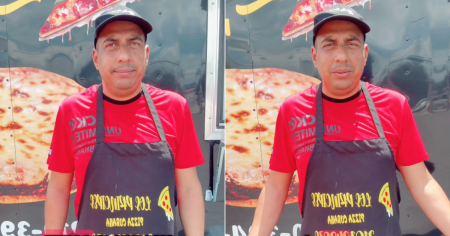
A Cuban tiktoker based in Houston, Texas, recently shared the story of a fellow countryman who, after only nine months in the United States, struggles to survive by selling pickles on a street corner, separated from his family and without any institutional assistance.
The content creator, known as Guampy (@guampy07), came across a man in front of the El Ahorro supermarket in his neighborhood and decided to record the encounter. "Look, my Cuban brothers, look over here," Guampy begins, showcasing the man who sells small jars of pickles. "This is a true brother, a brave Cuban who is fighting."
The man, sitting on a plastic chair next to his makeshift stand, tells him that he has been in the country for nine months. When asked how he feels, he replies: “I feel fine, the only thing is that I can’t do anything… because I don’t receive help from anyone. I haven’t received help from anyone.”
Guampy, visibly moved, expresses his desire to help him, as he has done before with others, and makes a call to the Cuban community: “He is not asking for help because he doesn’t want to work; you can see him here, selling his jars of pickles… This one is going to my house. I feel connected to you because you are Cuban. I’m going to help you, we are going to help you, the whole Guampy team.”
The gentleman also reveals that his wife remains in Cuba and his daughter is in Mexico, which exacerbates his emotional isolation.
The video quickly went viral on TikTok and sparked a wave of supportive comments. Numerous users stepped up to offer concrete help, ranging from housing and food to financial contributions.
"Wherever he is, I can help him; I'll take him to my house where he will have his food, snack, and lunch," commented one user. "Friend, have you found a place yet? I can offer for him to come to my apartment," wrote another person. Several users requested that the exact address be shared so they could assist him in person.
Among the hundreds of messages, several claimed to know the man and identified him as originally from Caibarién, in Villa Clara. “That man looks familiar to me, is he from Caibarién?” wrote one user. Others confirmed his identity: “I know him, he’s a great person,” “Tireless fighter, in Cuba he used to spend the early mornings selling bread and coconut candy in syrup.”
Many pointed out the visible sadness on his face, especially in his eyes. “His eyes do not lie,” “You can see the sadness on his face,” “Those little eyes broke my heart,” were phrases repeated in dozens of comments.
A day later, Guampy posted a second video showing him handing over money raised through the solidarity of his supporters.
This testimony has sparked a collective reflection on the situation of older Cuban migrants in the United States, many of whom face significant barriers without support networks. The community's response once again showcases the capacity for solidarity among Cubans both on and off the island.
Frequently Asked Questions about the Difficulties Faced by Cuban Immigrants in the United States
What challenges does a Cuban selling pickles in the U.S. face?
The Cuban faces emotional isolation and a lack of institutional support. He has been in the United States for nine months and has not received assistance, while his wife remains in Cuba and his daughter in Mexico, which worsens his isolation. Despite his efforts to work selling pickles, he lacks a support network to help improve his economic and emotional situation.
How has the Cuban community responded to the situation of this immigrant?
The Cuban community has shown strong support and solidarity towards immigrants. Following the viral TikTok video, many users offered tangible help, ranging from housing and food to financial contributions. This gesture of solidarity reflects the willingness of the Cuban community to support their compatriots in times of need.
What does the history of Cubans reflect about older immigrants in the U.S.?
The story reflects the immense barriers and vulnerabilities faced by older Cuban immigrants. Many of them arrive without support networks, which complicates their integration and adaptation. The lack of institutional assistance and emotional isolation are common challenges they must navigate in their daily lives.
What role do social media play in bringing visibility to these immigrant stories?
Social media has become a powerful tool for raising awareness and generating support for immigrants. Through platforms like TikTok, stories like that of this Cuban reach a wide audience, translating into solidarity and tangible help from people willing to assist. They also create a space for discussion about the challenges immigrants face in their process of adapting to a new life.
Filed under: