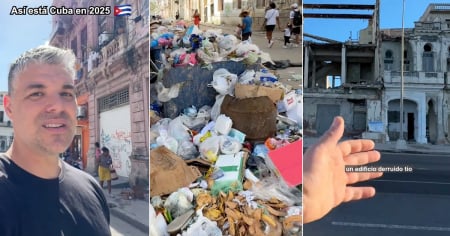
The Mexican YouTuber Luisito Comunica published a new video about his trip to Cuba this Tuesday, and this time the tobacco region of Pinar del Río was the destination of his visit.
While delving into the details of Cuban tobacco production, undoubtedly one of the most famous in the world, the content creator was greatly surprised by what are known as tobacco readings.
This practice, which dates back to the 19th century, is a way to entertain women working in factories, with one person assigned to read aloud from newspapers, books, etc. while the women strip the leaves from the tobacco.
However, what caught Luisito's attention the most was the kind of readings that are usually read to them, after having been inspected and approved by a "committee."
This is an example, and it's really unfortunate to say it this way, of the indoctrination that the Cuban authorities apply to their people, their population. Just the simple act of moving through Cuban streets and seeing political propaganda on every corner featuring the face of Fidel Castro and the phrases of Che Guevara, and on top of that, at work—where, by the way, you are working for the State, since most of the companies here are state-owned—while you work, they are reading more about Fidel Castro and more about Che Guevara and only positive news about Cuba, and here nothing bad happens and everything is good and everything is correct, it certainly speaks to how the Cuban authorities have maintained control over their population for decades,” comments the YouTuber in the video.
Although he did not express this on camera while filming in the tobacco factories and conveys it through voiceover, which could lead to many interpretations, Luisito shared his perspective on indoctrination in Cuba with a message for the younger generation.
I really want to take this opportunity to tell you, especially the young people watching this video, that you don't have to think the way you're told. You can read different kinds of literature, watch various types of movies, listen to other kinds of news. You don’t have to think necessarily like your grandfather or grandmother; create your own judgment, and whatever it may be, make sure it's well-founded,” emphasized the content creator.
The videos of Luisito Comunica have sparked divided opinions on social media, while some thank him for showing the reality of the island, others criticize him for perceiving a manipulated discourse in his reports that at times reflects that of the ruling elites in Cuba.
Frequently asked questions about indoctrination in Cuba and the videos of Luisito Comunica
What is indoctrination in Cuba and how does Luisito Comunica showcase it in his videos?
Ideological indoctrination in Cuba refers to the ideological control exercised by the government over the population, through methods such as tobacco readings, where only pre-approved texts that exalt figures like Fidel Castro and Che Guevara are read. Luisito Comunica addresses this issue in his videos, demonstrating how these practices are used to maintain a positive official narrative about the country, limiting access to diverse and critical information.
Why does Luisito Comunica urge young people to think for themselves?
Luisito Comunica encourages young people to not accept the thoughts imposed on them and to seek diverse information. In his video, he emphasizes the importance of developing one's own and well-founded judgment, rather than blindly following ideas dictated by governments or other authorities. This message is especially relevant in contexts where indoctrination is practiced, such as in Cuba, where access to unofficial information is limited.
What has been the public's reaction to Luisito Comunica's videos about Cuba?
The videos of Luisito Comunica have generated divided reactions among viewers. While some appreciate that he showcases the Cuban reality and highlights the difficulties faced by its residents, others criticize him for what they consider a superficial or biased approach. The controversy has intensified with accusations from figures like Alex Otaola, who claims that the YouTuber may be avoiding deep critiques due to pressure from the Cuban government.
Filed under: