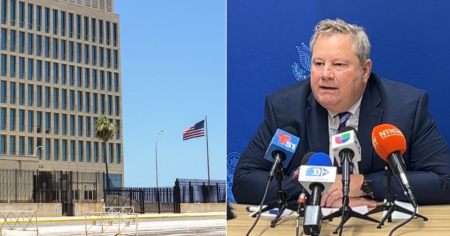
The tightening of consular filters by the Embassy of the United States in Havana is leaving dozens of Cuban families trapped in a paradox: meeting all the requirements of the family reunification program and still being rejected due to alleged ideological ties.
Andy Leal, a young Cuban resident in the United States, had been hoping for over two years to bring his mother, Mayra Jiménez García, from Havana.
They had completed the legal process, paid the fees, and attended the interviews, but instead of receiving the anticipated family reunification visa, Mayra received a flat denial.
In statements to journalist Eduardo "Yusnaby" Rodríguez from Telemundo 51, the Cuban mother explained that she was accused of having ties to the Communist Party of Cuba (PCC), even though she never was a member nor engaged in political activity.
“This breaks my heart. I have never been a communist. I am just a mother who wants to be with her son,” said Mayra from the Cuban capital.
Mayra is a Spanish citizen and resides in Havana. One of the statutes of the PCC is that its members cannot have dual nationality, yet the United States Embassy still suspects Andy's mother and refuses to issue the visa.
The official notification invoked a U.S. immigration law that prohibits issuing visas to individuals who are or have been members or affiliates of totalitarian parties. However, no evidence or avenues to appeal the decision were provided.
Cases like that of Andy and his mother are multiplying. In Miami, immigration lawyers and human rights organizations report that dozens of applications are being denied on the same grounds, even when the applicants have no political charges or verifiable ideological links. Simply having worked for a state-owned company is enough.
What does the U.S. Embassy in Cuba say about family reunification?
During a press conference held in Miami, the head of mission at the U.S. Embassy in Cuba, Mike Hammer, confirmed that consular criteria have become more stringent.
“We are strengthening U.S. laws that prevent visas from being granted to members of the Communist Party of Cuba who have held high positions or who have been active members until recent years,” he explained.
Hammer went further in his justification: “What we don’t want to see is the repressors on the streets of South Beach, enjoying a mojito. That cannot be; it’s not fair.”
Despite that stance, he also acknowledged that the system can fail: "The consular team makes the best decision with the information they have. We need to strengthen our laws, and when there is a specific case, it can be reviewed to ensure whether the decision is correct or not."
That small possibility of review is what has kept Andy going. He has sent letters to the embassy, sought legal support, and also contacted congress members. His last resort has been to share his story with the independent press in search of justice and visibility.
From Miami, Cuban families are calling for case-by-case reviews, increased transparency in the processes, and the right to defend themselves against unfounded accusations. For many, family reunification is ceasing to be a legal guarantee and has turned into a roulette marked by suspicions and arbitrariness.
Frequently Asked Questions about Visa Denials Due to Communist Ties in Cuba
Why is the family reunification visa being denied to Cubans?
The U.S. Embassy in Havana has tightened its criteria for granting visas to individuals with recent ties to the Communist Party of Cuba (PCC) or those who have worked for state-owned enterprises, even if they have not been members of the party. This approach is based on the strict application of U.S. immigration laws that prevent the granting of visas to individuals who may be perceived as affiliated with a totalitarian regime.
What options do people have when their visa has been denied?
Affected individuals may try to request a review of their case, providing evidence that they have no ideological ties to the PCC. Some have also chosen to seek legal support and contact congress members to raise awareness of their cases. However, the process can be uncertain and varies depending on the individual situation of each applicant.
How does this affect Cuban families seeking reunification in the U.S.?
The policy of tightening the criteria for granting visas has left many Cuban families in a state of uncertainty and desperation, as even when meeting legal requirements, they face rejections. This has turned the process of family reunification into a frustrating and emotionally draining experience for many.
What does the U.S. government justify to reinforce the restrictions on visa issuance to Cubans?
The U.S. government justifies these restrictions by stating that they do not wish for individuals who may have been repressors of the Cuban regime to find refuge in the country. Authorities argue that it is necessary to protect U.S. territory from individuals who could pose an ideological or political threat, although this approach has been criticized for its lack of transparency and concrete evidence.
Filed under: