
Related videos:
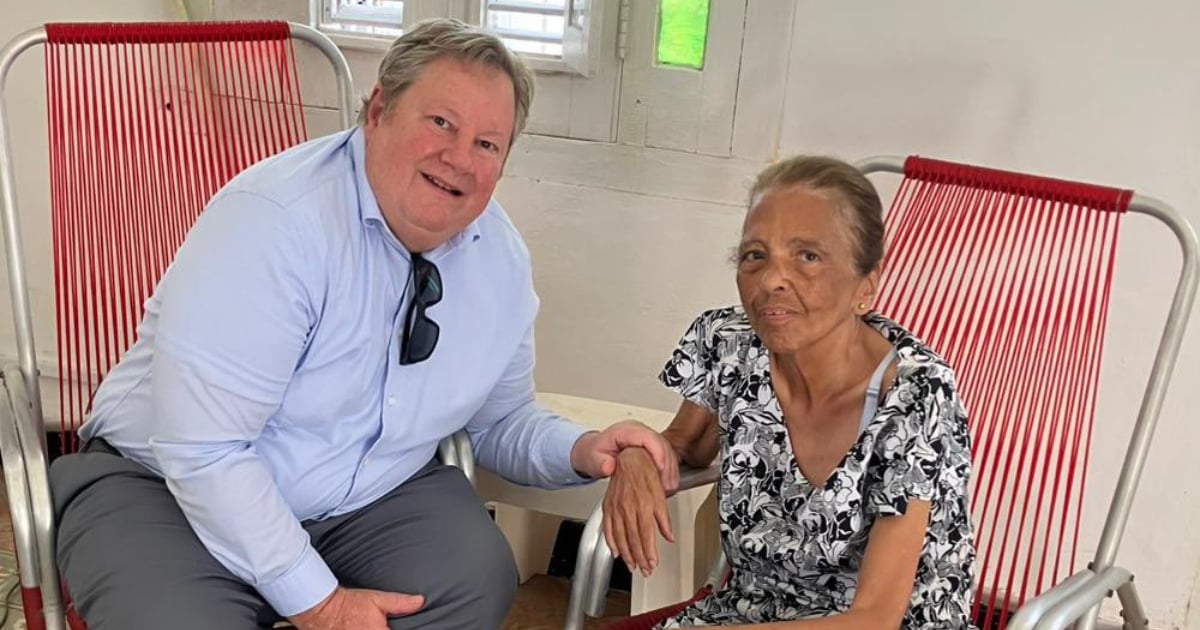
Cuban opponents have responded to the regime's campaign against the head of the U.S. Embassy in Cuba Mike Hammer, highlighting the humanitarian work he is doing.
“Those Cubans who think about democracy, who think about freedom, are envisioning a prosperous country, and that is why they have met with the United States ambassador,” said independent journalist Iris Mariño from Camagüey to Martí Noticias.
"But not only with him, we can meet with other diplomats from different nations to share our stories, to let them know how we Cubans are living today, and that is positive; it’s a constructive dialogue," added Mariño, who was able to interview the diplomat recently.
The political prisoner from July 11, Donaida Pérez Paseiro, who was released in January and resides in Placetas, Villa Clara, also praised Hammer in statements to Martí Noticias.
"It is something never seen before. It is a precious humanitarian effort, because it allows the world to understand even more how the ordinary Cuban lives, but, above all, how the peaceful opposition leader lives, and in what ways we are besieged and harassed by the political police simply for standing up for our rights," he said
Pérez Paseiro, whose husband Loreto Hernández remains imprisoned, believes that “the diplomats accredited in Cuba, especially those from democratic countries, should emulate Hammer, because understanding how the Cuban citizen lives, knowing how the opposition lives in Cuba or in any other country they are attending, should be among their objectives.”
"I understand that he can make an inquiry, a negotiation with our authorities to ensure this case is reviewed and results in the immediate release of Yoandri and the others. I find Mr. Hammer's efforts very promising, and we greatly appreciate his visit to our home and to the homes of the other political prisoners," says Annia Peralta, wife of political prisoner Yoandris Gutiérrez Vargas.
Gutiérrez Vargas, a member of the Republican Party of Cuba, is serving a seven-year sentence for his involvement in the events of July 11th in Bayamo.
Finally, the Cienfuegos opponent Juan Alberto de la Nuez, a victim of an attack and who recently received a visit from Hammer, supported the American.
"The common people recognize the work that this diplomat is doing on the ground, understanding the reality of everyday Cubans, the extreme poverty, and hearing firsthand the suffering of the families, of the political prisoners, and the situation of harassment, repression, and social isolation faced by the opposition," he said.
"His actions are an example for all the ambassadors based in the archipelago. Hammer provided his email so that the Cuban could contact him. It is a demonstration that he is listening to the cries of a people overwhelmed and suffering for more than half a century," he added.
The Cuban regime accuses Mike Hammer of lying about the failure of the revolution
The regime's propaganda machinery has reacted to a press conference by Hammer last Friday in Miami before U.S. media with an article by Johana Tablada, Deputy Director General of the United States Department at the Ministry of Foreign Affairs of Cuba (MINREX).
The official has accused Hammer of lying in his statements about the failure of the revolution due to a lack of "electricity, fuel, food, and medicine" without any "U.S. policy" being involved.
“False!!!: The unilateral coercive measures imposed by the U.S. against Cuba —known as the blockade— have a direct and severe impact on access to financing, technology, supplies, and medications, and are even recognized by the UN as the main obstacle to Cuban development,” reads the text published in Cubadebate.
As is usual in the regime's discourse, Tablada has not taken any responsibility for the ongoing crisis on the island and has dismissed the diplomat's claims as false.
"Although it is true that there is an economic crisis, blaming solely the Cuban government is a simplification that overlooks the multidimensional economic, financial, and trade war imposed from Washington for more than six decades," he added.
He also labeled Hammer as interventionist for his recent visits to the island to understand the reality of everyday Cubans and meet with opposition figures and members of civil society.
The official has also maintained this stance in line with the regime's narrative, referring to the families of political prisoners as "figures funded directly or indirectly by the U.S. as victims of the 'regime,' while concealing that they have openly called for subversion, sabotage, or violent acts."
The rest of Tablada's article has been a copy of the usual discursive maneuvering of the Cuban regime, blaming the U.S. government for the structural crisis affecting the island, and denying the existence of the opposition and civil society.
For Tablada, Hammer's press conference sought, among other points, to "install a narrative of a failed state about Cuba, legitimize diplomatic interference as solidarity, whitewash U.S. sanctions, and absolve itself of responsibility for the blockade."
Then, Lis Cuesta, the wife of Cuban leader Miguel Díaz-Canel, called Hammer shameless and unhappy, thus joining the smear campaign launched by the regime against the American official.
Hammer: "The revolution has failed."
On Friday, Hammer stated in Miami that the discontent among citizens on the Island is widespread and that “the vast majority” of Cubans believe that “the Revolution has failed.”
Hammer, who has visited all the provinces of the country since his appointment, described in a press conference before U.S. media a bleak picture following his tours around the island, where he has met with representatives of civil society and activists.
"There is no electricity; you can see the blackouts; there is a shortage of fuel, food, and medicine. And this, people acknowledge, the ones responsible are those of the Cuban regime. It has nothing to do with any U.S. policy," he pointed out.
The diplomat, who also expressed feeling monitored by the Cuban regime, emphasized that his mission has been to hear firsthand from the Cuban people, including sectors traditionally linked to the state apparatus, and that despite the surveillance imposed on him, he is determined to continue with these visits.
"I have been traveling through the country and asking if there is interest in having everyday Cubans meet with us to share their concerns, experiences, dreams… even their criticisms of the United States government," he stated.
In his statements, Hammer emphasized that the current U.S. administration plans to escalate its stance towards the regime. “The sanctions announced this Wednesday are just a beginning, not an end. More will come, I can assure you of that,” he warned, referring to the recent measures against Cuban officials linked to human rights violations.
Reaction to diplomatic activism
The article by Tablada adds to a recent intensification of attacks on the American diplomat through regime-aligned channels and social media posts, in which he is accused of acting as an “imperial emissary,” violating diplomatic protocols, and promoting an alleged strategy of “hybrid war” against Cuba.
Since his arrival in Havana in November 2024, Mike Hammer has maintained an active meeting agenda with civil society actors, which has caused noticeable discomfort within the state apparatus. In recent months, the Cuban Ministry of Foreign Affairs has summoned U.S. diplomats on three occasions to express its “strong protest” over what it considers acts of “interference.”
At the same time, the Cuban government has used incendiary speeches and unverified data to reinforce the narrative that the U.S. is financing opponents for destabilizing purposes, citing organizations such as the NED (National Endowment for Democracy) or USAID as sources of foreign funding for figures like Soler or Ferrer, the latter again facing unjust imprisonment.
Frequently asked questions about Mike Hammer's work in Cuba
Who is Mike Hammer and what is his role in Cuba?
Mike Hammer is the head of the United States diplomatic mission in Cuba. Since his arrival in November 2024, he has maintained an active agenda of meetings with opposition figures and members of Cuban civil society, aiming to promote human rights and denounce the violations of the Cuban regime.
Why does the Cuban regime criticize Mike Hammer?
The Cuban regime criticizes Mike Hammer for his meetings with opponents and his activism in favor of human rights. They accuse him of interference and claim that his actions aim to destabilize the Cuban government, while Hammer asserts that his goal is to hear firsthand the experiences of the Cuban people.
What topics has Mike Hammer addressed during his visits to Cuba?
During his visits, Mike Hammer has addressed issues such as political repression, the situation of political prisoners, and human rights in Cuba. He has held meetings with dissidents, activists, and families of political prisoners, and has repeatedly expressed his support for the release of these prisoners.
What has been the international reaction to Mike Hammer's work in Cuba?
Mike Hammer's work has been positively valued by sectors of civil society and democratic governments. He is recognized for his dedication to human rights and his efforts to raise awareness about the situation of opponents in Cuba, which has created diplomatic tensions with the Cuban regime.
Filed under: