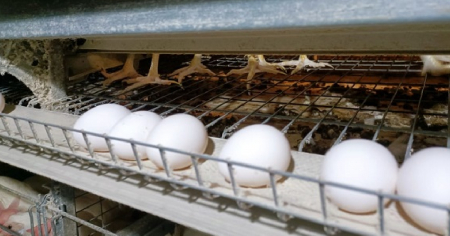
With the Cuban agricultural system mired in one of its worst crises in decades, the government has launched a new experiment in the province of Sancti Spíritus to try to save what remains of egg production.
The project, named "cooperated eggs", consists of a partnership between the state-owned Poultry Company and private actors to barely sustain the supply for social programs.
The proposal, which began rehearsals in November 2024, stems from the collapse of state poultry production following the loss of a significant portion of the laying hen population due to the lack of imported feed.
According to the local newspaper Escambray, the joint company Bioamazonas Pienso S.A. and the mipyme Landservi have taken on the feeding of the birds in a cooperative scheme that guarantees them 70% of the eggs as compensation, while 30% is allocated for social consumption.
But behind the rhetoric of "cooperation" lies a much more precarious and unequal reality: the State can no longer sustain its supply network and is once again implementing emergency solutions by delegating production to the private sector. In this case, the feed is provided by the entrepreneur, the control is maintained by the state enterprise, and the eggs are distributed, when they arrive.
An egg today, a promise tomorrow
Although the provincial delegate of Agriculture, Juan José Nazco, admitted that "without this decision, we would have neither eggs nor poultry today", the reality is that the volumes achieved remain laughably small compared to the demand.
In January 2025, only 180,000 eggs were successfully distributed and in February the number rose to 218,000. These were allocated to pregnant women and children with illnesses, leaving the rest of the population, including vulnerable groups, without access.
The reality on the streets is different. A carton of eggs reached a cost of 4,000 pesos in the informal market by the end of 2024, and although there was a temporary decrease in March, prices surged again with the rise of the dollar and new bottlenecks in the importation of feed for poultry.
The people of Sancti Spíritus, like the rest of the country, can hardly remember the last time they were able to buy a carton of eggs through the ration booklet. In this context, cooperatives serve as makeshift lifelines while the State continues to shift the costs of its own failure.
Due to insufficient internal production, Cuba has turned to importing eggs, acquiring more than 16 million units monthly from the Dominican Republic.
The crisis in egg production reflects deeper structural problems in the Cuban agricultural system, including a lack of inputs, fuel, and efficient planning. Meanwhile, the population continues to face difficulties in accessing basic food items, highlighting the need for more profound and sustainable reforms in the country's agricultural sector.
Frequently Asked Questions About the Egg Production Crisis in Cuba
What is the "cooperated eggs" project in Sancti Spíritus?
The "cooperative eggs" project is an alliance between the state-owned Poultry Company and private actors to sustain the egg supply in Sancti Spíritus, in response to the collapse of state production due to the lack of imported feed. The private sector provides the birds' feed and receives 70% of the eggs produced in return.
Why has egg production in Cuba collapsed?
The production of eggs in Cuba has collapsed due to a lack of inputs, fuel, and efficient planning. These structural problems have severely impacted the country's agricultural system, creating a crisis in the supply of basic food items such as eggs.
What is the situation of the egg market in Cuba?
The egg market in Cuba faces astronomical prices in the informal market, due to the shortage of domestic production and the need to import eggs to meet demand. A carton of eggs has reached a cost of 4,000 pesos in the informal market, unattainable for many Cubans.
What solutions is the Cuban government implementing for the egg crisis?
The Cuban government has resorted to importing eggs from countries such as the Dominican Republic, acquiring more than 16 million units monthly in an attempt to offset the lack of domestic production. However, these measures are insufficient to meet the total demand of the population.
Filed under: