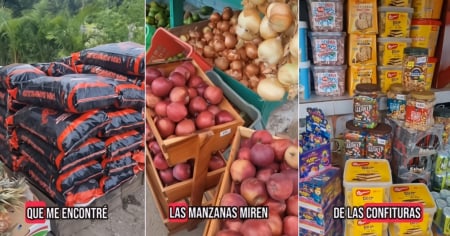
The agricultural markets in Villa Clara reflect the economic anarchy that dominates the everyday life of Cubans, with different prices for the same products, a lack of control, the absence of visible authorities, and consumers left unprotected in a system that benefits only the most cunning.
According to the testimony of the official journalist Jesús Álvarez López, who visited several markets on May 21, agricultural products displayed various prices that were irrational and lacked any apparent logic.
At approximately the same time, from 9:00 to 10:00 a.m., he saw tomatoes “at 120 pesos per pound in two rented markets, at 100 pesos in a state market, and listen to this, at 50 pesos per pound, of similar quality, offered by a young vendor at the corner of Estrada Palma and Paseo de la Paz. His tomatoes are at 50, but he sells sweet potatoes at 100 pesos per pound, violating the approved price cap,” reported the journalist in a comment published on the Villa Clara radio network CMHW.
“It is normal for tomatoes to increase in price in May, but there has been little rain, and what is inexplicable are their varying prices,” he pointed out, and posed the question: “Who can explain such a grotesque price difference for tomatoes of similar quality?”.
Meanwhile, other foods like onions remain unattainable and root vegetables are in short supply. Cassava, when it appears, is not even useful: “I buy it and it doesn’t soften, even though the seller swore it would,” Álvarez commented. In addition, he witnessed an elderly man approach the vendor with only 30 pesos in hand and ask for “a cassava that weighs a pound. I deduced it was for his lunch.”
At the same time, it was verified that the chayote or malanga head xanthosoma, which used to be left in the farmers' piles and almost always causes itching, “is being sold at the exorbitant price of 50 pesos per pound in a state market.”
According to the reporter, before the so-called "New Agricultural Product Marketing Policy," the state-owned Acopio was the governing entity, "and although there were price violations, at least the consumer had someone to complain to when they bought a substandard product that was labeled as first quality," but "I confess that I don't know whom we can complain to now," he lamented.
The disorder, as the commentary points out, only benefits "those who seek to fish in troubled waters, because it even harms the State by distorting the treasury, as no one knows what has actually been sold."
For Álvarez, “those who defend this price freedom have disrupted even the potato. I believe that silence on these highly sensitive issues discredits, diminishes authority, and reduces social support.”
Recently, the journalist himself reported on the collapse of the 2024-2025 potato harvest in Villa Clara, with yields far below expectations, a lack of organization, informal sales of supplies, and inflated prices by state entities.
The Cuban agricultural sector has faced multiple challenges in recent years, such as aging machinery, a lack of fertilizers and supplies, as well as restrictions imposed on small private producers. Additionally, there is rampant inflation and logistical difficulties stemming from the economic crisis the country is experiencing.
The latest official data reflects significant declines in the production of essential foods such as pork, rice, root vegetables, eggs, cow's milk, beans, and vegetables, a situation that confirms a major food crisis in Cuba.
The vice president Salvador Valdés Mesa acknowledged in February that food prices are so high that it is impossible to live on a salary of 6,000 pesos.
A minimum salary in Cuba is set at 2,100 pesos, while 39% of Cuban retirees receive the minimum pension of 1,528 pesos per month.
The independent economist Omar Everleny Pérez Villanueva estimates that the cost of food in Cuba has increased by 18% over the past year. Just to cover the basic basket for two people, in December 2024, approximately 24,351 Cuban pesos (CUP) were needed in the case of Havana, equivalent to about 202 dollars.
Despite acknowledging that there are material conditions to boost the agricultural sector, the Cuban government has yet to present a realistic, transparent, and sustainable plan that goes beyond the "blockade" as an all-encompassing argument.
In July 2022, the Cuban regime promulgated the Law on Food Sovereignty and Nutritional Education with the aim of ensuring safe and nutritious food for the entire population.
However, by the end of 2024, the Communist Party of Cuba admitted its failure in food production, highlighting underlying issues such as decades of state control, a lack of economic incentives for producers, and a bureaucratic system that stifles any attempt at innovation or efficiency in Cuban agriculture.
Recently, the regime again placed the responsibility of feeding themselves in the hands of the people, acknowledging that, in light of the profound crisis the country is experiencing, “the most reliable resources we will have in each territory are what we can produce with our own efforts.”
Frequently Asked Questions about the Food Crisis and Prices in Cuba
Why is there so much variation in the prices of agricultural products in Villa Clara?
The variation in prices of agricultural products in Villa Clara is due to the lack of effective control and regulation, which allows sellers to set arbitrary prices. This situation reflects economic anarchy and the absence of authorities to protect consumers, benefitting those who take advantage of the disorder for profit.
How has the agricultural crisis in Cuba impacted the availability of basic food items?
The agricultural crisis in Cuba has significantly reduced the availability of basic foods such as pork, rice, root vegetables, eggs, cow's milk, beans, and vegetables. This situation is the result of issues such as aging agricultural machinery, shortages of fertilizers and supplies, and restrictions on small private producers, exacerbating the food security crisis in the country.
What solutions have been proposed to improve agricultural production in Cuba?
To improve agricultural production in Cuba, measures have been suggested such as trusting local farmers, allowing them to pay for supplies in foreign currency, and establishing fair prices that benefit both producers and consumers. However, so far, the government has not presented a realistic or sustainable plan that effectively addresses these issues.
What is the impact of inflation on food prices in Cuba?
Inflation in Cuba has led to a significant increase in food prices, making basic products unattainable for most Cubans. This phenomenon is due to a combination of factors such as product shortages, the ineffectiveness of government measures to control the market, and the high costs of importing agricultural inputs.
Filed under: