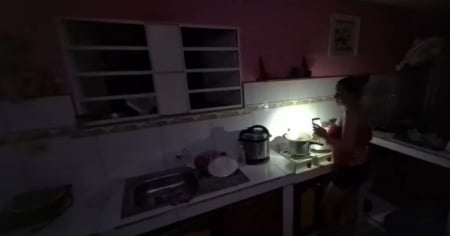
The Cuban government announced that power outages will continue throughout July and August, amidst an escalating energy crisis and with no structural solutions in sight.
The confirmation comes from an article published by the official newspaper Trabajadores, which, rather than providing hope, reveals the regime's inability to ensure a stable electricity service for the populace.
The official acknowledgment that the impacts will not cease is an admission of failure.
The cause, according to the Ministry of Energy and Mines (MINEM), is a combination of the lack of imported fuel, thermal power plants undergoing maintenance, rising demand, and the deterioration of the national electrical infrastructure.
According to Lázaro Guerra Hernández, general director of electricity at the agency, the estimated availability for the upcoming months will be just 1,935 MW, compared to a demand that could reach 3,500 MW, resulting in a deficit of more than 1,500 MW.
This implies daily blackouts of at least four hours per customer, although in practice these outages often last much longer.
That goal of reducing outages to an average of four hours a day will only be achievable if generation is increased by 13 GWh and consumption growth is controlled.
The government's hope is the reactivation of the Cienfuegos thermoelectric plant, which will contribute 158 MW, helping to meet the high traditional demand during the summer season.
Recycled promises and insufficient solutions
The regime is attempting to mitigate public discontent by highlighting the construction of new photovoltaic solar parks, which could minimally alleviate the situation during very specific time slots (from 11:30 AM to 3:30 PM), while maintaining the power cuts at 1200 MW.
However, even the officials themselves admit that this will not compensate for the losses in thermal generation nor will it prevent massive power outages.
Deeper maintenance (though not major overhauls) has also been promised for the thermoelectric plants, as well as the recovery of some distributed generation engines, depending on the arrival of diesel, all before the start of summer.
In this regard, it was announced that the Guiteras (Matanzas) and Felton 1 (Holguín) will need to go offline before summer, as part of urgent maintenance work to prevent major failures during the peak demand months.
Guerra Hernández assured that the interventions will be brief, aiming to reduce technical risks.
However, he warned that the Guiteras could go out of service again at the end of the year for major maintenance, which could further jeopardize the already fragile national electrical system.
The population, amidst the heat, scarcity, and silence
Meanwhile, the Cuban people are facing the hottest season of the year with daily blackouts, a lack of gas for cooking, nighttime outages, and the constant anxiety of not knowing when electricity will be restored.
Official promises are repeated year after year, but living conditions are progressively deteriorating.
Only temporary and palliative measures are taken, which do not address the structural collapse of an energy system on the brink of failure.
The regime, which boasts of technological advancements and international diplomacy in its propaganda, is unable to ensure the most basic necessity: light in the homes of its people.
Solar energy, even if it achieves its ambitious target of 2,000 MW, will not compensate for the sustained decline of the national electrical system since 2019.
This summer, the ordinary Cuban will once again have to face power outages, unbearable heat, and a lack of real answers.
Meanwhile, high-ranking officials of the regime continue to travel, organizing international events and blaming the "blockade" for a collapse that is already structural, chronic, and entirely attributable to ineffective and opaque management.
Frequently Asked Questions about Power Outages in Cuba During the Summer of 2025
Why do blackouts continue in Cuba during the summer of 2025?
Power outages in Cuba persist due to a deficit in electricity generation capacity, which exceeds 1,500 MW during peak hours. This situation is a consequence of a lack of fuel, the deterioration of thermoelectric plants, increased demand, and the collapse of the electrical infrastructure. Furthermore, the massive importation of household appliances has heightened demand, surpassing the capacity of the country's electrical system.
What measures is the Cuban government taking to mitigate blackouts?
The Cuban government has promised to increase generation by constructing new solar parks and recovering distributed generation engines. However, these measures are insufficient to offset the decline in thermal generation and will not eliminate blackouts. The situation is exacerbated by the lack of fuel and thermal power plants undergoing maintenance.
What is the impact of blackouts on the daily life of Cubans?
Blackouts severely affect the quality of life for Cubans, creating issues such as a lack of electricity for cooking, the loss of refrigerated food, difficulties in working or studying from home, and a direct impact on basic services like hospitals and schools. The situation has also caused social unrest and has been a catalyst for anti-government protests.
What has the Cuban government said about the solution to the energy crisis?
The government has announced a plan to recover 500 MW of capacity over the next three years through thermal generation and renewable sources. However, the promises do not resolve the short-term crisis, and blackouts will continue as long as the structural issues of the electrical system are not addressed. Authorities blame the U.S. embargo, but experts point to the lack of investment and management as the main causes of the collapse.
Filed under: