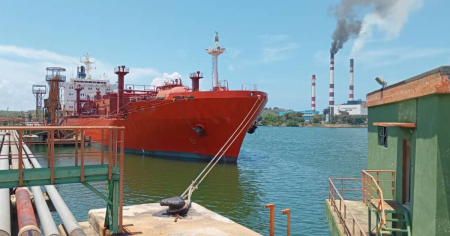
A ship loaded with liquefied petroleum gas (LPG) remained anchored off the coast of Santiago de Cuba for almost four months because the regime did not have the funds to pay for the supply.
This was acknowledged by the Minister of Energy and Mines himself, Vicente de la O Levy, during the official podcast From the Presidency, hosted by the ruler Miguel Díaz-Canel.
"Of the 150 days that have passed this year, there has been no gas in Cuba for 117 of them," admitted the minister, who detailed that during all this time "the ship has been parked," visible from the shore by the people of Santiago. "We couldn't unload it. We have no financing. They do not grant us payment terms to pay," he stated directly.
Far from being a one-time occurrence, the minister's testimony confirms that the financial collapse of the Cuban state is already directly affecting the population's access to basic resources such as domestic gas, used by hundreds of thousands of families for cooking in their homes.
Even though the regime claims it gathered the money to pay, the banking operation became another insurmountable obstacle. According to De la O Levy, the ship has been stranded since late February or early March. During that time, the government's attempts to move the money were unsuccessful. The regime had the money, but it couldn't reach the supplier due to international restrictions, he acknowledged.
“A moment has arrived when dozens of days have passed [without being able to pay], and we have examples where we have gone months with the money,” the minister explained, marking an unprecedented admission of the operational and logistical suffocation the regime faces, even as it claims to have specific resources available.
Only now, after months of waiting, the unloading of 1,300 tons of gas contained in that ship has begun. De la O Levy added that there is a second contracted and loaded ship, although he did not provide details about its location or whether there are guarantees that the government can receive it.
Since late 2024, Cuba has been facing a severe shortage of LPG, which is essential for cooking at home. The shortage has forced citizens to wait in long lines, even at night, in an attempt to purchase a "balita" of gas.
Desperation has led many to use wood or charcoal for cooking, practices that were considered outdated and represent a regression in living conditions.
Moreover, new regulations for the service have been implemented, including adjustments to contracts and service distribution, although uncertainty regarding stable access to gas persists among the population.
The scarcity of LPG is just another manifestation of the deep energy and economic crisis facing Cuba. Prolonged blackouts, fuel shortages, and the government's inability to ensure basic services have created growing discontent among the population. The protests in the east of the country in March 2024, and others that have occurred this year, driven by food shortages and power outages, are a clear example of the critical situation on the island.
Frequently Asked Questions about the Liquefied Gas Crisis in Cuba
Why was a liquefied gas ship anchored in Cuba for nearly four months?
The ship remained anchored for almost four months because Cuba did not have the funds to pay for the supply. Although the regime managed to gather the money, international restrictions prevented the payment to the supplier, which delayed the unloading of liquefied petroleum gas (LPG), essential for many Cuban families.
How is the liquefied gas crisis affecting daily life in Cuba?
The scarcity of liquefied gas has forced many Cubans to turn to alternative methods for cooking, such as using firewood or charcoal. This situation represents a setback in living conditions and has led to long lines of citizens trying to acquire the resource, in addition to increasing public discontent due to the lack of basic services.
What measures is the Cuban government taking to address the shortage of liquefied gas?
The Cuban government has promised to begin the distribution of liquefied gas in the eastern region after securing the funds for the payment of the ship. Consumers who did not receive the product in previous cycles will be prioritized, although uncertainty about a stable supply persists due to financial and logistical constraints.
How long will the current supply of liquefied gas in Cuba last?
The estimated coverage of liquefied gas with the current delivery is only 17 to 20 days. This limited supply reflects the government's inability to meet the accumulated demand, leaving many Cuban families without adequate access to this essential resource.
Filed under: