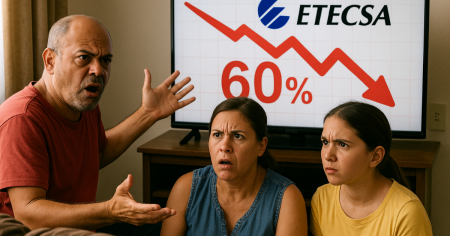
The Cuban regime knew that the abrupt increase in ETECSA's rates would generate public backlash, and anticipating a scenario of social unrest, it activated repressive mechanisms and deterrent measures both before and after the official announcement.
The new rate hike imposed by the state-owned ETECSA, published on May 31, has sparked outrage on Cuban social media and has been widely criticized by a citizenry that sees how the so-called “partial dollarization of the economy” is advancing into areas of public services and the sale of essential goods.
The increase in mobile data packages and other telecommunications services coincides with a time of rising economic and social tension on the island, exacerbated by inflation, blackouts, and the widespread deterioration of basic services.
However, ETECSA's announcement was not an impulsive move. Days earlier, the Cuban government adopted measures that seem to be part of a preventive plan in anticipation of a possible social unrest.
On May 29, Decree-Law 17 of 2024 was published in the Official Gazette, which toughened penalties for crimes affecting railway, telecommunications, and energy infrastructure.
The penalties were increased to up to 20 years in prison, even in cases where the crime has not been committed but the "intent" is proven. This legislative move is particularly suspicious as it occurred just hours before the announcement of the price hike, as if the authorities were anticipating sabotage or unrest stemming from social discontent.
The following day, on May 30th, a fire was reported at a recycling facility in Mayabeque that threatened to spread to the nearby electrical infrastructure.
Although the authorities have not provided details to support an intentional origin, the incident was amplified by official media, recalling previous episodes in which the regime used similar incidents as justification to intensify repression and reinforce its narrative about alleged internal threats.
On May 31, coinciding with the announcement of the new rates, the Ministry of the Interior (MININT) conducted an operation of “surveillance and patrolling” in several areas of the country.
According to reports from residents and activists, there has been an increased police presence, selective internet shutdowns, and surveillance of government critics. In some cases, citizens reported brief detentions and warnings for critical posts on social media.
These events, connected both temporally and thematically, point to a coordinated strategy on the part of the regime. Far from being taken aback by the outrage generated by the rate hike, the government seemed to be anticipating that reaction and prepared to neutralize it.
The narrative of the “internal enemy” and the threat to national security have become a common tool for the Cuban government to justify its most unpopular decisions.
ETECSA, as the state monopoly of telecommunications, has been a constant target of criticism for the low quality of its services and the high prices compared to the average incomes of Cubans. The "partial dollarization" of its services exacerbates the inequality and social exclusion that is rapidly increasing in the Cuban totalitarian regime.
The new price hike not only directly affects household finances but also further restricts access to information, communication with the outside world, and activities on social media, at a time when public discontent is increasingly being channeled through these means.
Preventive repression, the manipulation of fear, and the reinforcement of the punitive apparatus make up a well-known strategy of the regime.
The novelty in this case is the clear sequence of actions that suggests that the rate hike was not a miscalculation, but rather a decision made with full awareness of its social effects, and an explicit willingness to quell any expression of protest.
Citizenship, for its part, continues to resist from the spaces it has left: social media, independent media, and civic activism. Despite attempts to silence it, the voice of the Cuban people continues to seek ways to be heard.
Filed under: