
Related videos:
An opinion piece in the official press acknowledged the failure of the telecommunications rate hike and the disconnection of the state monopoly ETECSA from Cuban reality.
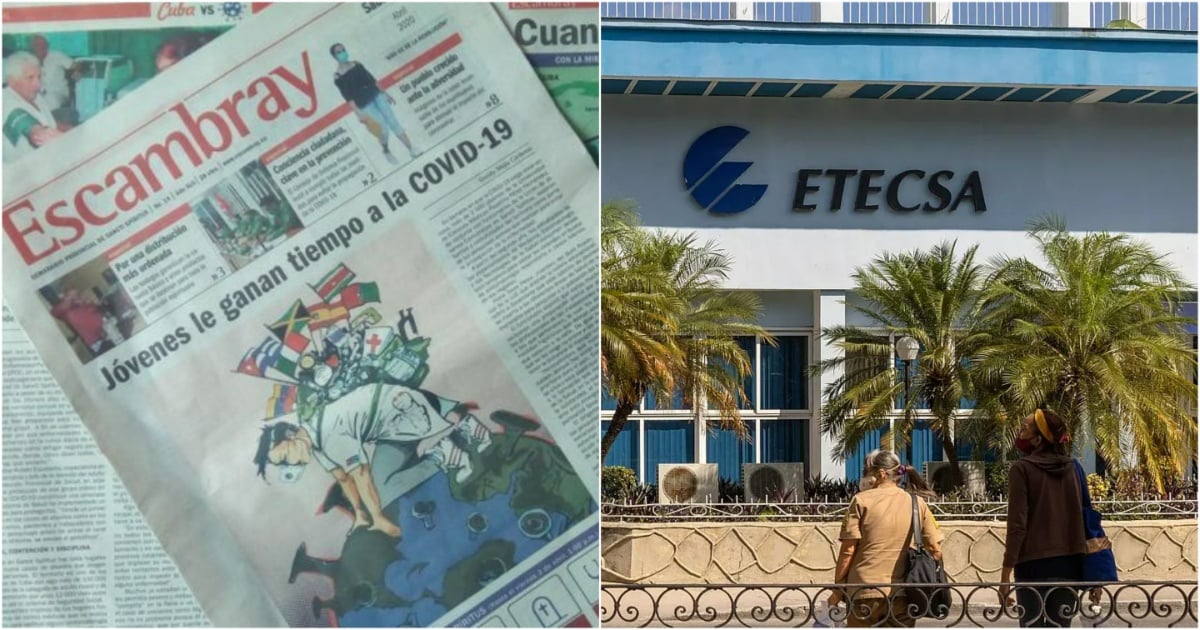
“The hours of dialogue -and at least partial rectification- are being paid for in Cuba these days, and not precisely in megabytes or data. And that is a sign, I believe a positive one, after Etecsa disconnected, not from its phones or from the Internet. It disconnected, perhaps inadvertently, from the reality of Cuba,” begins the text signed by Elsa Ramos and published in the official newspaper Escambray.
The article, titled “Etecsa Disconnected,” argues that “they have shown that when it comes to conceiving their ‘package,’ seemingly without having all the arguments on the table, the company failed to convince and fell short in their attempt.”
Ramos also makes the connection between "the entity and its specialists" and "the State and the Government" that many close to the official side overlook.
"What the entity and its specialists should have anticipated —and consequently, the State and the Government— has been suggested by thousands of Cubans from both wisdom and popular logic, all of whom are children of a country that has invested in education and knowledge," he comments.
It also dismantles the regime's argument that the discontent with the measures is due to a communication error.
"It would be easier if everything was reduced to just communication. The worst part is that, in trying to correct an economic distortion (...) and in its urgent and understandable need to attract foreign currency, it conditioned mobile phone consumption. Or did it dollarize it?"
For Ramos, the measure further deepens the inequalities that characterize contemporary Cuban society.
"It’s not just that the new rates further polarize our social divides; it’s that, as a consequence, they limit the use and consumption of resources for academics, teachers, students at all levels, doctors, remote or in-person workers, children, and even housewives or retirees, all of whom are Cubans and who rely on technology to develop, communicate, and even entertain ourselves and ease our harsh daily lives," he warns.
The article also challenges the state monopoly with a series of uncomfortable questions that scrutinize its business practices.
"Yet, did society have to be shaken for Etecsa to finally sit down and assess what has been a long-standing cry for attention? Why, if at the end of the month some do not use all that they purchase, is that money not carried over? Why, if connectivity is affected due to third-party damages like blackouts and it's not possible to use all the hours purchased for Nauta Hogar, can they not be postponed to the following month?" writes Ramos.
Ramos's article adds to an unusual editorial note from the newspaper Girón of Matanzas which criticized, a week ago, the state company for demanding more transparency and sensitivity in light of the severe economic crisis facing the population.
"Connectivity is not a luxury," the text emphasized, reflecting the growing pressure from various social sectors, including university students, artists, and regular users.
Although it justified the need for foreign currency by the state enterprise and subscribed to the regime's classic justifications regarding the "U.S. blockade," the editorial of Girón acknowledged that the measures adopted have generated a massive and legitimate adverse reaction.
Although the discontent regarding the measures is widespread across all sectors of the population, university students, in particular, have mobilized with statements and calls for a strike.
Recently, the official spokeswomen Arleen Rodríguez Derivet and Bárbara Betancourt denied the student protest against the rate hike and blamed independent media for spreading “textbook fake news.”
During Chapeando Bajito, a podcast from Cubadebate, the speakers acknowledged the discontent and student statements, but they assured that “everything has been directed through institutional dialogue.”
"Once again, fake news is pouring in. What we've seen in recent hours has been a true operation of war, only comparable to the invasion of lies on July 11," they complained.
The environment of "dialogue, proposals, and agreements" that the spokespersons described stands in stark contrast to the viral videos circulating on social media of frustrated students confronting officials who are unable to address their demands.
The academic strike in Cuba began on June 4 and is spreading across universities throughout the country, with its epicenter at the University of Havana. The response from the ruler Miguel Díaz-Canel has been clear: There will be no reversal of the tariff increase.
The student movement shaking Cuban universities is not only demanding fairer fees and equitable connectivity.
Frequently Asked Questions about ETECSA's Price Hike in Cuba
Why is the state-run press criticizing ETECSA for the new rates?
The state-run press criticizes ETECSA for disconnecting from Cuban reality and for imposing rates that deepen social inequalities. The criticisms focus on the lack of sensitivity and the unconvincing arguments used to justify the rate hike, which affects vulnerable sectors such as students and workers, limiting their access to technology in a country already hit by an economic crisis.
How does the price hike from ETECSA affect the Cuban population?
The price hike by ETECSA severely affects the Cuban population by restricting access to the internet and mobile phone services. The new rates, which favor dollar top-ups from abroad, exclude those who do not have access to foreign currency, creating a digital divide and limiting connectivity for a large portion of the population that can only top up in Cuban pesos.
What is the Cuban government's stance on the increase in ETECSA tariffs?
The Cuban government, led by Miguel Díaz-Canel, has defended ETECSA's rate hike, claiming it is necessary to maintain services. Despite criticism and student protests, the government insists that these measures are essential to obtain foreign currency and prevent a technological collapse, rejecting any reversal of the rate increase.
What impact has ETECSA's rate hike had on Cuban society?
The ETECSA rate hike has sparked widespread rejection and a wave of criticism from various sectors of Cuban society. Students, artists, and citizens in general have voiced their discontent through protests and public statements, denouncing the measure as "armed robbery" that exacerbates social inequalities and limits access to an essential right such as connectivity.
Filed under: