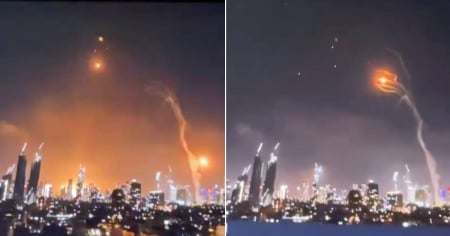
Amid the escalating tension in the Middle East following Israel's airstrike against Iran, U.S. President Donald Trump posted two explosive messages on his social media platform Truth Social, in which he claims to have warned Iran about the consequences of failing to reach an agreement and suggests that "there is still time to stop the massacre."
In his statements, Trump affirmed that he had given the Iranian regime multiple opportunities to negotiate and criticized them for not reaching an agreement.
"I told them it would be much worse than they knew, anticipated, or had been told: that the United States manufactures the best and most lethal military equipment in the world, by far, and that Israel has a lot of it, and much more to come, and that they know how to use it," he detailed.
"Everyone is dead now, and things will only get worse!" he wrote defiantly.
The official added that although there has already been great death and destruction, there is still time to put an end to the massacre, and warned that "the next planned attacks will be even more brutal."
He concluded his message with a grim warning to the Iranian leadership: "Iran must reach an agreement before there is nothing left."
In a second post, Trump revealed that two months ago he issued Iran a 60-day ultimatum. "Today is day 61," he asserted, lamenting that the deadline expired without diplomatic progress. However, he said, "Maybe now they have a second chance!"
Official denial of U.S. involvement
Despite Trump's aggressive stance, the current U.S. government has distanced itself from the Israeli attack. The Secretary of State, Marco Rubio, stated that the United States "did not participate in attacks against Iran" and emphasized that the government's priority is to protect its troops deployed in the region.
"Israel took unilateral measures (…) Our top priority is to protect U.S. forces," Rubio stated in an official statement, reiterating that Washington maintains open channels with its regional allies and is prepared for any eventuality.
Hours earlier, Trump had insisted that his administration still hopes for a "diplomatic solution" to the Iranian nuclear conflict, although he conditioned any dialogue on Tehran's complete abandonment of its nuclear aspirations.
An unprecedented attack
In the early hours of Friday, the Israeli Air Force carried out a massive offensive against over 100 military and nuclear targets in Iran.
Among the victims are at least six high-profile scientists, including Fereydoon Abbasi, former head of the Iranian Atomic Energy Organization, as well as the commander-in-chief of the Revolutionary Guard, Hossein Salamí.
Israeli Prime Minister Benjamin Netanyahu described the operation as "successful" and warned that it will continue "for as long as necessary."
Iran, for its part, has promised a "severe" retaliation, according to statements from the supreme leader, Ali Khamenei.
The International Atomic Energy Agency (IAEA) confirmed that the Natanz nuclear plant was hit, although no increases in radiation have been recorded.
Global repercussions
The international community responded with concern to the possibility of a regional escalation.
Russia, China, Japan, Norway, Australia, Oman, and Saudi Arabia joined the calls for restraint, while countries like Jordan activated defensive alerts.
In economic terms, global markets reacted nervously: the price of oil soared by more than 13% amid fears of a supply disruption in the region.
Meanwhile, the White House called a meeting of the National Security Council to monitor the developments of the conflict.
For now, the world watches with concern as Israel and Tehran prepare for a possible second act.
Frequently asked questions about the conflict between Israel and Iran and Trump's statements
What has been Donald Trump's reaction following Israel's attack on Iran?
Donald Trump posted messages on his social media platform Truth Social, where he claimed to have warned Iran about the consequences of not reaching an agreement and suggested that "there is still time to stop the massacre." Trump emphasized that the U.S. military team is the best and most lethal in the world, and highlighted Israel's ability to utilize it. Additionally, he mentioned that he issued a 60-day ultimatum to Iran, which has already expired without diplomatic progress.
Did the United States participate in the Israeli attack on Iran?
The Secretary of State, Marco Rubio, denied any implication of the United States in the airstrike launched by Israel against Iran. Washington stated that its priority is to protect its troops deployed in the region and that it did not participate in the attacks, emphasizing that Israel acted unilaterally for reasons of self-defense.
What was the economic impact of Israel's attack on Iran?
The attack by Israel on Iran has generated an immediate reaction in global markets. The price of oil surged by more than 13% due to fears of a supply disruption in the region, reflecting the anxiety over the potential for a global energy crisis.
How did the international community react to the conflict between Israel and Iran?
The international community expressed concern over the escalation of the conflict between Israel and Iran. Countries such as Russia, China, Japan, Norway, Australia, Oman, and Saudi Arabia issued calls for restraint, while others, like Jordan, activated defensive alerts in anticipation of a possible Iranian response.
Filed under: