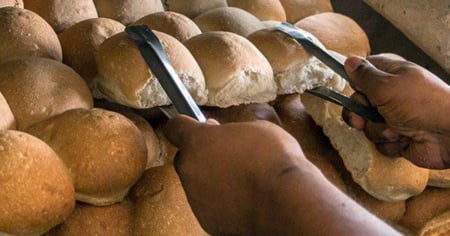
After a prolonged shortage, the released bread has reappeared on the Isle of Youth, but its return is far from easing family finances: sold at 110 pesos for a unit of soft crust weighing 200 grams, the product reaches consumers thanks to the purchase of flour and sugar through mipymes, a process that inevitably drives up its final price.
This was confirmed by Alberto Mirabal, director of the Food Company, who explained that the 48 tons of wheat flour they currently have were purchased from the private sector, which also explains the price difference with the Cuban Bread Chain.
In the case of the latter, they receive the flour "through the basket, through the little channel, as we say in good Cuban fashion, and in our case, we have to buy it, just like the sugar used for making bread, from mypimes to provide that liberated bread to the people," explained Mirabal as quoted by the official newspaper Victoria.
The quantities produced are minimal compared to the demand. Bakeries are instructed to make between 180 and 300 loaves of bread per day, and distribution is governed by the length of the line: two per person if there are many people, more if there are few. A planning that, far from addressing the need, barely manages the scarcity.
This is compounded by a structural change that further complicates the situation. The Cuban Bread Chain is in the process of disappearing and will be absorbed by the Food Company.
According to Ever Borges, the current director in the territory of Pinar del Río of the Cuban Bread Chain, several of its bakeries will become state-owned small and medium-sized enterprises, while others will fulfill functions for the Food Company and will contribute to the bread of the basic basket.
"We are waiting for the executives to come to the municipality to carry out the transfer. Afterwards, we would work on the project for the state mypime, and we would no longer receive anything through the basket; we will have to buy everything from the mipymes where we know the products are expensive. We will be making cookies, palitroques, and breads of various weights, which will be a little more expensive," Borges detailed.
Under the new model, pastry and other derivative products will also depend on the capacity to contract with small and medium enterprises (mipymes), a process that is still ongoing. The official promise is that the unit located on Paseo Martí in Nueva Gerona and the one in the La Fe settlement will maintain production from Monday to Saturday during the summer.
“We will be offering the bread for 100 pesos and we will be looking with the cost sheets for other breads that give us a slightly cheaper cost price, to reach the part of the population that cannot afford the one for 100 pesos,” added the executive. It will all depend on costs and the market, not on a public policy focused on food welfare.
The return of subsidized bread does not address the underlying problem: high prices, limited supply, and the precariousness of a food system that is now left to the logic of "every man for himself." Instead of ensuring access to a basic food item, the authorities seem content to provide bread... for a select few.
The National Office of Statistics and Information of Cuba (ONEI) reported that, during April, the price of unregulated soft round bread (80 grams) reached 60 Cuban pesos (CUP) in Santiago de Cuba, the highest figure recorded in the country that month. The minimum price was 18 CUP in Ciego de Ávila, highlighting a marked regional inequality in access to this staple food.
In Havana, prices ranged from 21.42 to 58.33 CUP per unit, making it one of the provinces with the greatest internal price disparity. Matanzas was the only province to report a uniform price of 39 pesos, with no variations, while Cienfuegos and Villa Clara also recorded maximum values exceeding 50 CUP. Provinces such as Guantánamo, Holguín, and Las Tunas showed more moderate prices, although still high in relation to average wages.
The wheat flour supply crisis in Cuba has forced restrictions on the production and distribution of regulated bread in several provinces.
In Artemisa, for example, the regulated bread is sold only on alternate days and with "innovative" blends of sweet potato, yuca, and pumpkin to stretch the limited raw materials available. In Guantánamo, the distribution of regulated bread is restricted to those under 13 years old and to social institutions, while the price of liberated bread has increased significantly.
Cienfuegos implemented new prices reaching up to 150 CUP for a 200-gram piece, in response to the rising production costs.
In Santiago de Cuba, where the ONEI recorded the highest national price, it had been publicly reported that a loaf of bread was sold for as much as 50 CUP. This situation sparked citizen protests due to speculation in the informal market and the lack of regulation from the State.
Frequently Asked Questions about the Shortage and Distribution of Bread in Cuba
What is the current situation of the liberated bread in the Isle of Youth?
The liberated bread has reappeared in the Isle of Youth, but its price is high, reaching 110 Cuban pesos for a 200-gram unit. The quantities produced are limited and fail to meet the demand, reflecting a precarious food system in Cuba. Liberated bread is a luxury that few can afford.
Why have bread prices increased in Cuba?
The increase in bread prices in Cuba is due to the supply crisis of raw materials such as flour and sugar, which are purchased through mipymes, raising production costs. The prices of bread have risen due to the shortage of flour and other supplies.
How does the disappearance of the Cuban Bread Chain affect bread production?
The disappearance of the Cuban Bread Chain means that its functions will be taken over by the Food Company, which could lead to greater decentralization. This measure aims to correct distortions in local management, but it could deepen territorial inequalities and worsen the bread shortage.
What alternatives exist in response to the shortage of bread in Cuba?
As a response to the scarcity, some provinces have implemented measures such as using a mixture of sweet potato, cassava, and pumpkin to stretch the available flour, and selling alternative products like croquettes. However, these solutions are insufficient and do not address the underlying problem.
What is the impact of the bread crisis on the daily lives of Cubans?
The bread crisis in Cuba has created a situation of uncertainty and discomfort among the population, as bread is a staple food in the daily diet. Long lines, high prices, and scarce availability directly affect the quality of life for Cuban families. The limited access to bread reflects the ongoing deterioration in the quality of life in Cuba.
Filed under: