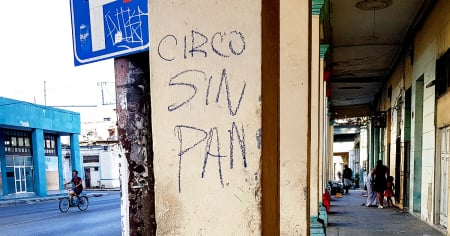
The shortage of flour and power outages are the main reasons why bread sometimes arrives every four days at stores in Mayabeque
“There is a period that lasts between two to four days in the province. At many times, one can notice that 50% of the production is allocated to a part of the province; we are talking about 5 municipalities, and then, the next day, it is delivered to 6 municipalities. This is due to the fundamental reason of the arrival of raw materials to the province through the Unión Molinera,” justified to the local television Yoerlán Posada Martínez, director of the Empresa de Alimentos y Producciones Varios Mayabeque.
The official admitted that the bread now weighs less, about 69 grams, and has a price of 75 cents due to this reduction.
Power outages have also contributed to the fact that bread cannot be made many times.
"In some places, they work with generators, and in others, even with wood-fired ovens," he clarified
Referring to the complaints about the poor quality of bread, Posada Martínez explained that bread dough often loses its qualities due to a lack of electrical current for its preservation.
"We have had the misfortune of having to rebuild organizations due to a loss of priorities," he said.
Bread crisis in Cuba
Cuba requires 20,000 tons of flour per month just to produce the regulated bread. If that amount is not guaranteed, the result is what we are witnessing: store after store without bread, and families who depend on that daily food facing increasing shortages.
A few days ago, it was reported that regulated bread is still not appearing regularly in the stores of Camagüey due to a chronic lack of flour, and although this issue has been known for months, there is no solution or concrete timeline in sight.
The province needs more than 36 tons of wheat flour daily, and what arrives is not even enough to meet the basic demand. The consequence is clear: most consumers cannot eat bread.
The official response has been to prioritize hospitals, schools, and the Family Care System (SAF). The rest will have to wait.
In Guantánamo, it was decided that starting from May 9, the regulated bread will only be sold to children aged 0 to 13 years, along with prioritized social institutions such as hospitals, educational centers, and the Family Care System.
In the case of Santiago de Cuba, the authorities : each time a truck with flour arrives from Havana, a decision is made regarding which municipality will receive it, while the others wait, with no certainty of when they will be able to bake again. In this area, the price of bread has reached 50 pesos for a single “ball” (unit).
In Havana, the crisis in the distribution of regulated bread has generated a wave of discontent among the population. In municipalities such as Guanabacoa, Regla, Boyeros, and Plaza de la Revolución, many residents reported going days without receiving this basic food item. In other areas, deliveries are reported to be of weights lower than those legally established or with unpredictable distribution schedules.
This is compounded by the terrible appearance and taste of the product, which is characterized by hard, poorly baked, deformed masses and even has a cockroach smell.
Even the official Cuban press has questioned the anarchy surrounding bread prices, reporting on everything from street vending to manipulation without regulation or protection.
Due to the disruptions in electricity and gas services, a bakery in the municipality of Centro Habana also had to resort to firewood to ensure the baking and delivery of regulated bread to the population.
Frequently Asked Questions about the Bread Shortage in Cuba
Why is there a shortage of bread in Mayabeque?
The shortage of flour and power outages are the main reasons why bread arrives irregularly at stores in Mayabeque. The lack of flour supply affects production, and the electricity cuts hinder the constant preparation of bread. Additionally, the dough loses quality due to the lack of electricity for its preservation.
How much does bread weigh now in Mayabeque?
The bread in Mayabeque has reduced its weight to about 69 grams. This decrease in weight has also led to an adjustment in the price, which has been set at 75 cents.
What measures are being taken in other provinces of Cuba in response to the bread crisis?
In various provinces of Cuba, different measures have been implemented to address the bread crisis. In Guantánamo, regulated bread is only distributed to children and priority social institutions. In Santiago de Cuba, a rotating distribution system is in place. The crisis is a reflection of the regime's inability to consistently provide this basic food item.
How does the energy crisis affect bread production in Cuba?
The energy crisis in Cuba, characterized by prolonged blackouts, severely affects bread production. Without electricity, many bakeries cannot operate normally and are forced to resort to alternative methods like wood-fired ovens, which impacts both the quality and quantity of the bread produced.
Filed under: