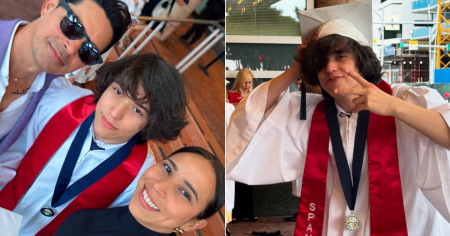
The Cuban singer Leoni Torres revealed how he was repressed in Cuba for publicly supporting the mass protests of July 11, 2021.
In an interview with host Jomari Goyso for his podcast "Sin Rodeo," Leoni confessed that he never wanted to leave his country, but he had to do so because after the events of July 11 and his public statements against the regime, his family faced reprisals, including an assault on his son.
According to him, on the day of the mass protests, when he saw the people in the streets, he and his wife Yuliet felt that the end of the dictatorship had come.
"We were almost celebrating: 'this is the end,' everyone was crying. We started to post, I did a live with Yuliet where she and I, live, said we wanted to choose our president, that we were fed up. That was a boost that gave us," she said.
When the government's repression arrived and everything returned to how it was before, reprisals against the artist began. He was never able to find work again, and the media forgot about him.
"Then they mug my son on the street; he was with a little friend, they hit him a few times, and the one they go after is him," she reported.
In addition, the police stationed a supposed street vendor in front of his house to keep watch on him and his family.
"We began to feel afraid, we hardly had any work left, so I told my wife: 'we need to leave.' That's why I'm going first, not knowing if I would see them again, because they were quite capable of telling them: 'you are not leaving here,'" he explained.
On July 11, 2021, when Miguel Díaz-Canel appeared on television and ordered the defenders of the system to suppress the protesters in the streets, Leoni made a direct statement warning the government not to assault the people.
"Cuba is out in the streets. It's time to listen to its people! Don't even think about attacking a single Cuban!", he said then.
Days later, Leoni and Yuliet shared a video in which they condemned the violence unleashed by the repressive forces against the people, without any justification.
You cannot repress a people that is asking to be heard. This is not the way to do it, with a club. We must listen to the people; they have every right to express what they do not want, and it is the responsibility of the rulers to listen and respond to that call," stated the actress.
"We want a free Cuba," Leoni added. "Free from injustices for all Cubans. We are in Havana and we have suffered so much through all of this we are going through. We want to choose our president," he continued.
Frequently Asked Questions about Repression in Cuba and the Exile of Leoni Torres
Why did Leoni Torres decide to leave Cuba?
Leoni Torres decided to leave Cuba due to the regime's harassment following his support for the protests on July 11, 2021 (11J). After publicly expressing his desire for political change in the country, he faced reprisals that included attacks on his son and police surveillance, which led him to choose exile to protect his family.
What consequences did Leoni Torres face for supporting the protests of July 11th?
Leoni Torres faced harassment from the regime, loss of job opportunities, and constant surveillance. These repressive acts intensified after his public statement in support of the protests on July 11, 2021, which led him to make the difficult decision to leave his country to safeguard his and his family's safety.
What was Leoni Torres' experience witnessing the protests of July 11?
Leoni Torres and his wife felt hope seeing the protests on July 11, believing it marked the end of the dictatorship in Cuba. However, the subsequent government repression and return to the status quo led them to face reprisals, which ultimately motivated their departure from the country.
What other cases of repression related to the 11J have been reported?
In addition to Leoni Torres, cases of repression have been reported, such as that of brothers Liosmel and Liosbel Sánchez, who were detained by ICE in the U.S. and are facing possible deportation to Cuba. These young men participated in the protests of July 11 and were pursued by the Cuban regime for their activism. Similar situations of repression against other dissidents and Cuban activists have also been documented.
Filed under: