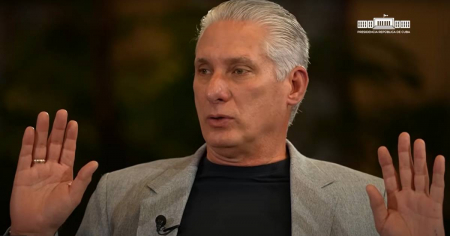
The Cuban leader Miguel Díaz-Canel defended the political model of the island, stating that in Cuba "there is democracy," and he held the "enemy" and the "haters' platforms" responsible for trying to capitalize on the growing social discontent.
The statements were made during an interview with Brazilian journalist Breno Altman, broadcast from the Palace of the Revolution through the YouTube channel of the Presidency of Cuba.
"The international press and social media depict a virtual Cuba that has nothing to do with real Cuba," stated Díaz-Canel, downplaying the extent of the criticisms circulating on digital platforms, while also criticizing the handling of protests in the United States.
ETECSA Case
When referring to the recent student rejection of the internet rate increases imposed by ETECSA, Díaz-Canel assured that while there was debate and communication, there was also an "intense operation" from abroad to amplify the discontent: "The enemy and the platform of haters saw that there was discontent and aimed to capitalize on it. They started with lies and false news," he stated, without providing concrete evidence of such campaigns.
His statements contrast with the reality perceived by large sectors of Cuban society, which in recent days have staged protests, student strikes, and virtual demonstrations against the increase in telecommunications service prices, seen by many as a mockery amid a deep economic crisis.
"Cuban democracy," according to the regime
During the interview, the leader insisted that the political system of the island guarantees popular participation, despite the lack of legal opposition parties, the persecution of independent press, and the fact that protests are often repressed by law enforcement.
Díaz-Canel's statements come at a time of rising tension, with prolonged blackouts, rampant inflation, scattered social protests, and an unprecedented migratory exodus. Meanwhile, the government seeks to maintain its internal narrative by resorting to classic arguments about the external enemy, media manipulation, and revolutionary unity.
However, for many Cubans, the gap between the "real Cuba" and the "official Cuba" is not due to foreign propaganda, but rather to the increasingly evident disconnect between those in power and the citizens.
Unusual gesture of self-criticism
In another moment, in an unusual gesture of self-criticism, the president acknowledged that the current crisis is not only a result of the U.S. embargo but also of internal errors in his administration.
"It would be dishonest to say that no mistakes have been made. It is impossible not to make mistakes when working under such pressures."
Díaz-Canel emphasized that the "fundamental" cause of the crisis remains the "criminal blockade" by the United States, particularly the sanctions imposed during Donald Trump's administration and maintained by the Biden administration, which were reintroduced by Trump during his second term. However, he acknowledged that internal factors have also contributed to the worsening of life on the island.
"There has been a coincidence of the blockade and a coincidence of incongruities, errors in the implementation of certain economic measures designed to improve the situation, which have not had the full impact possible," he confessed.
Among those failures, he mentioned the failed Tarea Ordenamiento, the country's import-oriented mentality, the lack of investment in strategic sectors such as agriculture and renewable sources, and serious issues such as corruption, administrative inefficiency, and the brain drain.
The president acknowledged that the two biggest current problems are the energy deficit and food insecurity. The former, the subject of countless citizen complaints due to daily blackouts, was described by Díaz-Canel as a result of outdated thermoelectric plants, lack of spare parts, and the inability to make investments.
“The system has a structure that is over 40 years outdated in terms of technology,” he admitted. “We have not been efficient in managing the few resources available,” he added.
Regarding food, he acknowledged the country's inability to sustain the basic basket: “We have not made the necessary investments in agriculture and food production.”
The leader also admitted that the historical "achievements" of the Revolution, free health care and education, have been affected. He indicated that more than 70% of the essential medicines are out of stock and that infant mortality, a traditional symbol of the system's accomplishments, has worsened.
"It has affected us significantly. We are not standing idly by, but the indicators have deteriorated," he said.
In the case of the educational sector, he spoke about issues with equipment, the printing of books, the loss of purchasing power among teachers, and the massive exodus of professionals.
Despite the gloomy diagnosis, Díaz-Canel insisted that the Cuban socialist model is the only possible alternative for the country.
"Although the screws of the blockade tighten on us even more, we will respond with talent, with creativity, with innovation," he argued.
However, their statement contrasts with the growing public discontent on the island and among emigrated Cubans, who view with skepticism an official discourse that has worn thin after decades of unfulfilled promises.
A call that fails to convince
Throughout the interview, Díaz-Canel made constant appeals to resistance, the unity of the people, and the ethical values of the Revolution. However, his speech is overwhelmed by reality: a impoverished island, a population burdened by shortages, and an unprecedented exodus.
Frequently asked questions about Díaz-Canel's statements and the situation in Cuba
What does Díaz-Canel say about democracy in Cuba?
Díaz-Canel defends that in Cuba "there is democracy" and blames the "enemy" for capitalizing on social discontent. However, this statement contrasts with the reality of a country where there are no legal opposition parties, independent press is persecuted, and protests are suppressed.
How does Díaz-Canel justify the increase in ETECSA rates?
Díaz-Canel asserts that the increase in rates is necessary to prevent a technological collapse and to improve service quality. He justifies this measure as essential due to the country's complex technological situation, although it has been widely rejected by the public.
What is the main cause of the crisis in Cuba according to Díaz-Canel?
Díaz-Canel points to the "criminal blockade" by the United States as the fundamental cause of the crisis, although he acknowledges that there are also internal errors that have worsened the situation. He mentions failures in the implementation of economic measures and issues in strategic sectors such as agriculture.
What problems does Díaz-Canel recognize in Cuba's electrical system?
Díaz-Canel admits that the national electrical system is in a critical situation, with obsolete thermoelectric plants and a lack of maintenance. He acknowledges issues such as fuel shortages and management errors, which have led to constant blackouts and widespread discontent.
How does the Cuban government react to criticism on social media?
The Cuban government dismisses criticism on social media as part of a "media war" orchestrated by external enemies. However, this criticism reflects the genuine discontent of citizens regarding the situation on the island and the disconnection between those in power and the public.
Filed under: