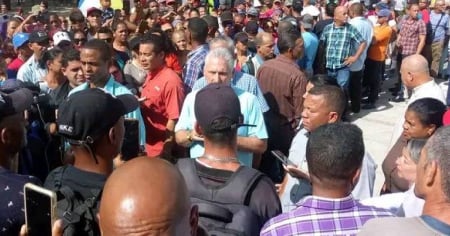
The Cuban leader Miguel Díaz-Canel justified the regime's repression in an interview granted to Brazilian journalist Breno Altman, where he described "counter-revolutionaries" as perpetrators of crimes.
In the conversation, broadcasted on the official site on YouTube of the Presidency of Cuba, the ruler once again resorted to the argument that opponents are funded by the United States government and commit crimes, thus justifying the arrest and police harassment against those who openly speak out against the regime.
"Above all, they fund them to carry out vandalistic and terrorist actions in Cuba. Since they lack any popular support, they often resort to acts that are criminal and promote vandalism, terrorist acts, assaults, attacks on national security, on public safety, and against the internal order of the country, because they are also supported by a platform that seeks to destabilize the nation," Díaz-Canel claimed, using a common argument in his rhetoric to discredit the Cuban opposition.
The regime's representative also stated that those individuals were not being judged for their disagreement with the government, defending that there is freedom of expression in Cuba and dissent is allowed.
"When they are judged by the law, with due process, in accordance with the standards of our Constitution, no one is condemning them for not being with the revolution or otherwise, but for the vandalistic and criminal actions they commit," he stated.
And what about the political prisoners?
After the journalist's question about whether there are political prisoners in Cuba, Díaz-Canel emphatically replied that there are not. "There are no political prisoners. There are prisoners for committing crimes."
In the section of the interview dedicated to press freedom and expression in the country, the leader reiterated that the platforms, which he also accused of being funded by the U.S., lie by claiming that there are political prisoners.
"There are prisoners for committing crimes, but they categorize, disseminate, lie, and build an entire platform of political prisoners, of prisoners of conscience, claiming there is no freedom of the press. They are the first to deny all of this, freedom of opinion, and freedom of the press," he stated.
Although independent organizations like Prisoners Defenders, which monitor political arrests in Cuba, report a total of 1,158 political prisoners, Miguel Díaz-Canel continues to deny their existence and resorts to discrediting them, labeling them as criminals.
Throughout the interview, he maintained his narrative that the country is under "attacks" from the U.S. In that way, he blamed the international press and social media for, in his opinion, portraying "a virtual Cuba that has nothing to do with real Cuba."
On the other hand, he downplayed the magnitude of the criticisms circulating on digital platforms, while also criticizing the handling of protests in the United States.
Nothing new under the sun
In line with other interviews given, Díaz-Canel asserted that the political system of the island guarantees popular participation, despite the absence of legal opposition parties, the persecution of independent media, and the frequent repression of protests by law enforcement.
The statements come at a time of rising tension, with prolonged blackouts, rampant inflation, scattered social protests, and an unprecedented migratory exodus. Meanwhile, the government continues to leverage classic arguments about the external enemy, media manipulation, and revolutionary unity.
However, for many Cubans, the gap between "real Cuba" and "official Cuba" is not due to foreign propaganda, but rather to the increasingly evident disconnection between those in power and the citizens.
Frequently Asked Questions about Díaz-Canel's Statements and the Situation in Cuba
Why does Díaz-Canel justify repression in Cuba?
Díaz-Canel justifies the repression claiming that the opposition commits crimes and is funded by the United States government to carry out vandalism and terrorist actions in Cuba. The leader maintains that the opposition is not judged for their ideas, but for their illegal acts, although independent organizations report the existence of political prisoners on the island.
Are there political prisoners in Cuba according to Díaz-Canel?
Díaz-Canel denies the existence of political prisoners in Cuba, arguing that there are only prisoners for committing crimes. However, organizations such as Prisoners Defenders report over a thousand political prisoners in the country, contradicting the claims of the ruler.
How is freedom of expression defined in Cuba according to the regime?
Díaz-Canel asserts that there is freedom of expression in Cuba and that dissent is allowed. However, independent press is persecuted and protests are suppressed, which suggests a lack of real freedom in the exercise of expression and press in the country.
What internal problems does Díaz-Canel acknowledge in the country's management?
Díaz-Canel acknowledges that there are internal errors that have contributed to the current crisis in Cuba, including failures in the Tarea Ordenamiento, a lack of investment in strategic sectors, and issues of corruption and administrative inefficiency. He also admits that the energy deficit and food insecurity are critical problems.
How does the Cuban government's official narrative affect international perception?
The official narrative of the Cuban government, which insists on blaming the external "enemy" and minimizing internal criticisms, contrasts with the international perception of a country facing significant economic and political challenges. International organizations and independent media highlight the gap between "real Cuba" and "official Cuba," suggesting a disconnect between the government and the citizenry.
Filed under: