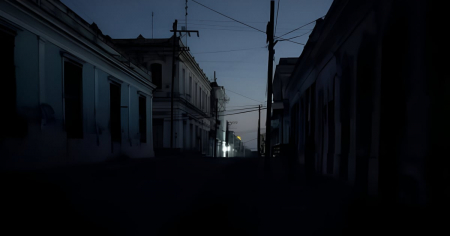
During his visit to the municipalities of Granma and Camagüey, President Miguel Díaz-Canel openly acknowledged what Cubans are already experiencing daily: prolonged power outages that further complicate their everyday lives.
"I know that yesterday many families endured more than 20 hours without electricity," the president stated this Thursday at the Ernesto Che Guevara polyclinic, located in the community of Vado del Yeso, in the municipality of Río Cauto in the province of Granma.
Furthermore, Díaz-Canel emphasized that we must not give up and urged to "overcome this situation" with unity "and by working together," according to a report from the website of the Presidency.
In Camagüey, official visits included two key facilities for the food system: the Taíno Cheese Factory, located in the Martí community of the Guáimaro municipality, and the Sibanicú Dairy Complex, the largest cheese factory in the country.
Both operate below their capacity due to power outages that hinder maintaining productive shifts. In the case of the Martí plant, production only occurs when electricity is available, thanks to an emergency notification plan.
In Sibanicú, the productive capacity of the factory is currently limited by insufficient collection of the milk required for the production process, and by the challenges posed by power outages.
Recently, it was revealed that the province of Camagüey, which for years was the largest producer of milk in Cuba, has seen its annual volume collapse to less than half of the 92 million liters it produced in 2019.
On the other hand, more than 15% of the cooling tanks are broken. The collection center in that area is forced to turn milk into cheese to avoid losses, while cold storage facilities and trucks are operating with enormous extra costs.
Last March, while visiting the municipality of Martí in the province of Matanzas, the president himself acknowledged that the local population was facing power outages of up to 32 consecutive hours, a situation that has caused increasing discontent among the people of Matanzas.
Blackout periods in provinces like Pinar del Río have escalated to alarming levels. According to officials from the Electric Company of the western territory, some circuits have faced blackouts lasting more than 30 continuous hours.
During a recent interview with Brazilian journalist Breno Altman, Díaz-Canel admitted that the national electric system is experiencing a critical situation.
The energy crisis in Cuba has unleashed an unprecedented wave of public outrage, as blackouts, which in some areas of the country have already exceeded 24 continuous hours, have pushed the population to the brink of physical and emotional exhaustion.
In the midst of this serious situation, the Russian Minister of Energy, Serguéi Tsiviliov, committed to advancing the modernization of the Cuban energy system, including the construction of a new 200-megawatt (MW) generating unit and the repair of existing 100 MW blocks, according to reports from outlets such as Telesur and News Rambler.
Cuba is experiencing this Friday, June 20, a new day of energy emergency, characterized by widespread blackouts across the country. The UNE estimates a peak demand of 3,500 MW with only 1,910 MW available, resulting in a deficit of 1,590 MW.
Frequently Asked Questions about the Energy Crisis in Cuba
What is the current situation of the electrical system in Cuba?
The electrical system in Cuba is currently in a critical situation, with aging thermoelectric plants and inadequate maintenance, which has resulted in prolonged blackouts that severely impact the daily lives of the population.
How are prolonged blackouts affecting the Cuban population?
Blackouts, which in some areas exceed 24 continuous hours, have pushed the population to the brink of physical and emotional exhaustion, impacting food preservation, water pumping, and nighttime rest due to the heat and mosquito bites.
What measures is the Cuban government taking to address the energy crisis?
The government has announced investments in renewable energy and the repair of power plants, but concrete results have not been seen. Furthermore, the U.S. embargo is blamed for part of the crisis, although internal mistakes and management failures are also acknowledged.
What impact does the energy crisis have on food production in Cuba?
The energy crisis has impacted food production, particularly in the dairy industry, where production capacity has been limited by power outages and a lack of supplies, contributing to the shortage of basic food items in the country.
Filed under: