
Related videos:
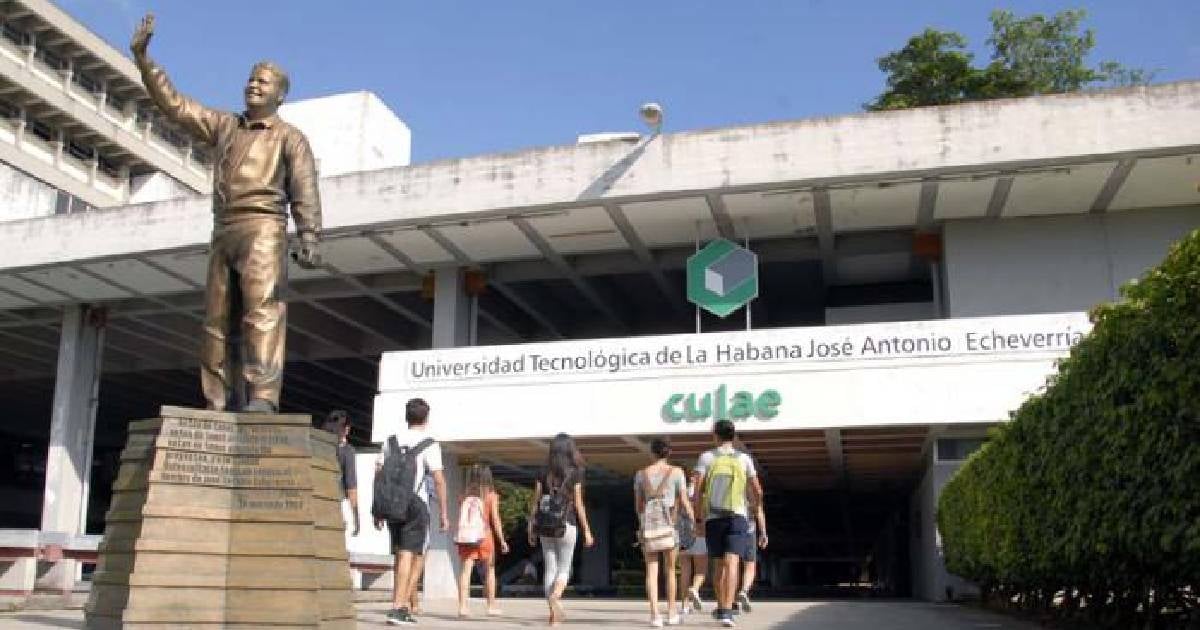
The Technological University of Havana "José Antonio Echeverría" (CUJAE) has opened calls to lease spaces within the campus to private businesses, which include two dining centers (one in Architecture and another in the Scholarship Cafeteria), a mobile food stand, a locksmith service, a beauty salon, and a sales point for agricultural products.
The Scholarship Dining Hall concentrates most of the opportunities, with four spaces dedicated to various fields: a culinary center, a locksmithing workshop, a beauty salon, and a sales point for agricultural products.
Meanwhile, at the Faculty of Architecture, a space is being tendered for another dining venue, and in another area of the campus, a mobile kiosk "for the sale of light snacks, sweets, and others."
The profile on Facebook of the Universidad Tecnológica de La Habana announced the bidding process on the night of June 18. The announcement states that applications will be accepted from June 12 to June 25, from 9:00 a.m. to 4:30 p.m., at the General Logistics Directorate of the institution.
Opportunity or rigged process?
However, some of those who commented on the post pointed out the unusual deadline of only seven days to submit proposals, from the date it was published (the night of June 18) to the 25th. For some, the short time frame suggests that the process might be designed to favor previously selected candidates.
Today is June 19, and you are publishing the announcement to present a bidding project when the campaign has already started and will close in a week. Who can create and submit a good project in a week? The rush and improvisation do not allow things to run smoothly unless this was already known and there are names and surnames involved,” questioned user Yorch Louis.
In his response, Bryan Pérez agreed with that assessment: “Because the names and surnames of those who will be given the venues are already known,” suggesting that the criteria may be rigged.
Doubts are rising due to the lack of public information regarding the evaluation criteria. According to the information, the opening of bids will take place between June 26 and July 2, and the results will be announced on July 9. The guidelines do not specify selection criteria or reference amounts, leaving the economic model behind these awards uncertain.
Not everyone views the process with skepticism. Luis Suárez Castañeda nostalgically recalled the variety of services that used to exist on campus. “It would be nice for these offerings to return,” he said.
Even Suárez dreams that the Student House, “a place so beautiful that it fell victim to looting and neglect,” and today “caught between mold and grime,” can be rescued by “some small or medium enterprise or the Office of the Historian of the City.”
However, this enthusiasm clashes with the reality of a hurried and opaque process, where the specter of “under-the-table agreements,” in the opinion of some, seems stronger than good intentions.
Amid the deep crisis affecting the state service structure in Cuba, the Cuban government has approved measures to transfer the management of certain establishments to private hands, an initiative aimed at revitalizing domestic trade in light of the state's inability to do so.
The Heritage Management Company S.A., part of the business group of the Office of the Historian of Havana, opened a few weeks ago a public tender to temporarily lease state-owned spaces along the Malecón.
Although it was presented as a "unique opportunity" to attract proposals for gastronomy, retail, cultural activities, and recreation, the announcement generated more questions than excitement.
On one hand, some social media users questioned the viability of these spaces, located in a fragile and highly exposed coastal area, while the idea of reviving the Malecón through private efforts, with the State avoiding responsibilities for urban maintenance, was interpreted by others as a covert delegation of institutional duty.
In May, the announcement of the rental of spaces for parties, meetings, fairs, and all kinds of events made the news, for up to 28,000 pesos per day, at the José Martí Anti-imperialist Tribune, built in front of the United States embassy in Havana as a showcase for the official discourse during the Battle of Ideas.
Just hours after the official site Cubadebate announced it in a sponsored post, the website removed the announcement, raising questions about whether the Cuban government has reversed its decision or is trying to discreetly reformulate the controversial proposal.
In March 2023, the state-owned Empresa de Grabaciones y Ediciones Musicales (EGREM) from Santiago de Cuba began the bidding for commercial premises in that province.
Similarly, the Antonio Maceo International Airport in the eastern city has opened bids for its dining spaces to private Cuban companies, aiming to enhance “the satisfaction of both external and internal customers by increasing dining services.”
In June 2022, it was reported that the government would auction 300 establishments in the gastronomy network for the first time. At that time, the Minister of Domestic Trade, Betsy Díaz Velázquez, acknowledged that Cuban domestic trade required a transformation that the State could not undertake, and that commercial units with greater autonomy and concessions perform better and contribute to the stability of sales.
Frequently Asked Questions about Leasing Spaces at CUJAE and the Cuban Context
Why did CUJAE decide to lease spaces to private businesses?
The CUJAE chose to lease spaces to private businesses as part of an initiative to boost domestic trade in light of the State's inability to sustain certain services. This measure aligns with a broader trend in Cuba, where the government has begun transferring the management of some premises into private hands to improve efficiency and service offerings.
What are the suspicions surrounding the bidding process at CUJAE?
The suspicions surrounding the bidding process at CUJAE focus on the short timeframe given to submit proposals, which suggests favoritism towards pre-selected candidates. Additionally, the lack of transparency in the evaluation criteria and the absence of details regarding the reference amounts contribute to the perception that the process could be rigged.
How does this situation relate to the student repression at CUJAE?
The leasing situation at CUJAE occurs within a context of student repression, where students have reported harassment by State Security. Students have expressed their dissatisfaction with government measures, which has created an atmosphere of tension and distrust towards the actions of the government and state academic institutions.
What impact does the economic crisis have on leasing decisions for public spaces in Cuba?
The economic crisis in Cuba has led the government to lease public spaces to private entities in an attempt to stimulate the economy and improve the availability of services. This strategy reflects the state's inability to maintain certain infrastructures and services, thus delegating their management to the private sector in an effort to reactivate the economy.
Filed under: