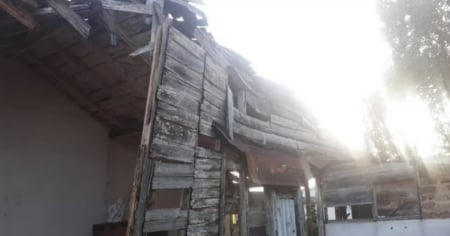
A seven-year-old girl and her grandmother are living outdoors after their home collapsed in the municipality of Venezuela, in the province of Ciego de Ávila. The case was brought to light on Facebook by Cuban writer Guillermo Rodríguez Sánchez, who shared images and statements from neighbors, as well as a video showing the conditions in which they live.
"Stephanie is 7 years old; she is a beautiful and very intelligent girl who was born with a congenital malformation; she has no ear canal or outer ear," Rodríguez wrote in the first post. "As a result, the girl is hard of hearing, and after receiving support at a special school for the deaf and hard of hearing, she is now in the second grade at the 'Venezuela Libre' school in the municipality of the same name in the province of Ciego de Ávila."
Stephanie lives with her grandmother Miraiba, who is 52 years old, in the Van Van neighborhood. “The little girl is there because she was abandoned by her mother a few months ago; one day her mother didn’t come to pick her up from school, and they had to call the grandmother,” Rodríguez said. “She has taken responsibility for the girl, but about three months ago, their home collapsed, and now they are living outdoors.”
The post describes that they possess "not a single appliance," that they "sleep under the moon and stars," and that they "survive thanks to a plate of food given to them by neighbors, in exchange for which they offer their only valuable possessions, the avocados from the tree in their yard."
"The girl keeps wearing a pair of shoes until they break... then there's nothing left," he added. In the shared images, personal items can be seen on the ground, arranged plants, a mirror, and basic utensils outdoors. "They are completely helpless; the mock-up of the property lacks even the most basic living conditions," he wrote.
Regarding the response from the local government, Rodríguez noted that “they asked for help from the local government, and the only response so far has been the delivery of those twisted logs you see in one of the photos.”
The activist also emphasized the character of the grandmother: “Verona and Benito, her father, visited countless residents in their area who can attest to this, completely devoted to the survival of her granddaughter, even helping others whenever possible by lending a hand with household tasks.” He added that, despite everything, “she welcomed Verona Bonce with a smile and also gifted her some avocados.”
In an update, Rodríguez reported: “We are already receiving monetary assistance for the grandmother and the girl from the municipality of Venezuela, in the province of Ciego de Ávila.” He explained that empathetic individuals were visiting them “to bring them toiletries, clothing, and personally leave some monetary contributions.” He also mentioned that, temporarily, “a small roof was set up using old tiles and some sticks with the help of neighbors.”
The video shared in that same post directly shows the environment in which they live. The person recording states: "These sticks you see here are the assistance offered to a woman named Miraiba and her 7-year-old granddaughter, who three months ago experienced the collapse of their home, and here they are living in almost inhuman conditions."
During the visual journey, one can see a mattress, a suitcase with belongings, a toilet bowl without walls, and outdoor utensils. "This is the house where they live, outdoors. There is no roof here," says the narrator.
About the girl, he adds: "She is a student at a special school for the deaf and mute because she has agenesis of the ear canal; she doesn’t have an auricle. The girl is beautiful; her name is Estefany, and she is 7 years old."
At another point in the video, she is briefly shown, and it is said: "This princess is Estefany, who as you can see does not have little ears."
In his third post, Guillermo Rodríguez addressed questions about the minor's parents. "For those asking where the father is, I don't know, I don't care; it has been investigated, and he is not present," he wrote. And regarding the mother, he added: "The mother abandoned her; I already mentioned this in the previous post, she has more children in the same situation, completely neglected and scattered around."
Rodríguez stated that "the abandonment of the girl is documented at the same school from where she had to be picked up by her grandmother," and reiterated that he will not disclose the mother's identity: "Of course I know who the mother is now, and I have all her information, but as you can see, I have a strong sense of ethics, coherence, and sense of reality. It is not my place to make that information public; this profile is constructive, not destructive."
Regarding why the grandmother only raises Stephanie, she wrote: "She took in this granddaughter and not the others because, in her extreme poverty, she decided to save the disabled one. I hope no one ever has to be in the painful position of having to choose which grandchild to give the only loaf of bread from the pantry and a nylon roof."
“We're going to try, cent by cent, to gather enough to take them to another little house, which, even if it’s not a chalet, will be better than that inhumane dwelling,” he concluded.
Structural housing crisis in Cuba
The case of Stephanie and her grandmother arises amidst a profound housing crisis in Cuba. In 2024, five times fewer houses were built than in 1984 and fifteen times fewer than in 2006, according to official data cited by economist Pedro Monreal. "In the worst year of the Special Period (1992), nearly three times more homes were built than in 2024," noted the expert.
Additionally, as acknowledged by state media, the housing plan of the regime faced a severe shortfall in the first quarter of 2025, achieving only 12.4% of the target. The shortage of cement, the shutdown of key factories, and low public investment have exacerbated the issue.
In 2024, the government allocated more than 11.9 billion pesos to tourism and only 1.682 billion to housing construction, which confirms—according to Monreal—a "skewed" investment priority.
In this context, cases like that of Stephanie and her grandmother reveal the social consequences of state neglect in key sectors, and the increasing reliance on neighborly and civilian solidarity to meet basic needs such as a decent roof over one’s head.
Frequently Asked Questions about Housing and Solidarity in Cuba
What problems do Stephanie and her grandmother face in Ciego de Ávila?
Stephanie and her grandmother are living outdoors after the collapse of their home, without appliances or minimal living conditions, relying on the kindness of their neighbors to survive.
How has the local government of Ciego de Ávila responded to this situation?
The local government has only provided twisted logs as "aid" following the collapse of Stephanie and her grandmother's home, highlighting an inadequate response to the seriousness of their situation.
What is the current situation of the housing crisis in Cuba?
The housing crisis in Cuba is severe, with a significant decrease in housing construction and a substantial failure to meet state plans, worsening the living conditions for many families.
What role does community solidarity play in Cuba in the absence of government support?
Community solidarity has become crucial in Cuba, where citizens are organizing to assist families in extreme poverty, compensating for the lack of effective responses from the government.
Filed under: