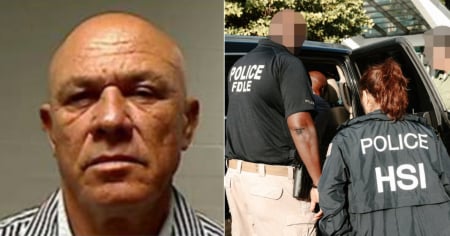
A Cuban migrant who identified himself as a "doctor" was arrested this Monday, June 23, by agents of the Immigration and Customs Enforcement (ICE), just after attending his appointment at the immigration court in San Antonio, Texas.
His case is part of a swift raid that resulted in 11 people being detained and transported in a dark-tinted bus to the Crosspoint processing center, reported Univision San Antonio.
The Cuban, who was wearing a white shirt, tie, and vest, was approached by journalists outside the courthouse and could only say: “I am Cuban, a doctor... they didn’t tell me why my case was dismissed. I’m afraid to return to Cuba.” The man admitted that he did not have legal representation at the time of his arrest.
Alongside him, a Peruvian mother and her two minor daughters were apprehended, as well as other migrants from Venezuela. They all attended their respective hearings at the court located at 800 Dolorosa Street, unaware that ICE would be waiting for them with a discreet and swift operation.
Arrests without warning, fear, and misinformation
The operation took place in seconds. Masked agents escorted the detainees to a tinted bus, avoiding contact with the press and family members. During the journey, the Peruvian mother managed to send a message from the window: "Let my people know we were arrested," she said, according to a report by Univision.
For weeks now, activists and families have been denouncing this new ICE strategy in San Antonio, where individuals fulfilling their obligation to appear in court end up being deprived of their freedom, often without a clear explanation or a chance to say goodbye.
The detention of the Cuban migrant adds to a growing concern within the island community in the U.S. about the tightening of immigration measures. "I don't have a lawyer" were his last words before boarding the bus, not knowing if he would be sent to a family detention center or an adult jail.
In the current context of repression in Cuba, where doctors have reported persecution for leaving internationalist missions or criticizing the system, their fear of being deported is not unfounded.
This case is not isolated. Only in June, several Cubans have been detained after appearing in courts or immigration appointments, among them the judoka Heriberto Rivero Carrera, who escaped from an official sports delegation, and Ariel Lara, a young father with humanitarian parole and a history of political activism. Both are now facing deportation processes despite having voluntarily come forward to the authorities.
Furthermore, on June 12, a Cuban family that had been fighting for political asylum in the United States for three years was right after appearing before an immigration court in San Antonio, Texas.
The arrests, amidst an atmosphere of fear, are particularly affecting Cuban migrants who are already facing vulnerable situations. For many, appearing before immigration with the hope of regularizing their status is becoming a trap.
Filed under: