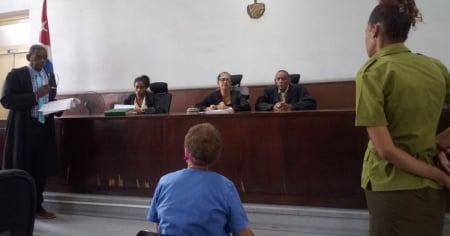
The Provincial People's Tribunal of Havana sentenced a citizen to 20 years in prison on Tuesday for transporting an air conditioner sent from abroad that contained over a kilogram of liquid cocaine hydrochloride inside.
The incident occurred in the middle of a public street and was presented on state television as part of a series of "exemplary trials" promoted by the Cuban regime, aimed at demonstrating a tough stance against drug-related crimes.
A summary of the trial was broadcast by Canal Caribe, which insisted that it was conducted under the "observance of due process," although no details were provided regarding the identity of the accused or the conditions under which the package was intercepted.
What was clear was the message: exemplary punishment, without discussion or context.
The hearing took place in the presence of others sanctioned for similar offenses who are currently on parole, in a ceremony laden with punitive symbolism, more focused on intimidation than on prevention.
Justice as Spectacle
Recently, another similar case occurred in Cienfuegos, where a young man identified as Noel Bibeaux Muñoz was sentenced to eight years in prison for the production and sale of synthetic cannabinoids known as "the chemical."
The so-called "exemplary trials" are not a new phenomenon in the Cuban judicial system. Throughout history, they have been used as a tool for political and social control, especially in times of crisis.
Instead of addressing the structural roots of crime—such as poverty, marginalization, or institutional collapse—the regime prefers to showcase public convictions, often lacking transparency, as a general warning to the population.
However, behind the facade of judicial rigor lies the negligence of a state that for years minimized the growth of drug consumption and trafficking in Cuba.
While the streets were filled with illegal substances, especially among young people, the authorities looked the other way. Now, in the face of the evident chaos, they choose to impose disproportionate sentences as a smokescreen to avoid acknowledging their own inaction.
An opportunistic and belated campaign
The tightening of penalties coincides with the Third National Exercise for Prevention and Confrontation of Crime, a massive operation launched this week by the regime under the direction of the Communist Party, the Ministry of the Interior, and other power structures.
The offensive includes audits, energy inspections, popular vigilance, and, of course, more public trials.
Alongside the courts, the state media machinery supports a "hardline" narrative that aims to reaffirm the authority of the State amid a profound governance crisis, characterized by endless blackouts, rampant inflation, shortages, and unprecedented mass emigration.
But human rights experts warn that this type of staged justice can easily lead to procedural abuses, with disproportionate punishments and a lack of real legal guarantees.
The politicization of the courts not only fails to address the issue of drug trafficking but also further erodes the credibility of Cuban judicial institutions.
Solution or propaganda?
While the government insists that "there is zero tolerance for drugs in Cuba," the reality is more complex.
The structural damage has already been done. Thousands of families have been affected by the expansion of drugs in their communities, without psychological support, without rehabilitation programs, and without serious public information.
Exemplary trials, no matter how severe, will not halt the phenomenon unless they are accompanied by comprehensive policies for prevention, education, and real opportunities for young people.
In its eagerness to punish the last link in the criminal chain, the regime continues to avoid addressing the true culprits behind the rise of drug trafficking: organized networks that operate with total impunity and, in some cases, may have connections within the state apparatus.
The story of air conditioning with cocaine could have been a smuggling anecdote. However, in the hands of the Cuban system, it becomes another tool of repression, showcasing how the government attempts to strengthen its power, not by addressing the country's problems, but by using them as a spectacle.
What is cocaine hydrochloride?
Cocaine hydrochloride is the refined and soluble chemical form of cocaine.
It is a crystalline salt (cocaine + hydrochloric acid) that usually appears as a fine white powder. It is typically snorted through the nose, although it can also be injected if dissolved in water.
Among its immediate effects are euphoria, increased energy, alertness, and decreased appetite.
The secondary effects include anxiety, paranoia, tachycardia, high blood pressure, and more serious consequences such as addiction or health issues like heart attacks, strokes, psychiatric disorders, and sudden death.
Frequently Asked Questions about Exemplary Trials and Drug Policy in Cuba
What are "exemplary trials" in Cuba?
The "exemplary trials" in Cuba are judicial processes used by the regime to send a warning message to the population, harshly punishing crimes such as drug trafficking. These trials are presented publicly to demonstrate the government's "iron fist," although they are often criticized for their lack of transparency and for serving more as a spectacle than as a solution to the structural problems of drug trafficking.
What penalties are being imposed in Cuba for drug offenses?
In recent times, sentences in Cuba for drug-related offenses can be extremely severe, reaching up to 30 years in prison, life imprisonment, or even the death penalty. These penalties are applied depending on the circumstances, such as the quantity of drugs, the involvement of minors, or connections to international trafficking. Additionally, the sentences include the deprivation of civil rights and a prohibition on leaving the country.
How is the Cuban regime's drug policy affecting the population?
The Cuban regime's anti-drug policy, focused on exemplary trials, has been criticized for not addressing the underlying causes of drug trafficking, such as poverty and lack of opportunities. While it aims to deter drug use and trafficking, there is also a noticeable absence of sufficient prevention, rehabilitation, and education programs. This has led to an increase in drug consumption, particularly among young people, and a climate of fear and uncertainty in the population.
What is cocaine hydrochloride and what is its impact on health?
The cocaine hydrochloride is the refined and soluble chemical form of cocaine, typically presented as a fine white powder. It is consumed by snorting it through the nose or injecting it after dissolving it in water. Its immediate effects include euphoria and increased energy, but it can also cause anxiety, paranoia, and serious health issues such as heart attacks and addiction.
Filed under: