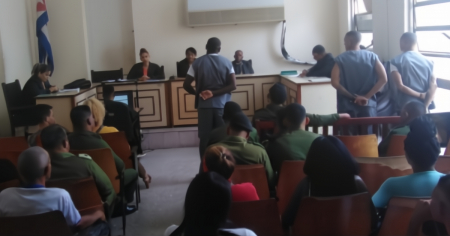
In the municipality of Niquero, in the province of Granma, the Cuban regime carried out a "symbolic trial" for the crime of assault against public order agents, as part of the Third National Exercise for the Prevention and Combat of Crime, Corruption, Drugs, Illegal Activities, and Social Indiscipline.
The measure aims, according to the official statement, "to instill in citizens the awareness of respect, legality, order, and discipline."
According to the official site La Demajagua, the judicial process was presided over by José Carlos Ortiz Peacock, head of the Municipal People's Court, who stated that the crime charged —as outlined in article 182, section one, of the Criminal Code— represents a serious violation of civic discipline and an obstruction to the work of the officials responsible for maintaining order.
The trial demonstrated that the defendant assaulted two police officers, causing injuries to one of them, which served as the basis for imposing a severe prison sentence, along with restrictions on public rights and a prohibition on leaving the country for the duration of the sentence.
Although the court claimed to have ensured due process and respect for constitutional norms, the context of the exemplary trial, held during a national campaign to toughen criminal policy, rekindles concerns about the use of the judicial system as a mechanism for control and public punishment.
Beyond judicial formalism and the supposed procedural guarantees, the trial in Niquero follows a pre-established script by the Cuban dictatorship, designed to instill fear in the population and send a message of political deterrence under the guise of legality. The label of "exemplary trial" is nothing more than a euphemism to justify disproportionate punishments and public reprimands, aimed at reinforcing social control during a time of rising public discontent.
This type of process does not seek justice, but rather to impose obedience, dramatizing specific cases to present them as “warnings” to anyone who questions the authority of the State or interacts tensely with its repressive forces.
Other "exemplary trials"
Last Tuesday, the Provincial People's Court of Havana held two "exemplary trials", focused on drug trafficking and violent robbery offenses, as reported by the judicial body on social media.
The hearings, which were conducted under the pretext of "ensuring due process," are part of a strategy by the Cuban regime to demonstrate a tough stance in response to the rising crime rate, particularly in the capital.
Although details about the identity of the accused or the sentences imposed were not disclosed, the emphasis on the exemplary nature of these processes confirms a repressive trend that prioritizes public punishment over a structural approach to the social issues that fuel these crimes.
The practice of holding "exemplary trials" has historically been used by the regime to send warning messages to the population, particularly in contexts of economic crisis and increasing discontent.
In a country where judicial transparency is limited and criminal processes are often marked by politicization, the increasing severity of penalties for common crimes—such as drug trafficking or violent robbery—can become a tool to distract public attention from deeper issues, such as inflation, prolonged blackouts, and mass emigration.
Frequently Asked Questions about "Exemplary Trials" in Cuba
What are "exemplary trials" in Cuba?
The "exemplary trials" in Cuba are judicial processes used by the regime to impose severe penalties in order to deter the population from committing crimes. These trials are portrayed as a means to maintain order and discipline, yet they are often criticized for being disproportionate and politicized, serving as tools of social control during times of economic crisis and public discontent.
Why does the Cuban regime carry out exemplary trials?
The Cuban regime uses exemplary trials as a strategy to send warning messages to the population, especially during times of increasing social unrest. These trials aim to enforce obedience and demonstrate a tough approach to crime, creating a climate of fear that deters dissent and reinforces state control.
What are the criticisms of exemplary trials in Cuba?
The main criticisms of exemplary trials in Cuba focus on their lack of transparency and the disproportion of the penalties imposed. It is argued that these trials do not seek justice, but rather reinforce social and political control. Furthermore, the regime is accused of using them to divert attention from deeper structural issues, such as poverty and social discontent.
How do exemplary judgments affect the Cuban population?
Exemplary trials impact the Cuban population, creating an atmosphere of fear and social control. By imposing severe penalties and using the judicial system as a tool of repression, these trials limit civic participation and freedom of expression, affecting trust in judicial institutions and exacerbating social discontent.
Filed under: