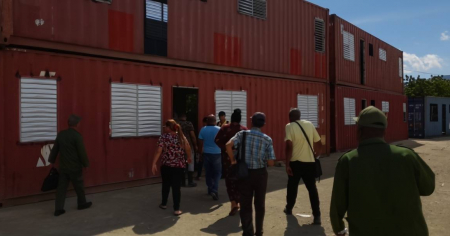
Amid the severe housing crisis affecting Cuba, the regime is attempting to promote several projects that include buildings constructed from shipping containers, as part of its proposals to alleviate the housing shortage in the province of Holguín.
In addition to these container houses, according to the Cuban News Agency, prefabricated modules are proposed for multifamily residences, elder homes, and buildings made without steel or cement, the latter inspired by traditional construction techniques from the colonial period.
Prefabricated multi-family buildings allow for better urban adaptation and flexibility in spaces, according to Solange Reyes Ochoa, an architect at the Engineering and Design Services Company, the group responsible for the project.
He also explained that constructions without steel or cement offer an alternative in the face of the chronic shortage of building materials on the island. These solutions, he assured, aim to enhance community well-being through “creative and sustainable” projects.
However, the proposal for container houses in Cuba is set against a backdrop of deep economic crisis, where millions of families barely have access to basic food, let alone options for decent housing.
In countries like Spain, shipping container homes have gained some popularity as a sustainable and affordable alternative, as they allow for versatile designs, shorter construction times, and more accessible prices, according to an analysis by Idealista News.
The features of these houses include their high resilience due to the original metal structure of the shipping containers, which are designed to withstand extreme conditions and heavy loads.
Additionally, they offer the possibility of relocation, minimizing their environmental impact compared to traditional homes, although they require a foundation on the land where they are installed.
Construction times in Spain range from one to six months, depending on the size and complexity of the project, which is hard to imagine in Cuba, where bureaucracy, shortages, and a lack of infrastructure delay any building plans.
While the Cuban regime presents these initiatives as a "creative solution," the reality is that the majority of the population cannot access decent housing, in a country where the crisis of materials, low wages, and high prices - often in foreign currencies - make any official proposal a pipe dream for most Cubans.
Frequently Asked Questions about the Housing Crisis in Cuba and Container Homes
Why is the Cuban regime using shipping containers to build housing?
The Cuban regime has chosen to build homes using shipping containers as a solution to the housing crisis due to the shortage of traditional construction materials such as concrete and steel. This measure aims to provide "creative and sustainable" alternatives in response to the economic and logistical challenges faced by the country.
What are the advantages and disadvantages of container houses in Cuba?
Container homes offer advantages such as high durability and the possibility of relocation, which reduces their environmental impact. However, in the Cuban context, the disadvantages include challenges in obtaining supplementary materials, bureaucracy, shortages, and lack of infrastructure, which complicate the effective implementation of this type of housing.
What impact has the materials crisis had on housing construction in Cuba?
The materials crisis has led to a collapse in Cuba's housing construction program, with only 12.4% of the plan being fulfilled in the first quarter of 2025. The shortage of cement and other essential materials has been a significant barrier, compounded by a paralyzed industry and lack of investment.
How does government investment in housing compare to other sectors in Cuba?
In 2024, the Cuban government invested significantly more in the tourism sector than in housing construction, allocating 7.1 times more resources to tourism. This disproportionate priority has contributed to the deterioration of the housing stock and has left many families in precarious conditions without a visible solution.
Filed under: