
Related videos:
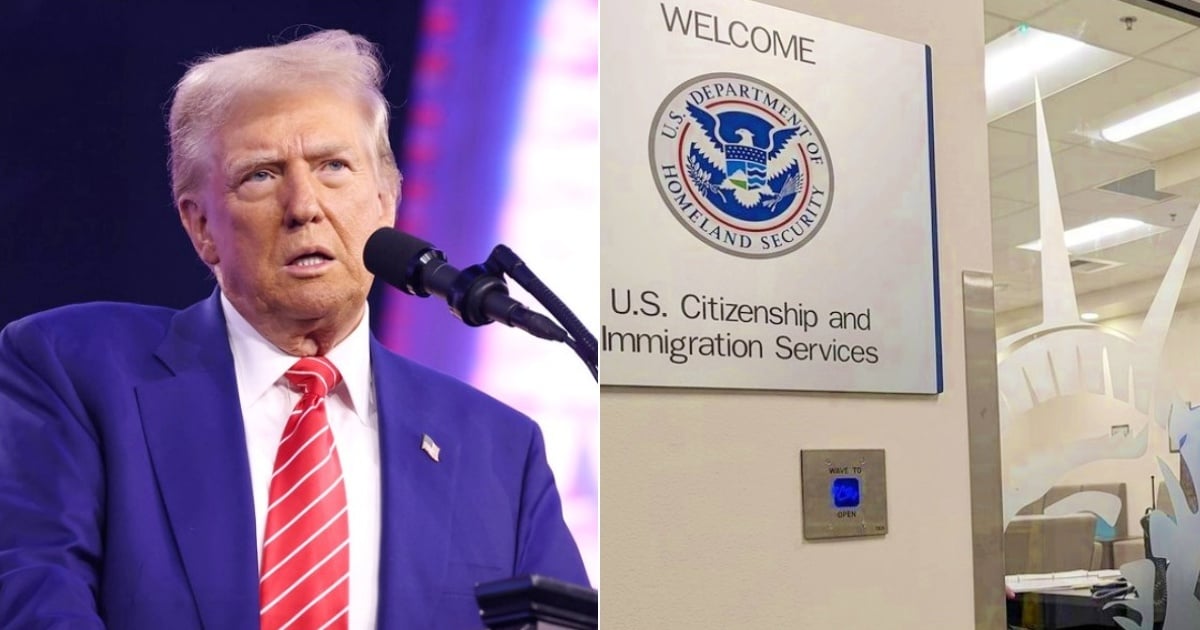
The president Donald Trump has intensified his immigration policy with a measure that threatens to strip thousands of naturalized Americans of their citizenship.
Through new guidelines issued by the Department of Justice (DOJ), your government has formalized a strategy that prioritizes civil denaturalization processes, reversing decades of moderate practice in this area.
The policy was outlined in a memorandum dated June 11, signed by Deputy Attorney General Brett A. Shumate, who directs the DOJ's Civil Division to "pursue the maximum naturalization proceedings in all cases permitted by law and supported by evidence."
Who is in the government's crosshairs?
The document outlines ten priority categories for the revocation of citizenship, including:
-Individuals linked to terrorism, espionage, or illegal technology trafficking.
- Involved in war crimes, torture, or extrajudicial executions.
Members of criminal gangs or drug trafficking networks.
-Convicted of violent crimes, sexual offenses, or human trafficking.
- Cases of financial or medical fraud against the State (such as PPP, Medicare, or Medicaid).
-Persons who omitted relevant criminal information in their naturalization process.
-Cases with pending criminal charges or referred by federal prosecutors.
Furthermore, the memorandum grants the Civil Division "discretion to process cases outside of these categories as deemed appropriate."
“Many of the categories are so vague that they lack meaning. It’s not even clear what they refer to,” warned Steve Lubet, emeritus professor at the Pritzker School of Law at Northwestern University.
A legal turnaround with profound implications
Unlike criminal proceedings, the civil procedures used in these cases do not grant the right to an attorney, a characteristic that has raised significant concern among civil rights advocates.
According to the memorandum, this approach simplifies and speeds up the revocations, as the burden of proof is considerably lighter. "The burden of proof that the government must meet is lower, and it is much easier and quicker to reach a conclusion in these cases," explained Cassandra Robertson, a law professor at Case Western Reserve University, to NPR.
The precedent: The Elliott Duke case
A recent example is that of Elliott Duke, a veteran of the army born in the United Kingdom, whose citizenship was revoked on June 13 by a judge in Louisiana.
Duke was convicted in 2014 for distributing child sexual abuse material, a crime he concealed during his naturalization process.
The DOJ considered this a landmark case of how the policy will be implemented under the new guidelines.
Five strategic axes of the DOJ under Trump
Denaturalization is just one of the five pillars that the DOJ has been instructed to monitor under the orders of President Trump and Attorney General Pam Bondi.
The other four are:
- Judicial persecution of sanctuary cities.
-Research on gender-affirming healthcare as alleged healthcare fraud.
-Lawsuits against diversity, equity, and inclusion (DEI) programs.
-Expansion of the fight against antisemitism.
These changes are transforming the traditional approach of the DOJ's Civil Rights Division.
NPR reported that between January and May 2025, approximately 70% of the lawyers in the division—about 250 professionals—resigned in response to this institutional shift.
Concern about the creation of an unequal citizenship
According to the Migration Policy Institute, nearly 25 million naturalized citizens currently reside in the United States. For many of them, citizenship no longer seems to be an inviolable guarantee.
Sameera Hafiz, from the Immigration Legal Resource Center, stated: “It is a way of, in a sense, attempting to create a second class of American citizens.”
This policy threatens to create a “dual-tier” citizenship system, where naturalized citizens are more vulnerable than those born citizens, especially if they have had any contact with the penal system, even in a tangential manner.
No dates or quotas, but with immediate impact
Although a formal timeline for its implementation has not been established, the measure is already underway.
On the other hand, ICE reported its thirteenth death in custody in the current fiscal year, highlighting an increasingly punitive immigration environment.
On June 28, Jim Ryan, the president of the University of Virginia, resigned following a federal investigation into the use of DEI programs in scholarships and admissions, reflecting the institutional scope of the policies promoted by President Trump.
Citizenship through naturalization, once regarded as a secure goal in the American dream, has now become a revocable status under the new guidelines of the Trump administration.
Although officially focused on dangerous criminals or fraud cases, these measures open the door to broad interpretations that, according to experts, are arbitrary.
The message is clear: in Trump's United States, citizenship is earned... and it can also be lost.
Frequently asked questions about the revocation of citizenship and immigration policies under the Trump administration
What does Trump propose regarding the citizenship of naturalized Americans?
Trump proposes to revoke the U.S. citizenship of certain naturalized individuals through civil denaturalization processes. The policy establishes ten priority categories for revocation, including ties to terrorism, espionage, human trafficking, war crimes, and other serious offenses. This measure is part of a shift in the immigration policy of the Trump administration, intensifying oversight and potentially creating a "two-tier" citizenship.
How does the denaturalization policy affect naturalized citizens in the U.S.?
The policy of denaturalization could create a "two-tier" citizenship system, where naturalized citizens are more vulnerable to losing their status than those who are citizens by birth. This threatens the security of nearly 25 million naturalized citizens, especially those with criminal backgrounds or who omitted relevant information during their naturalization process.
What changes has Trump implemented regarding birthright citizenship?
Trump has signed an executive order to deny birthright citizenship to children of undocumented immigrants. This measure seeks to reinterpret the 14th Amendment of the Constitution, which grants citizenship to anyone born in the U.S. The policy faces significant legal challenges, as it contradicts the historical interpretation of the amendment as a guarantor of the right of soil.
What other immigration measures has Trump taken recently?
In addition to the policies of denaturalization and the elimination of citizenship by birth, Trump has signed executive orders to strengthen border security, declare a state of emergency at the border with Mexico, and expand the expedited deportation of migrants. These measures are part of a broader strategy of tightening immigration controls, which has included the mobilization of troops and the classification of entities as sanctuary cities.
Filed under: