
Related videos:
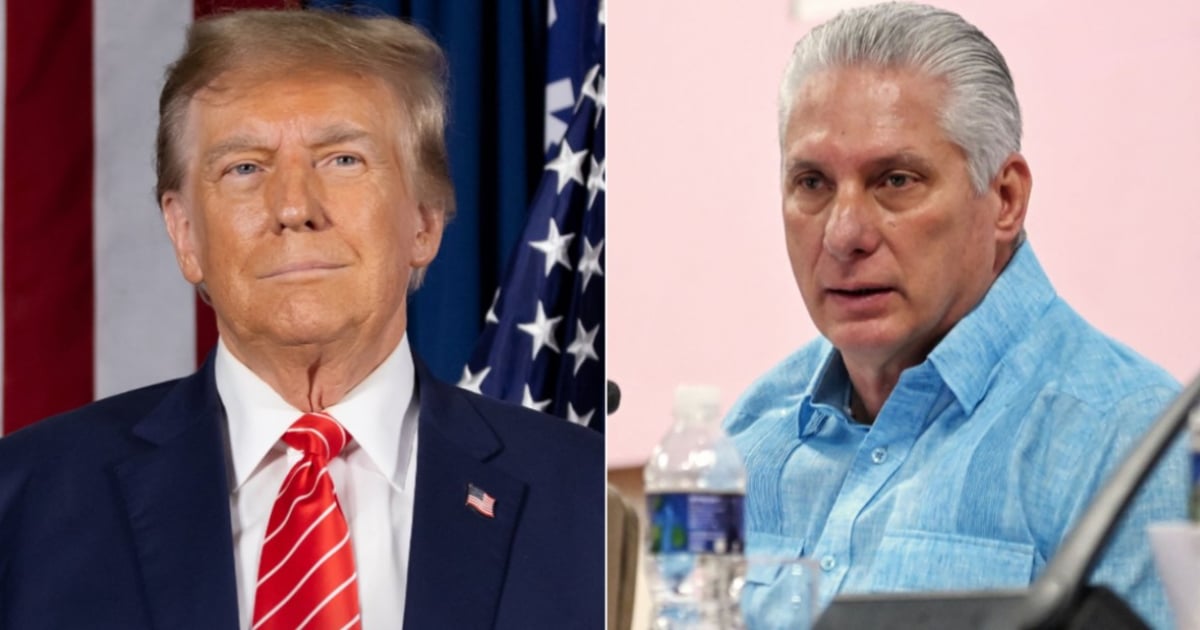
The Cuban leader Miguel Díaz-Canel reacted on social media to the new memorandum signed on Monday by U.S. President Donald Trump, which strengthens the embargo and prohibits tourism from the United States to the island.
More than firmness, the reaction of the ruler designated by Raúl Castro revealed a deep fear of what the change in policy represents: a renewed external pressure that targets the very heart of the repressive structure of the Cuban regime.
The impact will be felt, but they will not bend us, warned the occupant of the Palace, attempting to convey resolve while his words dripped with the nervousness of someone witnessing the unraveling of the web of interests that sustains his power.
The new NSPM-5 is not, as Díaz-Canel claims, an "aggressive plan against Cuba" nor does it aim to cause "the greatest harm and suffering possible to the people." On the contrary, it is a strategy aimed at separating the Cuban people from those who exploit and use them as a shield.
The goal is clear: to weaken the military and intelligence apparatus that has taken over the country, represented by conglomerates like GAESA, and to strengthen spaces for individual autonomy, such as access to free Internet, freedom of the press, and the promotion of private enterprise.
But these are precisely the threats that the "continuity" of Castroism fears the most. Because it knows that an informed people, with real economic options, with the ability to associate, move, and express themselves without fear, is a people that can awaken.
That's why the reaction from the so-called Palace of the Revolution has been immediate and furious, weaving the same old propaganda speech: blockade, imperialist aggression, heroic resistance.
What Díaz-Canel does not mention is that the "blockade" that most impoverishes Cubans is not in Washington, but in Havana: the blockade against free enterprise, free opinion, political parties, private property, alternation in power, and independent justice.
That internal barrier, imposed by a one-party system upheld by the force of repression, is the true cause of the daily suffering of millions of Cubans.
When the Cuban leader complains that the United States acts in response to "narrow and unrepresentative interests," he is unintentionally describing his own model of governance.
In Cuba, there is no representation whatsoever. There are no free elections or multiparty systems. There is no independent press to hold the government accountable. The Cuban citizen is reduced to a passive spectator of a political charade, where everything is decided in advance by a party elite that is unaccountable.
The regime's fear does not stem from the sanctions per se, but from what they could trigger: an acceleration of the internal decay of the system. The economy is in ruins, massive emigration is emptying the country of its youth, popular legitimacy is minimal, and the increasing repression only postpones the inevitable.
In that context, every measure that limits the financing of the repressive machinery is a direct threat to the interests of a dictatorship that has been in power for 65 years and is, by far, the longest-serving in the Western Hemisphere.
Díaz-Canel assured that "they will not break us," but his words are sounding increasingly hollow. History shows that totalitarian regimes do not fall because they are defeated from outside, but because they rot from within. In Cuba, the process of decay is well advanced, and those in power are aware of it.
The true fear of the regime is not of Trump, nor Rubio, nor the sanctions. It is of the Cuban people when they decide to stop being afraid. It is of a generation that is growing up connected, informed, and tired of recycled lies. It is of an active diaspora that demands to participate in the future of the country. It is of the possibility of free elections, real pluralism, and transitional justice.
That is why they react with fury to every measure that exposes them. That is why they try to portray what is actually a legitimate humanitarian concern as interference: the need to dismantle a system that insists on its failed model and pave the way for a free Cuba, where power does not have to impose respect through repression, propaganda, and worn-out slogans.
Filed under: