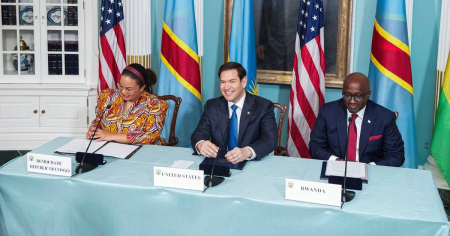
The United States Secretary of State, Marco Rubio, announced the end of the United States Agency for International Development (USAID), which will cease to operate as an executor of foreign aid starting this first of July.
According to the senior official, the new model aims to align international assistance with Washington's strategic interests and to move away from what he described as "decades of taxpayer-funded inefficiency," in a statement published under his signature on an official State Department website.
Rubio stated that USAID, created in the context of the Cold War, has failed to meet its fundamental objectives since the end of that conflict, which is why its closure was announced last March. This resulted in the cancellation of 83 percent of the programs and the termination of over 5,000 contracts.
Instead, he said, the agency funded a “complex industrial NGO” financed with public money, showing no tangible results in terms of development or improvements in the international perception of the United States.
“USAID had decades and an almost limitless budget to expand the influence of the United States and promote global economic development. In contrast, today there is more instability, increased anti-American sentiment, and very few results,” stated the secretary, who in February, leading the Department of State, had taken control of USAID last February.
However, last March, it reinstated certain contracts and grants that funded independent Cuban media, humanitarian aid projects, and support programs for political prisoners on the island.
These initiatives, which had previously been canceled or suspended, began to receive funding again, according to El Nuevo Herald, a publication that recalled the controversy generated around these issues, especially following the closure of Radio y TV Martí.
The report published by Rubio highlights figures that support his decision: since 1991, the United States has allocated 165 billion dollars to sub-Saharan Africa, but countries in that region have voted alongside the U.S. only 29% of the time on key resolutions at the UN, the lowest rate in the world.
It also mentions the more than $89 billion invested in the Middle East and North Africa, where, according to the document, the image of the United States is now worse than that of China in almost every country, except Morocco.
One of the most compelling examples Rubio used was that of the funds allocated to Gaza and the West Bank: “$9.3 billion since 1991, and the beneficiaries included allies of Hamas. We have not received gratitude, only grievances.”
The criticism extends to what is seen as a deviation from the original purpose of foreign aid, and at the same time, it accused USAID of prioritizing the interests of the UN, large NGOs, and international actors over those of the American taxpayer.
“USAID presented itself as a charitable organization. But foreign aid is not charity. It is a tool of foreign policy. It must serve the interests of the United States,” he said.
Starting July 1, all foreign assistance programs will be executed from the Department of State, with a focus on efficiency, oversight, and strategic returns. According to Rubio, the new model will prioritize investment over dependency, trade over prolonged assistance, and accountability over bureaucracy.
The senior official promised that the funds will be directed exclusively to countries that demonstrate the willingness and capacity to develop independently.
In addition, he noted that fragmented accounts are being eliminated and funds are being consolidated to respond quickly to international emergencies, avoiding delays associated with bureaucratic processes.
The redesign also aims to better position the United States in light of the growing Chinese influence in Africa, Latin America, and other regions of the global south.
"We are facing an exploitative aid model from China. Our response will be more strategic and more beneficial for both the United States and our partners," he stated.
Finally, Rubio concluded with a clear message: "Where there used to be a rainbow of unrecognizable logos in humanitarian aid, there will now be one clear symbol: the flag of the United States. Those who receive our assistance will know it comes from the American people, not from a faceless NGO."
Frequently Asked Questions about the closure of USAID and its impact on U.S. foreign policy
Why has the decision been made to close USAID?
The closure of USAID was announced by Secretary of State Marco Rubio, with the aim of aligning international assistance with the strategic interests of the United States. Rubio argued that the agency had not met its objectives and had incurred inefficiency funded by taxpayers, deviating from its original purpose of serving American interests.
What implications does the closure of USAID have for the organizations that received its funding?
The closure of USAID means that the implementation of foreign assistance programs will be taken over by the State Department. This has led to the cancellation of a high percentage of programs and contracts, affecting numerous non-governmental organizations and independent media that relied on these funds. The decision has generated criticism and legal actions due to the anticipated negative impact on vulnerable communities.
How does this measure affect the relationship between the United States and regions such as Africa and the Middle East?
The end of USAID and the redesign of the U.S. foreign aid model could weaken American influence abroad, especially in regions where USAID has played a crucial role. The reallocation of funds towards countries that demonstrate the willingness and capacity for autonomous development aims for greater efficiency, but it could also allow powers like China to fill the gap left by the United States in vulnerable areas.
What impact does this decision have on independent media in Cuba?
The cancellation of USAID funds has severely impacted the Cuban independent media outlets that were receiving financial support from the agency. The withdrawal of these funds complicates the work of journalists who seek to counteract the propaganda of the Cuban regime. Without this support, these media outlets face the urgent need to find other sources of funding to continue operating.
Filed under: