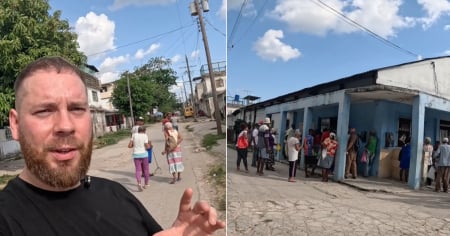
The Spanish YouTuber José María Pastor, known on social media as @topeadosdeviaje, has shaken up TikTok with a series of videos filmed in Cuba, where he candidly showcases the social and economic situation that the island is experiencing. Through direct testimonies, images of daily life, and personal reflections, the creator has documented scenes ranging from endless lines to receive food to teachers asking for food on the street.
"I am in Cuba. I came to capture its culture, its food, and its people, but what I found was much harsher than I imagined." This is how one of the videos published by the Spanish YouTuber José María Pastor, known as @topeadosdeviaje, begins. His account after visiting Cuba has sparked significant reactions on social media due to the stark way he describes the social, economic, and human situation he witnessed during his stay.
In his videos, posted on TikTok and YouTube, the content creator narrates in the first person scenes of poverty, rationing, desperation, and extreme precariousness: “I saw people begging for rice, milk, even the last sip of a soda, teachers earning 10 dollars a month, elderly people asking for a coffee without even asking, just with their eyes.”
In one of her most talked-about clips, she asserts that she has never felt such helplessness on a trip: “I’ve been fortunate to travel a lot, but I’ve never felt such helplessness.” Through street scenes and spontaneous conversations with locals, she reveals how many Cubans live amidst blackouts, food improvisation, and monetary marginalization. “There are stores full of goods, but many Cubans can’t enter because they don’t have dollars,” she states. “I didn’t come to judge; I came to face a painful reality head on.”
In another excerpt, he explores the local food scene on the island: “Today I went out to sample authentic street food in Cuba, from churros to pizzas made with whatever little ingredients are available, and when there aren't any, they improvise.” He recounts eating in various places using his mobile phone's flashlight due to the lack of electricity, accompanied by warm beer, while Cubans offered to share what little they had without asking for anything in return. “This is not just gastronomy; it is survival, it is improvisation; this is Cuba.”
"A meal can be a luxury for many families. They offered me what they had and adjusted it as they went along. Yet, people still smiled, shared, and invited me to try without expecting anything in return," she added.
The testimonies collected also highlight the weight of the exodus as the only option for many. “Many Cubans openly told me if I knew someone who would want to marry him or her to be able to leave the country,” comments in one of the most viral videos, where a man says: “I cry practically every day... out of agony, suffering; I just can't take this anymore. Honestly, to live like this here, it’s better to be dead.”
Another of the most striking scenes he recorded was the encounter with a Cuban teacher on the street, who said to him: "Look at how we are in Cuba, we don’t even have food to eat, we are in very bad shape." When asked about her salary, she replied that she earned "3,000 pesos" as an educator, equivalent to "10 dollars" a month.
José María Pastor, 30 years old, is a graduate in Journalism and Documentation, originally from Águilas in the Region of Murcia. He began documenting his travels on his channel “Topeados,” which now has over 11 thousand subscribers on YouTube. In a 2022 interview, he shared that his passion for travel was born during the confinement caused by the pandemic. "Life can be wonderful," he concludes each of his videos, quoting journalist Andrés Montes.
Although his aim was to showcase the culture and daily life of the Cuban people, what he encountered compelled him to bear witness to what he describes as “a painful reality.” After his experience on the island, he wrote: “I left the country feeling very unwell.”
On YouTube, where he has shared the tough reports he has made on the island, he wrote in one of them: "I show you the harsh reality that millions of Cubans are living. Hunger, shortages, blackouts, wages that don't even cover food... and a day-to-day life that is becoming increasingly difficult. I have walked through neighborhoods in Havana, spoken with people of all ages, walked through empty markets, and experienced situations I never imagined. Here, they didn't ask me for money. They asked for rice, milk, medicine, a bit of bread... or the last sip of a soft drink. The hardest part: I met teachers who earn $10 a month. People who haven't eaten meat in months. Those who look at you with hope because you are a tourist... and because they know life is different outside. This is not to attack or politicize. It's to tell what many want to say but cannot. Because Cuba is not just old cars and beautiful beaches. Cuba is also resistance, dignity, and the daily fight for survival."
"What has impacted me the most is the hunger," he acknowledged in another video uploaded to his channel.
The series of videos recorded in Cuba adds to the numerous testimonies of foreign creators who have denounced the social collapse on the island in recent months. From the American Adventure Elliot, who showed the ration book with nonexistent products, to the Spaniards from the channel Black Mango, who described the island as “a prison with a blue sky,” the images of deterioration, hunger, and despair are echoed in every account.
In one of his most recent videos, Pastor wrote: “I was left speechless. I am processing what I just experienced,” after speaking with another older woman who began to cry as soon as she started talking to him. “They don't have words, they have pain,” he reflects. In another clip, an elderly woman simply said to him: “Thank you for listening to us.”
The series continues and promises to keep showcasing what he himself describes as “one of the hardest realities I have documented in my life.” With over 11,000 subscribers on YouTube and a growing community on TikTok, his voice joins the many that are bringing to light a Cuba far removed from travel brochures.
Frequently Asked Questions about the Social and Economic Reality in Cuba
What is the current economic situation in Cuba according to visitor testimonials?
The economic situation in Cuba is critical, marked by shortages of food and basic goods, extremely low wages, and rampant inflation. Various visitors, such as the YouTuber José María Pastor, have documented this reality, showcasing long lines to obtain food, frequent blackouts, and the desperation of Cubans to survive. Testimonies like that of Adventure Elliot also highlight the collapse of infrastructure and the lack of essential resources such as medications.
How does the situation in Cuba affect professionals such as teachers?
Teachers in Cuba are facing an extremely precarious economic situation, with salaries around 10 dollars a month, which is insufficient to meet basic needs. This reality has been highlighted by several content creators, who have demonstrated how with their monthly salary, they can barely afford a few groceries, exposing the severe economic crisis that affects public sector workers on the island.
What kind of experiences have foreign visitors shared about daily life in Cuba?
Foreign visitors have shared experiences that reveal a daily life characterized by scarcity, rationing, and improvisation. Testimonials from people like José María Pastor and Carolina Márquez highlight poverty, lack of access to basic goods, and infrastructure problems. Moreover, they demonstrate how everyday shortages affect the emotional and physical well-being of Cubans, who must cope with blackouts, transportation issues, and an economy in crisis.
How do visitors describe the food situation in Cuba?
The food situation in Cuba is precarious and is characterized by a shortage of basic products and the need to improvise with the little that is available. Testimonials from visitors like José María Pastor reflect that many times Cubans cannot choose what to eat, but must settle for whatever is available. Street food becomes an expression of daily survival, where there is often a lack of electricity even for cooking.
Filed under: