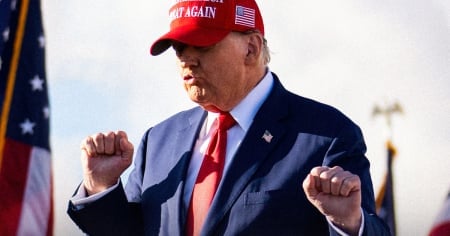
In one of the most intense legislative sessions in recent years, the U.S. House of Representatives narrowly approved this Thursday the "Great and Beautiful Bill", the tax and budget plan promoted by President Donald Trump.
The vote, which ended with 218 votes in favor and 214 against, reflects the profound political divide that runs through Congress and the country, and adds to the close vote that was also reached on Tuesday in the Senate.
This project, a cornerstone of Trump’s economic agenda, extends the tax cuts from his first term (2017-2021) and imposes severe reductions on social programs like Medicaid, eliminates incentives for clean energy, and significantly increases the budget allocated to border security and defense.
Despite the internal divisions within the Republican Party, the relentless pressure exerted by the president himself, including last-minute phone calls, proved decisive.
Trump, who had aimed to sign the law before July 4th, Independence Day, will be able to do so right in time to make it a symbol of his second administration.
Initial reactions
Among the first reactions is that of former president Joe Biden.
"The Republican budget bill is not only reckless but also cruel. It drastically cuts Medicaid and deprives millions of Americans of healthcare," wrote the former president on X.
"Rural hospitals are closing and food assistance for veterans and seniors is being cut. Energy bills are rising, which could lead to substantial cuts to Medicare, all while increasing the deficit by $4 trillion. All of this to grant a massive tax exemption to billionaires. Workers deserve better," he added.
Very different is the viewpoint of Cuban-American Congresswoman, María Elvira Salazar, who has described it as a "historic victory!"
"The Chamber has just approved the Great and Beautiful Bill. This is a victory for every American who works hard and believes in the American Dream. Tax relief for working families. Tips and overtime: protected! More money in your pocket. More jobs, more growth, more freedom. Today, we won. And this is just the beginning!" he stated on X.
Very enthusiastic as well is the White House press secretary, Karoline Leavitt, who warned that "President Trump's 'One Big, Beautiful' bill aligns with the sensible agenda that nearly 80 million Americans voted for."
Leavitt alluded to "the largest tax reduction for the middle class in history, permanent border security, massive military funding, and the restoration of fiscal sanity."
"The pro-growth policies of this historic legislation will drive an unprecedented economic boom. President Trump eagerly anticipates enacting the 'One Big, Beautiful' bill to officially usher in America's Golden Age," he added.
The price of Republican success
The Republican majority in the House (220-212) could barely afford to lose more than three votes. However, the bill faced internal opposition.
Republican lawmakers expressed their dissatisfaction with the projected increase in the fiscal deficit—estimated at $3.3 trillion over a decade—and the social cuts introduced in the Senate version.
After intense negotiations overnight, the necessary support was achieved without substantially altering the text of nearly 900 pages.
In return, Trump promised to rely on executive orders to benefit specific districts represented by reluctant legislators.
The Speaker of the House, Mike Johnson, expressed complete confidence ahead of the vote.
"We are ready to fulfill our promise to the American people", he said, convinced that the votes were assured.
Jeffries, the voice of the democratic resistance
In an unprecedented act, the leader of the Democratic minority, Hakeem Jeffries, took the stand for 8 hours and 44 minutes, setting a historical record in the House of Representatives.
Their goal! To delay the approval of the project and bring visibility to the millions of citizens affected by the measures.
Jeffries denounced the regressive nature of the project.
"Mr. President, you are taking away healthcare from millions of Americans. You are taking away food from children, veterans, and the elderly... And for what purpose is all this being done? To give huge tax breaks to billionaires across the country. We are better than that," he said.
During his marathon speech, which evoked historical addresses from figures such as Rosa Parks and Martin Luther King Jr., Jeffries described the process as a “crime scene” and accused Republicans of pushing through a plan that he labeled “a disgusting abomination.”
Through the so-called "magic minute," Jeffries took the opportunity to read testimonials from voters and reiterate his opposition to a law that, according to him, "threatens the health, safety, and well-being of the American people."
Social and Political Consequences
The fiscal plan dubbed by Trump as his "Great and Beautiful Healthcare Bill" threatens to leave 12 million people without medical coverage by restricting access to the Medicaid program.
Additionally, it introduces cuts of 1.1 trillion dollars in social and food programs, particularly affecting vulnerable sectors such as children and retirees.
This megaproject has also been a source of tension between Trump and influential figures like Elon Musk, reflecting its ability to divide even among its own allies.
However, the parliamentary victory reinforces the image of a president who, despite the challenges, continues to shape American politics with a firm hand.
The Republican leader Mike Johnson, in response to Jeffries' speech, made an ironic comment.
“It takes much longer to build a lie than to tell the simple truth”, thus minimizing the impact of the democrat's oratorical marathon.
A fiscal legacy for July 4th
The approval of the plan marks a legislative milestone for Trump, who had set the symbolic date of Independence Day to sign his new major tax reform.
With this victory, the president consolidates his control over Congress, reinforces his agenda for reducing the state, and sends a clear message of ideological continuity compared to his first term.
Now, with the House aligned and the Senate having approved the text, all that remains is Trump's signature for the bill to come into effect.
Filed under: