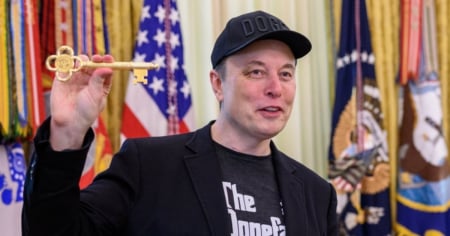
The relationship between Elon Musk and the President of the United States, Donald Trump, appears to have entered a phase of open confrontation.
Just days before leaving his position as head of the Department of Government Efficiency (DOGE), the tech mogul has issued harsh criticism of the new Republican budget proposal, which he called a "repugnant abomination."
Musk not only condemned the increase in spending and the deficit outlined in the project, but he also warned that he could become actively involved in the legislative elections to support candidates who challenge the Republicans who supported the measure.
From key ally to outright critic
Musk, who until a few days ago played a key role in the White House as the director of DOGE, expressed his strong opposition to the legislative project.
“I’m sorry, but I can't take it anymore. This massive, outrageous, and bloated spending bill from Congress is a disgusting abomination. Those who voted in favor should be ashamed: they know they did wrong. They know it.”, he wrote on his social media X.
These words, echoed by media outlets and politicians from both sides, represent a direct and unequivocal critique of what Trump calls his “Big Beautiful Bill,” which aims to extend tax cuts, reduce taxes on tips and overtime, and increase spending on defense and immigration.
Shock from the deficit and social cuts
According to Musk, the project "undermines the work the DOGE team is doing" and claims that it is far from being fiscally responsible.
In a recent interview with CBS, prior to his formal departure from the Government, he stated: “Frankly, I have been disappointed to see the immense public spending, which increases the budget deficit instead of reducing it.”
This week, the magnate went even further in his posts, warning that the budget plan “will massively increase the already gigantic budget deficit to $2.5 trillion (!!!) and will impose an overwhelmingly unsustainable debt on American citizens.”
Several independent organizations have confirmed these projections.
The Congressional Budget Office estimated that the project could increase the deficit by $3.8 trillion over 10 years, while the Penn Wharton Budget Model puts it at $2.8 trillion.
Yale's Budget Lab went even further: if the temporary measures are made permanent, the long-term cost could reach $23.7 trillion, elevating the debt to 200% of GDP by 2055, according to U.S. media reports.
Musk threatens to intervene in the legislative elections
Through X, Musk suggested that his break from fiscal Trumpism could translate into direct political action.
“In November of next year, we will bid farewell to all the politicians who betrayed the American people”, he wrote as a threat.
It is a message that could suggest the billionaire businessman intends to use his influence and fortune to support rival candidates in the Republican primaries.
This is not a minor threat. Musk invested at least 250 million dollars in Trump's 2024 campaign.
Although after his departure from DOGE he announced that he would spend "much less" on politics, he left the door open to getting involved if he sees a reason. The controversial law seems to have provided that reason.
Cracks in the Republican Party
The law was approved by a very narrow margin in the House of Representatives: 215 votes in favor and 214 against, thanks to Trump's intense pressure on undecided lawmakers.
However, the Senate promises to be a greater obstacle.
Republican figures such as Rand Paul, Josh Hawley, and Ron Johnson have expressed their opposition.
Paul, a staunch advocate for budgetary balance, wrote: “I agree with Elon. Both of us have witnessed the massive overspending in public expenditure, and we know that adding five trillion in debt is a monumental error. We can and must do better.”
Trump, for his part, responded with personal attacks.
On Truth Social, he labeled Paul's ideas as "crazy (losers!)" and asserted that "the people of Kentucky can't stand him."
Even so, he cannot afford to lose more than three votes in the Senate, where no Democrat plans to support the bill.
Political and economic consequences
The project, which cuts key health programs (such as Medicaid), nutrition (SNAP), and education, has also faced severe criticism from the opposition.
The Democratic leader of the Senate, Chuck Schumer, described the proposal as "horrible at its very core" and stated: "Tax breaks for the ultra-wealthy funded by cuts to healthcare for millions of Americans."
From within the Republican party itself, some moderates fear a high political cost.
Senator Joni Ernst was confronted by voters in Iowa when she defended the law: when warned that people die without health coverage, she responded sarcastically, "Well, we're all going to die," which sparked outrage among those present.
An irreparable fracture
The relationship between Musk and Trump seems to have definitively broken down.
Although Musk tried to step down from his role as “advisor and friend,” as he mentioned in the farewell ceremony in the Oval Office, his harsh statements reflect a significant shift in stance.
There is even speculation that Trump's withdrawal of Jared Isaacman's nomination, a close associate of Musk, as NASA director may have been a preemptive retaliation.
Meanwhile, from the White House, Press Secretary Karoline Leavitt downplayed the conflict: "The president is already aware of Elon Musk's stance on this bill. That does not change the president's opinion."
Filed under: