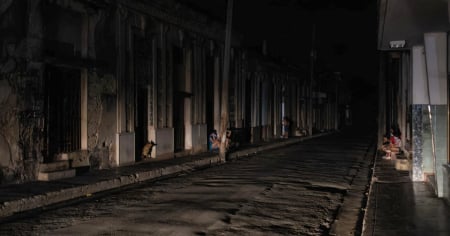
Junior González Núñez, first vice president of the Superior Business Management Organization (OSDE) Water and Sanitation, explained on state television that power outages and voltage drops have a “directly proportional” impact on hydraulic service, to the extent that they halt the pumping of water in much of the country.
“Today we registered that approximately 70% of the service disruptions are linked to issues in the national electric service, whether due to generation deficits or actual service disruptions where there are outages, low voltage, and other problems that the Cuban people are currently experiencing,” he acknowledged.
According to the official, although water is a natural resource, in Cuba it requires a complex industrial process to meet drinking water standards, and the entire process depends on electricity.
Most wells are located far from urban areas, which requires pumping water up to seven times before it reaches homes. But without power, the entire system comes to a halt.
“Once the electrical service is restored, it takes between six and eight hours for water to reach the cities”, González explained, highlighting the fragility of the infrastructure and the suffering faced by the population, particularly in vulnerable neighborhoods where the wait can extend for days.
Power outages are compounded by other structural factors that worsen the water issue: the prolonged drought affecting the island, the age of the pumping equipment, the lack of spare parts, and the technological obsolescence of the national hydraulic network.
The official himself detailed that the infrastructure relies on a technology park that is “expensive, complex, and with virtually total coverage,” which is currently experiencing constant breakdowns.
"The country dedicates significant financial resources for the replacement and assurance that these equipment have fewer issues," he said, without providing specific figures or explaining why a crisis that has been affecting the population for years has not been reversed.
As a partial solution, the Cuban government has begun installing pumping systems powered by solar panels. According to González, 866 photovoltaic systems have already been imported, benefiting rural areas in ten provinces.
However, this effort, although positive, remains marginal compared to the scale of the problem and reflects the regime's lack of foresight in diversifying its energy matrix in past decades.
A thirsty population, a delayed response
Eighty percent of Cubans rely on the 24 state-owned water supply and sewage companies. The remaining 20% must fend for themselves with wells or alternative infrastructures, often without health guarantees. In this context, the promise of transfers and modernization seems as distant as water itself when there is no electricity.
The interview, far from providing reassurance, has confirmed what millions of Cubans experience daily: the inability of the State to ensure basic services. Years of disinvestment, erratic political decisions, and an extreme dependence on the centralized system have placed the country at a critical point where even turning on the tap offers no guarantees.
Although the official reiterated the argument of the embargo as the cause of the energy deficit, the reality is that the water and electricity crisis in Cuba is a result of an inefficient, corrupt, and technologically outdated state structure that has prioritized propaganda over real solutions for decades.
Meanwhile, millions of Cubans on the island wait, without electricity, without water, and without answers, for something to change.
Frequently Asked Questions about the Water and Energy Crisis in Cuba
Why do electrical problems affect the water supply in Cuba?
70% of the disruptions in water supply in Cuba are related to issues with the electrical service. The country's hydraulic infrastructure relies on a pumping system that requires electricity. Without a constant electricity supply, water pumping stops, delaying its arrival in cities and severely impacting the daily lives of citizens.
What measures has the Cuban government taken to address the water crisis?
The Cuban government has begun to install pumping systems powered by solar panels to mitigate the problem. However, this effort remains insufficient in light of the magnitude of the issue, reflecting a lack of foresight to diversify the energy matrix in the past. The water crisis continues to severely impact the population, especially in rural and vulnerable areas.
What is the current situation of the water supply in Santiago de Cuba?
In Santiago de Cuba, the water supply situation is critical. In some municipalities, citizens have waited up to 85 days to receive the service due to breakdowns in pumping equipment and a lack of energy backup. The prolonged drought and the aging infrastructure further exacerbate the situation.
Filed under: