
Related videos:
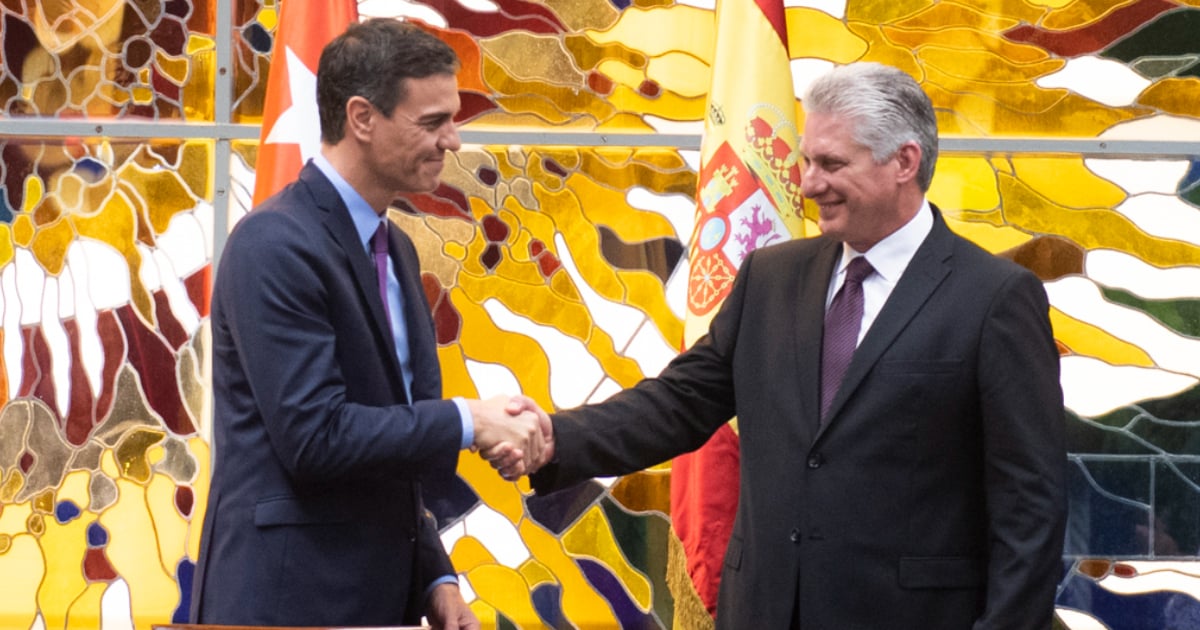
The Spanish government, led by Pedro Sánchez and currently embroiled in a serious corruption crisis, activated a program for debt forgiveness with Cuba for an amount of up to 375 million euros.
This decision was formalized in Seville, through the signature of the Minister of Economy, Trade and Business, Carlos Cuerpo, and means that the funds initially allocated for debt repayment will be transformed into investment projects within the island.
The initiative is part of an agreement signed between both countries in 2016, but it is now being realized within the framework of a new multilateral effort promoted by the Paris Club.
According to the Government, the goal is to finance sustainable development projects in strategic sectors such as energy, water, and food security, and to allow the participation of Spanish companies and Cuban entities under standards of transparency and accountability.
Through this scheme, the regime in Havana will avoid returning cash and instead will carry out projects supervised by both governments. Spanish authorities emphasize the usefulness of the model to "strengthen" international cooperation and promote projects with a high social impact.
As of 2020, the external debt that the Cuban government has with Spain amounted to 1,970.66 million euros (2,258 million dollars), representing nearly two-thirds of the total debt owed by all of Ibero-America (3,086.68 million euros).
Sánchez under scrutiny
The measure comes at a delicate time for Sánchez's government, which has faced harsh criticism due to corruption scandals that have shaken the leadership of the Spanish Socialist Workers' Party (PSOE).
The most serious case involves Santos Cerdán, former Secretary of Organization of the PSOE, regarded as the right-hand man of the president, who was placed in provisional detention without bail, accused of leading a network of illegal commissions alongside other high-ranking officials and advisers of the party.
The Supreme Court judge, Leopoldo Puente, accused him of leading a corruption scheme related to public works contracts, in collaboration with former Transport Minister José Luis Ábalos and his former advisor Koldo García. According to the investigation, Cerdán allegedly managed and distributed the "kickbacks" among those involved and maintained control over a million-dollar "loot" that has not yet been recovered.
The Anti-Corruption Prosecutor requested his imprisonment due to the risk of evidence destruction and his central role in the corrupt network. Cerdán, for his part, denied the accusations and claimed he had not taken "even one euro," also defending the innocence of the PSOE.
The 'Debt Swap'
The debt conversion program that the Cuban regime and the Spanish government have resorted to means that instead of paying the debt to Spain in cash, the Cuban regime will invest the equivalent in local currency in previously approved projects.
Through the debt swap, andinstead of paying the debt in cash to the creditor country, the debtor country agrees with the creditor to forgive or reduce the debt (in whole or in part) and commits to invest the equivalent amount in local currency in projects previously agreed upon with the creditor.
Projects are typically focused on Education, Health, Environment, Sustainable Development, and Social Infrastructure
Although the Spanish government presents it as an innovative tool for cooperation, the decision has faced criticism for coinciding with the outbreak of corruption cases that directly involve the president's circle.
In the last two decades, Spain has signed similar agreements with more than 25 countries, forgiving over 1.6 billion euros.
However, the current context has led some sectors to view this new step towards engagement with the Cuban regime as a maneuver to divert attention from the internal political crisis.
Frequently Asked Questions about Spain's Debt Forgiveness to Cuba and Its Implications
Why did Spain decide to forgive part of Cuba's debt?
Spain decided to forgive part of Cuba's debt to finance sustainable development projects on the island. This decision is part of a bilateral agreement from 2016 and aims to promote international cooperation in strategic sectors such as energy, water, and food security, allowing the participation of Spanish and Cuban companies.
What is the debt conversion program between Spain and Cuba?
The debt conversion program allows Cuba to not pay its debt to Spain in cash, but to invest the equivalent in local projects. This mechanism, known as "debt swap," transforms the payment of debt into investments in previously agreed-upon sectors, and is overseen by both governments to ensure transparency and social impact.
How is debt forgiveness related to cases of corruption in Spain?
The debt write-off measure comes at a time when Pedro Sánchez's government is facing a serious corruption crisis. Some critics view this decision as a maneuver to distract from internal political scandals. Nevertheless, the government defends that the write-off is part of a previously agreed international accord.
What impact does debt forgiveness have on Spanish companies in Cuba?
The debt relief aims to facilitate the participation of Spanish companies in development projects in Cuba. However, many Spanish companies are facing unpaid debts from the Cuban government, which has jeopardized their financial stability. Foment del Treball has reported overdue payments exceeding 350 million euros to Spanish companies, complicating the economic and commercial landscape between both countries.
Filed under: