
Related videos:
Residents of the city of Sancti Spíritus have recently noticed that circuit 119 receives more electricity than the others. The Provincial Electric Company justifies this decision by stating the need to ensure minimum accommodation conditions for workers from other provinces who are building the Cabaiguán solar photovoltaic park, which is the most advanced of the three under construction.
According to the company's director, Roberto Hernández Rojas, the Los Laureles hotel, where the workers are accommodated, has issues with its generator. For this reason, it has been decided to protect the electrical service of circuit 119, which supplies that area, during specific time slots: between 5:00 PM and 12:00 AM, and between 5:00 AM and 7:00 AM.
Cited by the official newspaper Escambray, the executive stated that it is necessary to ensure "a level" of protection there, as after long days under the sun, workers need basic conditions such as water and electricity upon their return.
The company assures that this decision has not increased the level of impact on the other circuits. “So far, we have the authorized megawatts for this. It does not mean having to raise the level of impact for the other circuits, nor is there any other implication regarding the territory's deficit,” Hernández emphasized.
However, several user comments on the post contradict this version. The complaints indicate that the protection of circuit 119 has been accompanied by an unequal redistribution of service, to the detriment of neighborhoods with less institutional "interest."
Residents of circuits 116 and 117, for example, report frequent power outages, challenges in cooking, storing water, or simply accessing basic services like the internet.
The user identified as Evaristo Rivero agreed on the necessity to address the workers, but stated, “it is not true that as a result of this other circuits are unaffected, especially regarding rotation and the number of hours.”
He referred to the circuit where he lives (117) as the “ugly duckling” of the Electric Company, “because the only thing of interest is the funeral home... it’s become almost impossible to get water, since the water service does not coincide with the electricity, and don’t even get me started on Nauta Hogar, since those of us who work donate money to ETECSA every month.”
And he questioned: how can the electricity director say that protecting another circuit does not affect the other customers, who, moreover, he knows that more and more businesses are moving to these circuits to the detriment of others, who are also our brothers and arrive exhausted after several hours of work, to rack their brains about how to cook, to get water.”
Provincial Electric Company executives recently acknowledged that Sancti Spíritus is experiencing blackouts of up to 20 hours a day“interspersed with two or fewer hours of power, without prior notice” due to a lack of generation and fuel, and that the solar parks under construction will not alleviate the crisis in the short term.
The central territory has 95 primary circuits, of which 71 are classified as switchable. With a capacity of only five to 10 MW for daily rotation, against a demand of around 140-150 MW, there is no capacity to implement organized distribution schemes.
Unlike other provinces that implement predictable rotating schemes - three hours on, three hours off, five hours on, five hours off - in Sancti Spíritus, the technical conditions and the fragility of the system do not allow for that. When there is not enough energy to maintain even two operational blocks, "you can't make a logical rotation," stated the technical director of the Electric Company, Odeivys Valdés Alba, in an interview with Escambray.
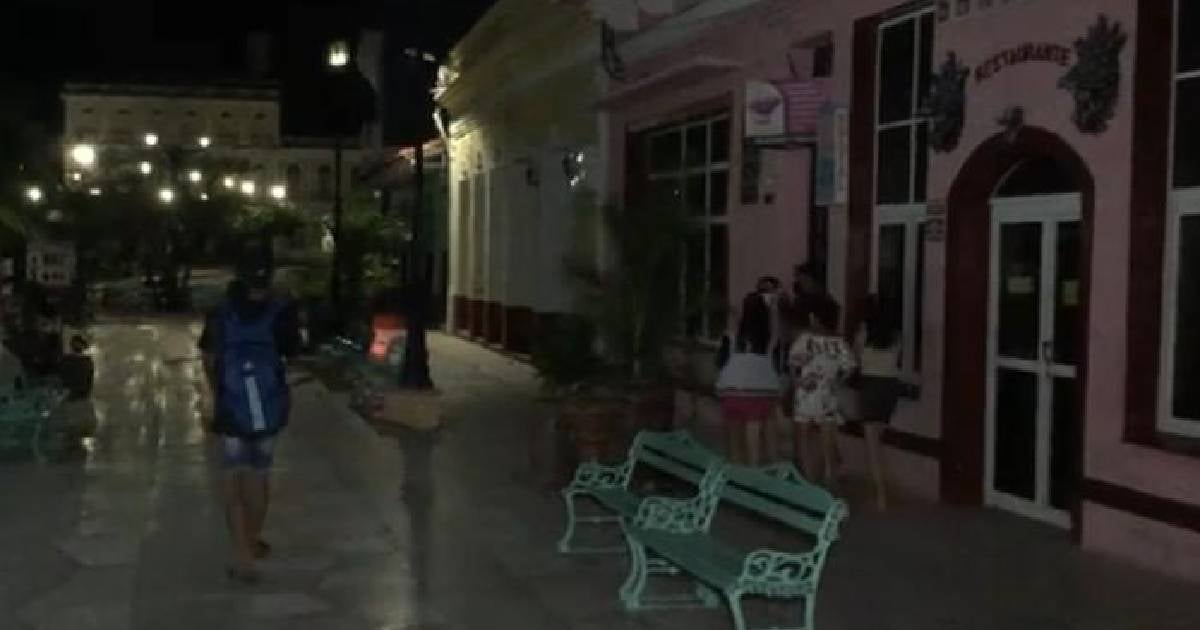
Recently, Sayli Alba Álvarez, a mother and cultural promoter residing in the city of Yayabo, described through her Facebook profile how power outages have become a norm and the darkness enveloping the city goes beyond electrical issues, casting a deep shadow over cultural life, safety, and the future of its youth.
“My city has died and I have run to hide,” declared Álvarez. “I can’t see my city. My city is erased. I didn’t see its park or my library.”
Cuba remains submerged in a constant energy crisis. For this Sunday, July 6, the Electric Union forecasted that blackouts will continue throughout the country. During peak hours, an impact of 1535 MW is expected.
Frequently asked questions about circuit 119 and the electrical crisis in Sancti Spíritus
Why does the 119 circuit of Sancti Spíritus receive more electricity?
The 119 circuit receives more electricity because it supplies the Hotel Los Laureles, where workers constructing the photovoltaic solar park in Cabaiguán are accommodated. Due to failures in its generator, it has been decided to protect this circuit during certain hours to ensure basic conditions such as water and electricity for these workers.
Does the protection of circuit 119 affect other circuits in Sancti Spíritus?
Although the Provincial Electric Company claims that this measure has not increased the level of impact in other circuits, residents of other circuits, such as 116 and 117, report frequent blackouts and difficulties in accessing basic services. The general perception among citizens is that the distribution of the service is uneven.
What is the current situation regarding blackouts in Sancti Spíritus?
In Sancti Spíritus, power outages can last up to 20 hours a day due to a lack of generation and fuel. The province is unable to implement predictable rotating schemes due to technical conditions and the fragility of the system, which makes power outages frequent and widespread.
What impact do solar parks have on the energy crisis in Cuba?
Although several solar parks have been built, they have not alleviated the energy crisis in the short term. Solar generation integrates into the National Electric Power System and does not directly supply local circuits, which limits its effectiveness in addressing the prolonged blackouts affecting the Cuban population.
Filed under: