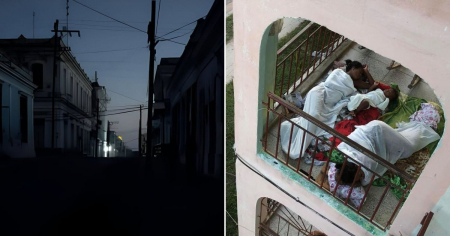
The Electric Union (UNE) reported that the National Electric System (SEN) will continue to experience disruptions throughout July 11, with planned electricity outages in several provinces of the country due to generation deficits.
According to the official report, on Thursday, blackouts were reported throughout the 24 hours, and the situation continued into the early hours of Friday. The greatest impact occurred at 10:00 p.m., with 1,509 MW out of service, although this did not coincide with the peak demand.
Today, the system has a generation capacity of only 2,080 MW, compared to a demand of 3,100 MW, resulting in a current shortfall of 1,054 MW. The UNE anticipates that by noon, the shortfall will remain at 950 MW.
Unit 2 of the Felton Thermal Power Plant is reported as malfunctioning, and maintenance is being performed on: Unit 8 of the Mariel Thermal Power Plant, Unit 2 of the Santa Cruz Thermal Power Plant, Unit 4 of the Cienfuegos Thermal Power Plant, and Unit 5 of the Renté Thermal Power Plant.
There are also thermal limitations with 426 MW out of service and issues due to a lack of fuel, leaving 74 distributed generation plants with 517 MW offline, as well as 5 engines in the Melones Patana with 85 MW and 5 engines in the Regla Patana with 40 MW, for a total of 642 MW affected by this issue.
During the peak nighttime hours, the Cuban electricity company forecasts a supply of 2,305 MW and an estimated demand of 3,580 MW. This would result in a deficit of 1,275 MW, with a potential impact of up to 1,345 MW, a figure similar to those recorded in recent days.
The energy generated by the country's 19 photovoltaic solar parks reached 1,703 MWh, with a maximum output of 401 MW recorded at noon, according to the UNE report.
The serious energy situation keeps the population on edge, as they face extensive daily blackouts amid the sweltering summer and the national economic crisis. However, while millions of Cubans live in darkness, unable to rest, the official press gives "advice" for combating insomnia.
We Will Overcome recommended that the population take herbal infusions, drink warm milk with honey, read books, or practice deep breathing before sleep. It also suggested taking evening walks, enjoying hot baths, and practicing relaxation techniques to achieve a restful sleep on nights like this 11J in Cuba.
Frequently Asked Questions about the Energy Crisis in Cuba
What is the main cause of blackouts in Cuba?
The main cause of blackouts in Cuba is the deficit in electricity generation due to breakdowns in thermoelectric units, scheduled maintenance of plants, lack of fuel, and thermal limitations. These deficiencies have left the National Electric System (SEN) unable to meet the electricity demand, resulting in prolonged and frequent blackouts throughout the country.
How is this energy crisis affecting the Cuban population?
The energy crisis severely impacts the Cuban population, causing extended daily blackouts that complicate essential activities such as cooking, using appliances, and preserving food. This situation also generates increasing discomfort among citizens, who face additional hardships due to the lack of effective solutions from the government.
What measures is the Cuban government taking to address the energy crisis?
The Cuban government has implemented measures such as scheduled power outages and prioritizing supply for essential services like hospitals. However, these actions have not been sufficient to resolve the generation deficit. The lack of investment in infrastructure and reliance on imported fuel are structural problems that have yet to be effectively addressed.
What is the current situation of the National Electric System (SEN) in Cuba?
The National Electric System (SEN) in Cuba is facing a critical situation, with a generation deficit ranging from 1,500 to 1,700 MW. This deficit is due to multiple factors, including breakdowns in thermoelectric plants, maintenance of units, and a lack of fuel. This situation has resulted in a continuous cycle of blackouts across the country, severely impacting the population and the economy.
Filed under: