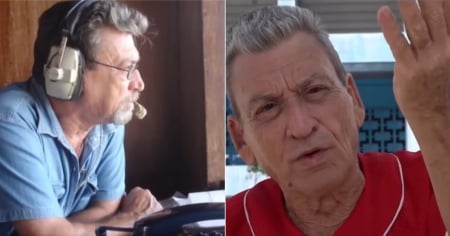
The Univisión journalist Javier Díaz sent a message to his colleagues who, from the state media in Cuba, continue to be –in his view– "direct accomplices" of the Castro dictatorship.
Four years after the social uprising on July 11, 2021, Díaz reaffirmed his critical stance against state-aligned communicators and urged them to "stand on the side of truth" before it is too late.
"My message from July 11, four years after the Cuban people finally awakened and took to the streets en masse in the main provinces and municipalities of the country, remains the same as the one I sent four years ago to journalists, broadcasters, and communicators," he began saying in a video posted on his Instagram account.
Díaz was emphatic in pointing out that those who work in state media can no longer hide behind the argument of "just doing their job."
"Anyone who currently works in the media, who appears in front of a newscast or an informational segment, does not simply become a teleprompter reader; rather, they have a strong complicity with the Cuban dictatorship by repeating the lies and the narrative that the regime wants the nation to receive in order to continue indoctrinating them," he declared.
The communicator urged those who still belong to the official information system to make a decision: either separate themselves from the regime or face the consequences when Cuba is free.
"The smartest thing is for you to find a way to leave the country, as others have done, or simply to side with the truth and establish yourself as an independent journalist within the Island. (…) The day Cuba is free, you will be judged by the same standards."
He also accused some communicators of directly benefiting from the system, just as the generals, ministers, and individuals who remain within the elite of the Cuban government do.
Díaz concluded his message with a call: "It is time for you to gradually raise your voice in favor of Cuba's freedom...".
The notice from July 11, 2025, is not the first that Javier Díaz has publicly directed to his former colleagues in the Cuban state media.
At the end of July 2021, he challenged Cuban television to explain "why so many professionals are leaving the Island in search of not only a better future but also freedom."
At that time, Díaz criticized the national news program for dedicating reports to discredit journalists who currently work in independent or international media from exile, pointing out that the public can already distinguish between truth and propaganda.
"For me, it is an honor that my family and the people in Cuba who know me see me and remember my time on national television. But I also want them to explain why this 26-year-old young man decided to leave his homeland, his professional career in Cuba, his family, and his friends […] to seek a better future in another nation," he stated in another post.
On a previous occasion, Díaz addressed the journalists Carlos Manuel Alonso, Humberto López, Oliver Zamora, Froilán Arencibia, and Talía González, urging them to take an ethical stand in the current state of the country.
In one of his most controversial statements, he accused them of being "accomplices in homicides" for their role in the narrative that justifies state repression during and after 11J, including the denial of reports about violent arrests and abuses by special forces.
Javier Díaz, who was once a face on Cuban television, has stated that he chose to work as a broadcaster instead of a journalist on the Island specifically to avoid being part of the propaganda apparatus.
Since then, his figure has become one of the most active voices of the Cuban exile community in defense of press freedom and human rights in his homeland.
Frequently asked questions about Javier Díaz's criticisms of state journalism in Cuba
What is Javier Díaz's main message to the official Cuban journalists?
Javier Díaz urges Cuban state journalists to side with the truth and distance themselves from the Cuban dictatorial regime. He emphasizes that continuing to work in state media makes them complicit in the oppressive system by disseminating propaganda and lies that indoctrinate the Cuban people.
Why does Javier Díaz criticize the state media communicators in Cuba?
Díaz criticizes the communicators of state media because he believes that by repeating the regime's narrative, they are complicit in the Cuban dictatorship. According to him, these journalists are not mere teleprompter readers, but active participants in the dissemination of lies that perpetuate oppression in Cuba.
What options does Javier Díaz suggest for Cuban journalists in state media?
Javier Díaz suggests that journalists find ways to leave the country or become independent journalists within Cuba. This recommendation is based on the idea that they should adopt an ethical stance and contribute to press freedom and the truth instead of serving the regime.
What has Javier Díaz's journey been like since he left Cuba?
Javier Díaz emigrated to the United States in 2016 and has worked for Hispanic media outlets, currently being a recognized face of Univisión in Miami. Despite his success, Díaz has maintained a critical stance toward the Cuban regime and uses his platform to denounce the lack of press freedom and human rights in Cuba.
Filed under: