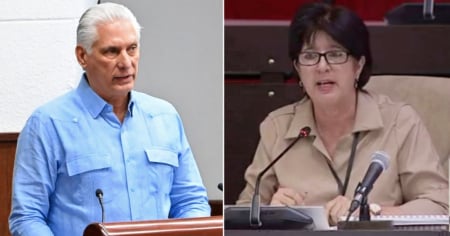
Marta Elena Feitó Cabrera, Cuba's Minister of Labor and Social Security, denied this Monday the existence of beggars in Cuba and criminalized those who seek food or alms on the streets.
“We have seen people who appear to be beggars, but if you look at their hands and the clothes they wear, they are disguised as beggars. They are not beggars; in Cuba, there are no beggars. They have found an easy way of life to make money without adhering to the formalities that should be observed,” said the official during one of the working committees of the regime's parliament, which is currently in session.
Feitó Cabrera labeled the homeless individuals as drunks and seekers of "an easy life," without addressing the structural causes of the phenomenon, which would be expected from someone in his position.
"Typically, we refer to wandering behavior as anything. For instance, when there's someone on the street cleaning windshields (...) it's a person who has sought an easy way of living, cleaning windshields at a traffic light, and likely afterward, with that money, they go to buy alcoholic beverages at the corner," he remarked.
Finally, the minister allowed herself to be ironic about a growing phenomenon that is undeniable evidence for anyone who walks the streets of Cuba.
"The divers are in the water, those people who are in the garbage bins, throwing out trash, sifting through the garbage on the ground, looking for cans. Those people, as some say, 'are not looking for food in the dumpsters.' That's not true either. Those are patterns they try to impose on us," he stated.
The official went so far as to accuse “those people” who “are recovering raw materials” of being “illegal self-employed workers (…) who are violating tax laws.”
The words of the minister, as is often the case with the official rhetoric of the regime, contrast sharply with a reality where 89% of Cuban families suffer from extreme poverty, according to the report from the Cuban Observatory of Human Rights (OCDH).
This time, they even contradict their own previous statements. In February of this year, Feitó Cabrera, in front of Miguel Díaz-Canel, admitted that in Cuba, as of that date, 1,236 communities live in misery.
The official stated, on the other hand, that 96% of the issues related to extreme poverty in the country are "in the process of integral transformation," precisely as Cuba is experiencing one of the worst economic crises in its history.
Last year, the firm DatoWorld, a notable international electoral observatory, indicated that Cuba is the poorest country in Latin America.
The country has a poverty rate of 72%, and this alarming figure places it at the forefront of countries in the Latin American region, according to information shared on DatoWorld's official X account.
Last year, Cuba was also classified as the country with the most miserable economy in the world, according to the Annual Index created by American economist Steve H. Hanke, a professor at Johns Hopkins University.
Frequently Asked Questions about the Situation of the Homeless and Poverty in Cuba
Are there beggars in Cuba according to the government?
The Minister of Labor and Social Security of Cuba, Marta Elena Feitó Cabrera, denied the existence of beggars in the country, stating that the people seen on the streets "disguised as beggars" have found an easy way of life and do not work with the necessary formalities. However, this claim contrasts with the visible reality on the streets of Cuba, where many people live in misery.
What are the causes of extreme poverty in Cuba?
Extreme poverty in Cuba has multiple causes, including the regime's ineffective economic management, inflation, shortages, and the lack of effective public policies. The Cuban government tends to blame external factors such as the U.S. embargo and familial neglect, but the reality is that internal policies have significantly contributed to this situation.
What has the Cuban government done to address the issue of the homeless?
The Cuban government has implemented a protocol to manage individuals with "wandering behavior", focusing on their relocation to social protection centers. However, these measures have been criticized for not addressing the structural causes of poverty and for being more about social control than effective assistance.
How has the Cuban population reacted to the government's statements about poverty?
The Cuban population has reacted with criticism and skepticism to government statements denying the existence of beggars and attributing poverty to external factors. Many Cubans point out the lack of opportunities, low wages, and social insecurity, believing that these are the real factors exacerbating the poverty situation in the country.
Filed under: