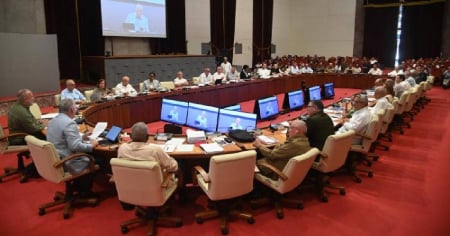
The Cuban government officially acknowledged that the national economy contracted again in 2024, with a decline in Gross Domestic Product (GDP) of 1.1% at constant prices, as revealed this Monday by the Minister of Economy and Planning, Joaquín Alonso Vázquez, during a working session of the Parliament.
Although the figure represents a slight improvement compared to the collapse recorded in 2023, the data—revealed in the sessions leading up to the Fifth Ordinary Period of Sessions of the Tenth Legislature of the Parliament—confirms the sustained economic contraction trend that the country is experiencing, as reported by the official newspaper Granma.
In his own words, the head of the Economy admitted that "what is currently entering the country is not enough" to guarantee even the most basic resources such as supplies, fuel, food, or maintenance of the energy infrastructure.
The statement, made during the Economic Affairs Commission of the National Assembly of People's Power, portrays a reality that millions of Cubans experience every day: rampant inflation, chronic shortages, collapse of the electrical system, and widespread loss of purchasing power.
"We have lacked energy and we are short on fuel: without energy and without fuel, it is very difficult for us to develop," Alonso stated, who also acknowledged that maintenance on the thermoelectric plants could not be carried out, nor could the operability of the distributed generation system be guaranteed, which is stalled due to a lack of parts and supplies.
Adding to this concerning situation is the fact that goods exports barely reached 62% of the target during the first half of 2025. Although there were occasional upticks in categories such as tobacco, lobster, and seafood products, the drop in nickel exports, along with logistical, energy, and supply difficulties, have severely impacted export performance.
According to Alonso, foreign currency earnings from exports fell by 7% compared to the same period last year.
Meanwhile, the foreign exchange market remains fragmented, external debt continues to accumulate, and the country still lacks access to development credit.
"We do not have enough resources to supply all the necessary inputs or the parts needed to keep the productive sectors running," lamented the minister.
Regarding food production, the situation is equally critical. Although some minimum capacities have been recovered, the fulfillment of plans relies on projections adjusted to resource scarcity, and egg production has been identified as one of the most impacted areas of the agricultural sector.
The official speech also acknowledges that the current figures "do not meet the demands of the population," nor do they cover the deficits in imports, which is why plans for the second half of the year are being reevaluated.
In this context, the government assures that it continues to prioritize "social policy" and that over 300,000 people have received financial assistance to cover the regulated family basket, while another 18,000 vulnerable families received resources amounting to over 270 million pesos.
However, these figures pale in comparison to the magnitude of the economic deterioration and the deep discontent among the populace.
During his speech, President Miguel Díaz-Canel acknowledged the seriousness of the situation and questioned the current economic approach: “What the country is receiving today is not enough for supplies, food, or to create a functioning market.”
He warned that if the new financing schemes do not generate real foreign currency, "we will have only shifted money from one place to another without solving anything," and he also emphasized that the lack of foreign currency hinders the stabilization of the exchange market.
“What is going to motivate people to sell foreign currency if the national currency they receive has nothing to be spent on?” Díaz-Canel asked in one of the most candid statements about the collapse of the current economic model.
In summary, the Cuban economy continues to be in freefall, with a productive model lacking any visible recovery capacity, planning that is disconnected from reality, and a government management that acknowledges the symptoms but does not provide structural solutions.
Meanwhile, millions of Cubans face the weight of a crisis every day that can no longer be masked with speeches or disguised with promises.
Contradictorily, in 2024, the Cuban government announced a projection of 1% economic growth for the year 2025, as reported by the relevant minister during a session of the National Assembly.
This goal, which may seem modest at first glance, was set against a backdrop of a deep economic crisis that has impacted all productive sectors and severely affected the quality of life of the population.
The minister explained that this growth forecast was based on the supposed recovery of tourism, the increase in income from exports, and the reactivation of productive and industrial activities, along with the imagined – and unachieved – stabilization of the National Electric System (SEN).
However, the news of the contraction is not surprising. In May, the Cuban regime officially acknowledged the stagnation of the national economy.
Los resultados económicos al cierre de marzo estuvieron marcados por el incumplimiento de planes, caídas en sectores estratégicos y una zafra azucarera que sigue en números rojos.
Frequently Asked Questions about the Economic Crisis in Cuba
What is the current state of the Cuban economy in 2025?
The Cuban economy is in a critical situation, with a contraction of 1.1% of GDP in 2024, a decline in exports, uncontrolled inflation, and chronic shortages. The government acknowledges that revenues are insufficient even for the most basic resources, such as food and fuel.
What problems does Cuba's energy system face?
The Cuban energy system is in collapse due to a lack of fuel and parts for the maintenance of thermoelectric plants. This has led to prolonged blackouts that affect production and the daily lives of Cubans.
How does the economic crisis affect food production in Cuba?
The food production in Cuba is in a critical situation, unable to meet the demands of the population. Although the government claims there is growth, the reality shows a persistent shortage of basic products such as eggs and milk.
Why is the foreign exchange market in Cuba still fragmented?
The Cuban currency market remains fragmented due to the existence of multiple exchange rates and the lack of an effective floating rate. The scarcity of foreign currency and the low supply of goods complicate a reorganization that the government has been unable to implement.
What measures is the Cuban government taking to address the economic crisis?
The Cuban government has acknowledged the seriousness of the crisis, but its measures are limited to redistributing the scarce existing resources, without providing effective structural solutions. The lack of foreign currency and a centralized economic system are significant barriers.
Filed under: