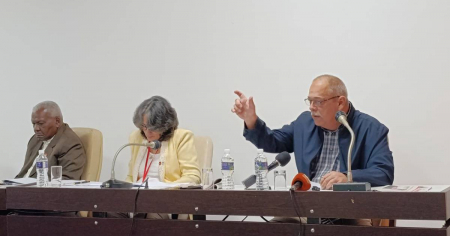
In one of his starkest statements in recent years, the Cuban leader Miguel Díaz-Canel admitted this Monday that the country's current income is not even enough to buy the most basic raw materials needed for national production.
“We only redistribute scarcity”, he said before the Commission on Economic Affairs of Parliament gathered at the Palace of Conventions, in a gesture that illustrates the structural collapse of the Cuban economy and the absence of a clear direction to confront the profound crisis.
Despite the technocratic tone and calls to "transform the approach" to economic management, Díaz-Canel acknowledged that the country lacks sufficient foreign currency to sustain even an internal market in national currency or a functional exchange market. "The core of the problem is wealth generation," he insisted, while official data show a widespread deterioration across all sectors.
Despite the seriousness of what was said, the government continues to rely on repetitive rhetoric and measures that fail to reverse the economic decline. Díaz-Canel himself admitted that the government's strategy has so far been to redistribute the little that exists, without being able to generate wealth or stabilize the economy: "We often try to solve problems by redistributing the scarce resources available", he said.
The president once again appealed to future proposals: a government program that will be presented by the prime minister at the Fifth Ordinary Session of the Tenth Legislature of Parliament, scheduled for next Wednesday, July 16; self-financing schemes for selected sectors, and promises of productive linkages.
However, so far, none of these measures have succeeded in changing the course or alleviating shortages, inflation, or the decline in purchasing power.
While high-ranking officials emphasize the importance of "integrating into international markets" and attracting foreign investments, the reality for the average Cuban is one of daily survival in a country with insufficient food, constant blackouts, and prices that do not reflect the salaries.
Díaz-Canel proposed to redefine imports and exports, improve the management of foreign trade, and "take advantage of opportunities" in blocks like the BRICS or the Eurasian Economic Union. However, beyond the diplomatic gestures and reformist intentions, what resonates in his words is the acknowledgment that the current economic model in Cuba is unsustainable.
“We must increase domestic production and make our products competitive,” he stated. However, without supplies, without energy, without liquidity, and with a bureaucratic and centralized structure that has proven inefficient, the question is: with what means will they do it?
This is not the first time that Díaz-Canel acknowledges the government's mistakes and admits that the country's income is insufficient. Back in December 2023, during a similar session of the Parliament's Economic Affairs Commission, he stated that “if the blockade is lifted, there are a pile of solutions”, attributing most of the crisis to the U.S. embargo, while also acknowledging the existence of “mistakes made” that have caused internal distortions.
On that occasion, he avoided mentioning the need for self-production and limited himself to justifying the shortages with the argument of decreased remittances, loss of credits, and reduction in fuel shipments.
Meanwhile, at that time, his Minister of Economy, Alejandro Gil, warned that inflation would end 2023 with an increase close to 30%, and the Parliament acknowledged the failure of the “Tarea Ordenamiento”, one of the largest experiments that turned into an economic failure for the Cuban government in recent years.
Filed under: