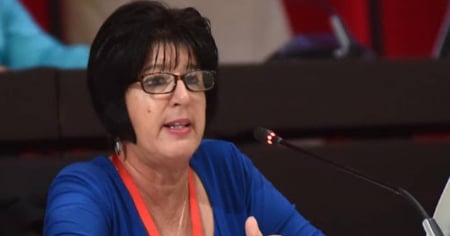
The Cuban Prime Minister, Manuel Marrero Cruz, joined in criticisms this Tuesday that were late and ambiguous, regarding the recent statements made by the Minister of Labor, Marta Elena Feitó Cabrera, who denied the existence of beggars in Cuba and criminalized poverty in a speech that has caused widespread outrage both on and off the island.
In a series of tweets posted on his official account, Marrero stated that attention to vulnerable individuals "has always been and will continue to be a priority of the Revolution," and urged not to be "superficial" when analyzing phenomena such as homelessness.
He also stated that sensitivity to vulnerability "cannot be mere discourse, it must be action," and he defended that his government works to ensure that no Cuban is left unsupported.
However, his intervention comes after a wave of criticism on social media and the similarly vague statement by Miguel Díaz-Canel, which many interpret as a new official response strategy to manage the fallout without acknowledging political responsibility or implementing real consequences.
An attempt to "put out the fire" without saying sorry
Marrero's message has been seen as an attempt to extinguish the political fire ignited by Feitó's words, who on Monday, during a parliamentary commission, stated that there are no beggars in Cuba, only "disguised" individuals who choose a "easy life" instead of working.
The minister not only denied the visible poverty in the streets of Cuba but also ridiculed those who rummage through garbage, clean windshields at traffic lights, or beg, even accusing them of being "illegal self-employed workers."
Her statements contrast with the figures from the Cuban Observatory of Human Rights, which estimate that 89% of households on the island live in extreme poverty, and also with the official data she herself presented in February before Díaz-Canel, when she acknowledged that more than 1,200 Cuban communities live in conditions of misery.
Social media has been the stage for a resounding rejection, not only towards the minister but also towards the political system that allows such dehumanizing rhetoric.
Intellectuals, artists, journalists, and ordinary citizens have reacted with anger and sadness. Musician Dagoberto Pedraja shared images of people sleeping among garbage. Comedian Ulises Toirac condemned the criminalization of poverty. Activist Yuliet Teresa recounted her encounter with a woman suffering from mental disorders who was sleeping in a doorway, stating, “One does not sleep disguised as a beggar, but with a soul broken by poverty.”
The actor Luis Alberto García pointed to the complicit silence of the parliament: “Not a single deputy stood up to the minister. We are in a very bad place, Camilo.”
The citizens not only demanded a public apology but also real policies, concrete actions, and above all, respect for the dignity of those who suffer.
But neither Díaz-Canel nor Marrero have apologized to the Cuban people. Not a single high-ranking official has acknowledged the real existence of begging, nor have they announced effective support programs, let alone a process of accountability for the minister.
As journalist Yirmara Torres succinctly put it: “Are they never going to apologize to the Cuban people?”
Frequently Asked Questions about the Statements of the Minister of Labor of Cuba and the Government's Reaction
What did the Minister of Labor of Cuba declare about beggars?
The Minister of Labor, Marta Elena Feitó Cabrera, denied the existence of beggars in Cuba, stating that those who ask for alms or seek food on the streets are "disguised" as beggars and choose an "easy life" instead of working. These statements have sparked outrage both within and outside of Cuba, as they are seen as a criminalization of poverty.
How has the Cuban government reacted to the controversy generated by the minister's statements?
The prime minister, Manuel Marrero, and president Miguel Díaz-Canel have issued statements aimed at softening the impact of the minister's words. Marrero emphasized that caring for vulnerable individuals is a priority for the government, and Díaz-Canel pointed out the lack of sensitivity in addressing vulnerability, but neither has apologized nor acknowledged the real existence of begging in Cuba.
What criticisms have arisen after the statements made by the Cuban Minister of Labor?
Criticism has been strong, coming from both citizens and public figures, who believe that the minister's statements are insensitive and disparaging. It has been pointed out that her words ignore the reality of extreme poverty on the island, and there have been calls not only for a public apology but also for effective policies to address the situation of vulnerability.
What is the poverty situation in Cuba according to recent reports?
According to the Cuban Observatory of Human Rights, 89% of households in Cuba live in extreme poverty. Furthermore, Minister Feitó had previously acknowledged that more than 1,200 communities live in conditions of misery, which contrasts with her recent statements denying the existence of begging.
Filed under: