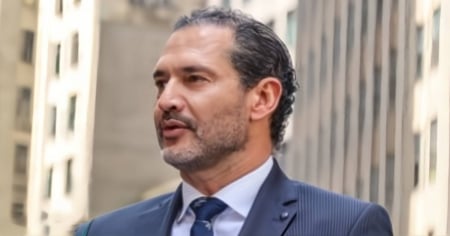
Alejandro Fernández Feitó, son of the former Minister of Labor and Social Security of Cuba, Marta Elena Feitó Cabrera, has decided to publicly break with the Cuban regime and his mother's political persona.
Since his new residence in Florida, where he emigrated in 2024 through the humanitarian parole program initiated by the Joe Biden administration, the young man has openly expressed his disagreement with the system governing the island.
“My political vision is completely opposite”, asserted Fernández Feitó in statements to journalist Mario J. Pentón for Martí Noticias.
"I cannot take responsibility for what she says or has been told to say," he added, referring to his mother, whose recent intervention in the National Assembly of People's Power sparked a wave of outrage both inside and outside Cuba.
A forced resignation following the scandal
The former minister sparked widespread backlash after stating in the Assembly that "there are no beggars in Cuba", but rather people who "are disguised" and have chosen "an easy way of life."
His words, harshly criticized on social media and in independent media, not only outraged the public but also prompted a noticeable reprimand from the leader Miguel Díaz-Canel.
Shortly thereafter, the Political Bureau of the Communist Party accepted the resignation of Marta Elena Feitó Cabrera.
However, her departure from office did not stop the criticism of a system that denies the country's structural poverty while thousands of Cubans continue to emigrate in search of basic freedoms and dignified living conditions.
In that context, his son decided to raise his voice and draw a line both personally and ideologically. “I cannot take responsibility for what she says or for what she has been told to say; my political view is completely opposed,” Alejandro reiterated.
"There is no future on that island."
With a technical background—he is an engineer by training—and work experience in state and military entities such as Cubatur and the technology company DATYS, Fernández Feitó explained that his decision to emigrate was driven by a “generational conviction”, rather than a specific political urgency.
“With humanitarian parole, I saw the opportunity of a lifetime to finally have the freedom I never had. There is no future on that island. Everyone leaves in search of the rights and opportunities that are denied to them in their own land,” he declared.
Alejandro has removed any professional connection to the Cuban state apparatus from his social media. He explained that he never had an active political involvement and was not affiliated with any structure of power.
“In Cuba, one knows that for expressing what they think, they could end up without a job or in prison. But there comes a moment when one can no longer endure it.”, he confessed.
The weight of repression and the admiration for the brave
The young man also shared how his character and environment influenced his decision to stay out of any direct political confrontation while living on the island.
"I never participated in any violent activity in Cuba because it goes against my nature, which is calm and extremely introverted, and I also know that in Cuba they can ruin your life in an instant," he explained.
Despite this, Fernández Feitó expressed deep respect for those who, despite the risks, decided to openly confront the regime.
“I have great admiration for all those who have had the courage to stand up against the dictatorship, and today are imprisoned in a jail within the prison island,” he stated.
Moreover, when referring to his personal aspirations, he emphasized the structural shortcomings of the country where he was born.
"I am a person with clear aspirations and life goals: from wanting to be able to travel and have a salary that doesn’t make me miserable, to basic things like having electricity or water in my own home," he said.
A growing trend
The case of Alejandro Fernández Feitó is not isolated. In recent years, several children of high-ranking officials in the Cuban regime have emigrated to the United States.
Some have done so quietly, while others, like him, have chosen to clearly express their ideological break from the system that their parents helped uphold.
In this regard, journalist Mario Pentón emphasized that Fernández Feitó “condemned the Cuban dictatorship” and highlighted the use of that term by the young man, who reaffirms that his political stance is in stark contrast to that of his mother.
Frequently asked questions about Alejandro Fernández Feitó's break with the Cuban regime and his mother's statements
Why did Alejandro Fernández Feitó break with the Cuban regime and his mother?
Alejandro Fernández Feitó decided to break away from the Cuban regime and the political figure of his mother, Marta Elena Feitó Cabrera, due to his disagreement with the political system in Cuba. He stated that his political vision is completely opposed and that he seeks the freedom and opportunities that were denied to him on the island. His break is also connected to his mother's controversial statements, which denied the existence of homeless people in Cuba and provoked public outrage.
What controversial statements did Marta Elena Feitó Cabrera make that led to her resignation?
Marta Elena Feitó Cabrera, the former Minister of Labor and Social Security of Cuba, stated in the National Assembly that in Cuba "there are no beggars," but rather people "dressed as beggars" who have chosen an "easy way of life." These statements were seen as insensitive and disconnected from the social reality of the country, provoking a wave of criticism and her subsequent resignation.
How has the Cuban government reacted to the statements of former minister Feitó?
The Cuban government, through the Political Bureau of the Communist Party and the Council of State, accepted the resignation of Marta Elena Feitó Cabrera following her controversial statements. President Miguel Díaz-Canel also commented on the "lack of sensitivity" in the approach to vulnerability, although he did not directly mention the former minister. This reaction has been seen as an attempt to mitigate the political damage caused by her words.
What has been the reaction of the Cuban population and the media to Feitó's statements?
The Cuban population and the media have reacted with outrage to the statements made by Marta Elena Feitó Cabrera. Intellectuals, activists, and citizens have fiercely criticized her words, considering them an affront to the most vulnerable. Furthermore, campaigns have been launched to demand her dismissal, and social media has been flooded with messages denouncing the disconnect between the official discourse and the reality of the Cuban people.
Filed under: