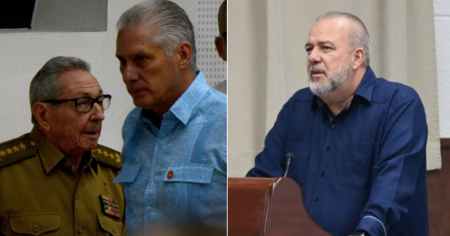
The closing session of the National Assembly was marked this Friday by a show featuring Raúl Castro Ruz shouting in support of Miguel Díaz-Canel. The performance coincided with the controversial constitutional reform to eliminate the age limit for the presidency.
The enthusiastic "Long live Díaz-Canel!" and "Long live the Revolution!" from Raúl Castro were the closing remarks of the Fifth Ordinary Period of Sessions of the National Assembly of People's Power, generating reactions on social media.
The scene was shared in an official post by the Presidency of Cuba, which described the sessions as "a true Assembly of the people."
Díaz-Canel, standing behind the former president, responded with a "Long live Raúl!", completing a political spectacle aimed at publicly reaffirming unity in the leadership of the Cuban regime, amidst a week marked by controversies.
Express reform: The age limit to be president is abolished
On the same day, without prior public consultation, the National Assembly approved a reform to Article 127 of the Constitution, eliminating the 60-year age limit to be elected president in a first term.
The new wording opens the door to older candidates, arguing the case for "aging population" and the need to leverage "the experience, loyalty, and commitment" of veteran leaders.
The process was driven by the State Council, reviewed by the Political Bureau of the Communist Party, and directly proposed by Raúl Castro, as confirmed by Esteban Lazo, president of the Parliament.
The government justified the measure, arguing that a referendum is not necessary since it does not involve a reduction of mandate nor does it directly affect the foundations of the system, as outlined in Article 228 of the Constitution.
The scandals, empty speeches, and a staged closure
These legislative sessions were also marked by the scandal of the Minister of Labor, following her controversial statements claiming that there are no beggars in Cuba, but rather “people disguised” as poor.
The parliament applauded the statements of Marta Elena Feitó, without directing a single remark to her, but when her speech was released to the media, a wave of criticism erupted on social media. This forced Díaz-Canel to speak out against the official, who was ultimately removed from her position.
Raúl Castro took advantage of the closing of the Assembly to publicly express his support for the current leader, which many interpret as a gesture of control amid the social, economic, and political turmoil facing the island.
A tailored reform
Until now, Article 127 stipulated that to be president of the Republic, one must be between 35 and 60 years old, be a Cuban citizen by birth, have no other citizenship, and be in full enjoyment of civil and political rights.
The new formulation of the law will allow older leaders, such as Díaz-Canel himself at 65 years old, to be reelected or nominated without legal restrictions, paving the way for political continuity without generational alternation.
The regime speaks of “responsibility for the future of the nation,” but many Cubans watch with concern as power structures are reinforced without citizen consultation, while the country’s economic and social crisis deepens.
Frequently Asked Questions about the Constitutional Reform and the Political Situation in Cuba
What is the new constitutional reform in Cuba related to the presidency?
The National Assembly of Cuba approved a reform to Article 127 of the Constitution, removing the 60-year age limit for being elected president for a first term. This allows individuals over 60 years old, such as Miguel Díaz-Canel, to be re-elected or nominated without age restrictions.
Why does the Cuban government justify the elimination of the age limit for being president?
The Cuban government argues that the removal of the age limit is due to "population aging" and the need to leverage the "experience, loyalty, and commitment" of veteran leaders. This decision did not require public consultation, as it does not directly affect the foundations of the system, according to Article 228 of the Constitution.
What happened with the Minister of Labor of Cuba and her statements about begging?
The Minister of Labor, Marta Elena Feitó Cabrera, resigned after stating that in Cuba there are no beggars, only people "disguised as poor." These statements caused an uproar both in Cuba and internationally, and were widely criticized for their lack of empathy.
What was Raúl Castro's role in the recent National Assembly of Cuba?
Raúl Castro starred in a political spectacle at the National Assembly, shouting slogans in support of Miguel Díaz-Canel. This was interpreted as a gesture of control and reaffirmation of unity in the leadership of the Cuban regime, amid political controversies and constitutional reform.
Filed under: