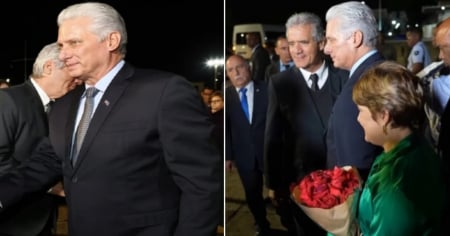
Lis Cuesta, wife of Cuban ruler Miguel Díaz-Canel, reacted with sarcasm this Saturday to the sanctions imposed by the United States government that prohibit entry to that country for both the president and his immediate family members, including her.
In a tweet posted on his official account, Cuesta wrote: “.@DiazCanelB has already been in NY, hit the streets, and received love. #It’sDone. They’re arriving late.” The message, accompanied by a video of the leader walking down a New York street surrounded by bodyguards, is interpreted as a provocation that ignores the seriousness of the sanctions and the suffering of the Cuban people.
The publication comes just 24 hours after the U.S. State Department formally sanctioned Díaz-Canel and his inner circle for their direct involvement in "serious human rights violations," especially following the brutal crackdown on July 11, 2021. The sanctions include the revocation of visas and a ban on entry into the country, extended to their immediate family members.
The mocking tone of Cuesta's tweet has generated outrage among Cubans both on the island and abroad, who see it as a demonstration of the disconnection and cynicism of the ruling elite. While hundreds of thousands of Cubans face extreme obstacles to legally emigrate or reunite with their families through humanitarian parole, the so-called “not first lady” publicly boasts about having been on U.S. soil.
"For her, it's just a story; for us, it's a verdict," commented a user from Miami on social media. Others pointed out that Cuesta was never officially invited to the delegations, but she always appears alongside Díaz-Canel on his trips, without being held accountable or representing any position.
A history of travels and privileges
Lis Cuesta has accompanied Díaz-Canel on at least two official visits to New York, in 2018 and 2023. Her presence on these trips has been the subject of criticism, particularly because she is a figure without a recognized institutional role in Cuba, where there is not even an official title of "First Lady."
In his first official visit in 2018, both were seen dancing casino in Harlem, amidst an official agenda that included speeches at the UN and diplomatic meetings. In 2023, an incident occurred in which the U.S. Secret Service had to urgently evacuate the Cuban leader from a religious event.
Sanctions and their symbolism
Although many believe that the sanctions are more symbolic than effective, the decision sets a precedent: it is the first time that Díaz-Canel has been personally sanctioned by the U.S., placing him on the same list as figures like Raúl Castro. The measure responds to the anniversary of July 11 and aims to send a message of support to those who protested in Cuba and remain imprisoned to this day.
Washington also sanctioned the Minister of Defense, Álvaro López Miera, and the Minister of the Interior, Lázaro Alberto Álvarez Casas, along with their families. Furthermore, it expanded its list of banned hotels due to their links to the military conglomerate GAESA.
Between repression and arrogance
While in Cuba blackouts, shortages, and political repression continue, the ruling elite seems more concerned with maintaining its triumphalist narrative. Díaz-Canel himself reacted to the sanctions with a message that blends victimhood and propaganda: “What bothers the US about #Cuba is our true independence, that we have free healthcare and education.”
For many Cubans, that rhetoric sounds empty in the face of a reality of resource-strapped hospitals, classrooms without teachers, and an economy on the brink of collapse.
And now, Lis Cuesta’s mockery only reinforces the perception that the power elites live in a bubble of impunity and privilege, entirely disconnected from the suffering of the people they claim to represent.
Frequently asked questions about the sanctions on Díaz-Canel and Lis Cuesta
Why did the United States sanction Miguel Díaz-Canel and his wife Lis Cuesta?
The United States has sanctioned Miguel Díaz-Canel and his wife Lis Cuesta for their involvement in serious human rights violations, particularly following the repression of the protests on July 11, 2021, in Cuba. These sanctions include a travel ban and the revocation of visas, aiming to hold the Cuban regime accountable for the systematic repression against dissenters.
How did Lis Cuesta react to the sanctions from the United States?
Lis Cuesta reacted to the United States sanctions with a tone of mockery and provocation. In a tweet, she mentioned that Díaz-Canel had already been in New York, suggesting that the sanctions were coming too late. This reaction was perceived as a disconnection and cynicism by the ruling elite in the face of the suffering of the Cuban people.
What is the impact of the sanctions on Cuba's ruling elite?
The sanctions imposed by the United States are more symbolic than effective, but they set a precedent by personally sanctioning Díaz-Canel and high-ranking officials of the Cuban regime. These measures aim to send a message of support to those who protested in Cuba and are still imprisoned. Additionally, they could prevent Díaz-Canel from attending international events, such as the UN General Assembly.
How has the Cuban government reacted to the U.S. sanctions?
The Cuban government has reacted to the U.S. sanctions with a tone of victimization and ideological defiance. Díaz-Canel and other officials have attempted to portray the measure as an act of arrogance and impotence on the part of Washington, claiming that they will not succeed in bending the will of the Cuban people. However, this rhetoric is seen as hollow in light of the crisis facing the island.
Filed under: