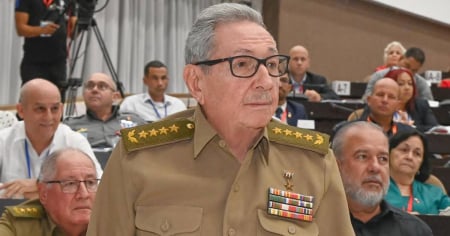
Miguel Díaz-Canel delivered a speech this Friday at the closing of the Fifth Ordinary Period of Sessions of the National Assembly of People's Power, where he blended revolutionary slogans, references to the United States as a historical enemy, and a series of controversial statements, due to their contradiction with the reality of the country.
A large part of his address was dedicated to reiterating familiar formulas, but there were phrases that stood out for their symbolic weight, for the starkness with which they described the current situation, or for reaffirming ideological control. These are the most controversial, grouped by central themes.
Dollarization and social inequality
One of the most striking statements was his explicit acknowledgment that Cuba has entered a process of dollarization, something that for years was denied or downplayed by the authorities.
"We have been forced to accept the partial dollarization of the economy, which undoubtedly benefits those who possess certain capital resources or receive remittances and leads to an undesirable widening of the gaps that define social inequality," he said.
It is one of the few official recognitions that the country's economic situation benefits a minority, while leaving the majority of Cubans who do not have access to foreign currency in a position of increasing vulnerability.
Admission of the collapse in basic services
The ruler provided a direct description of the collapse of public services in Cuba. In the list of calamities, he mentioned:
The import capacity for staple food items and the fuels necessary for electricity generation and the functioning of the economy is limited. There is a scarce availability of medications, a decrease in transportation services, solid waste collection, and water supply.
The regime acknowledged the "harsh reality that the people face every day," a situation extensively documented by the independent press, but did not present any concrete solutions to these problems.
Improvements in the economy?
Díaz-Canel attempted to present an image of partial fiscal recovery after a very negative year (2023), thanks to better revenue collection and spending control, which allows him to announce alleged social improvements.
"During the first four months of this year, we had a surplus, and so far, the current account is closing without a deficit, something that hasn't been achieved in more than ten years," he said.
However, he avoided delving into the structural effects of the economic crisis, such as inflation, low productivity, or dependence on dollarization, and shifted the responsibility for the current situation onto the U.S. embargo.
On vulnerable sectors in Cuba: Are they protected?
When referring to the most affected Cubans in the current crisis, Díaz-Canel acknowledged that salaries are insufficient in Cuba and urged a focus on better wealth redistribution in the country.
"We must enhance the effectiveness of the redistributive social function of the State with public and fiscal policies that, without stifling solutions, prevent the concentration of wealth in the hands of a few, thereby increasing inequality and poverty," he said.
Additionally, he requested to "pay close attention to inflation which, although showing a slight slowdown, is still very high, limiting the purchasing power of workers' wages and the lower income of pensioners and retirees."
"The main focus of fiscal policy is and will continue to be to address those who are suffering the most from the country's difficult situation," he stated. Everything remains empty rhetoric because he was unable to comment on what the plan for urgent measures that would benefit vulnerable individuals will be.
Blame the external enemy
Díaz-Canel insisted several times that the main causes of the crisis are not internal. He made it clear by stating, "the main obstacle to achieving it is external," referencing the U.S. embargo.
"The Cuban economy operates under many risks for any decision, largely due to the fierce enemy persecution. We cannot add more to the inherent insufficiencies," he said.
This approach reinforces the narrative of the Cuban government, which blames the "blockade" for the country's structural shortcomings, without delving deeply into management errors, institutional corruption, or the deterioration of the socialist production model.
Ideological control in cyberspace
Díaz-Canel also demanded that the government take the ideological offensive on social media. He ordered to "seek international alliances to break the media blockade; promote sovereign technological solutions and, increasingly, build an articulated cyberspace of emancipation".
The regime believes it is engaged in a "battle on the internet." It denounced alleged "discrediting operations against the country," driven by influencers' networks, independent media, and even by "algorithms that amplify negative narratives, digital weapons such as bots and fake accounts."
These expressions reveal the government's intention to maintain an increasingly tight control over the public narrative on social media, digital platforms, and independent media, in a context where digital dissent has gained space and influence.
Lack of internal self-criticism
Díaz-Canel reiterated that “the import mentality has eroded” the Cuban economy for years and has been an obstacle to the country's development, but this comment was not accompanied by a deep reflection on the responsibilities of the State or its leadership.
He also did not mention the mass emigration, the impact of repression, or the increase of poverty in Cuba in clear terms.
He avoided referencing the scandal involving the Minister of Labor who on Monday denied the existence of an alarming number of beggars in the country, and ended up being dismissed from her duties.
Despite all of this, the Cuban leader asserted that "this has been a true Assembly of the people".
Radical slogans in a country in crisis
One of the most controversial moments of the speech came at the end, when the leader repeated the old slogans of the revolutionary epic: “Independence or death, yes! Homeland or death, yes! Socialism or death, yes! Surrender, never!”.
The use of that militaristic language has been questioned by Cubans who consider it disconnected from the current context, at a time when the country is marked by poverty, mass emigration, and social despair.
Frequently Asked Questions about Díaz-Canel's Speech at the National Assembly of Cuba
What did Díaz-Canel say about dollarization in Cuba?
Díaz-Canel acknowledged that Cuba has entered a process of partial dollarization of its economy, something that was previously denied or downplayed by the authorities. He admitted that this benefits those who have resources or receive remittances, increasing social inequality in the country.
How did Díaz-Canel describe the state of basic services in Cuba?
The Cuban leader admitted the collapse of public services in the country, mentioning the shortage of medication, the decline in transportation services, solid waste collection, and water supply. However, he did not present concrete solutions to these issues.
What measures does Díaz-Canel propose to protect the most vulnerable sectors in Cuba?
Díaz-Canel emphasized the need to improve the redistribution of wealth in Cuba through public and fiscal policies that prevent the concentration of wealth. However, he did not present a specific plan or urgent measures to benefit vulnerable sectors.
What is Díaz-Canel's position on the U.S. embargo?
Díaz-Canel blamed the United States embargo as the main obstacle to Cuba's economic development. He stated that the embargo poses many risks to the Cuban economy but avoided delving into internal management errors and other structural issues in the country.
What message did Díaz-Canel convey regarding ideological control on the internet?
Díaz-Canel emphasized the need to reinforce ideological control in cyberspace, indicating that a cohesive emancipatory cyberspace must be built and that the ideological offensive should be instigated. This reflects the government's intention to maintain strict control over the public narrative on social media and digital platforms.
Filed under: