
Related videos:
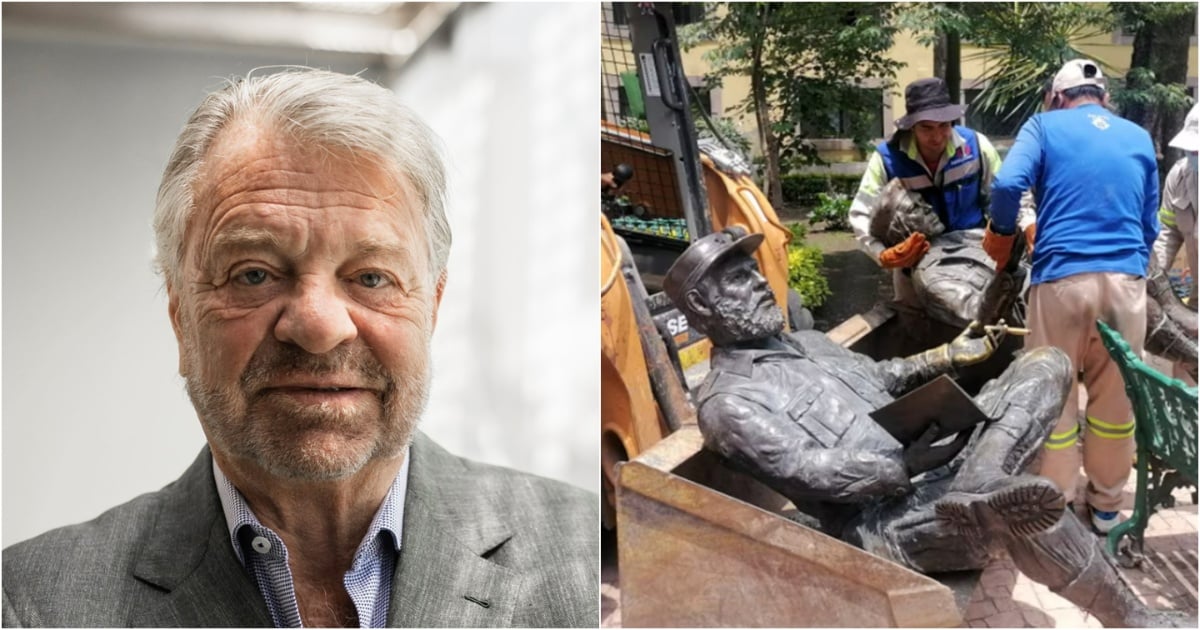
The former Mexican chancellor Jorge G. Castañeda criticized the admiration of Claudia Sheinbaum's government for the Cuban dictatorship regarding the removal of the statues of Fidel and Che from the Tabacalera park in the Cuauhtémoc district of Mexico City.
In an opinion piece published in Nexos, the writer and former diplomat stated that the discussions surrounding the removal of statues could spark a debate “about the increasingly authoritarian nature of the 4T [Fourth Transformation], and its deep and unconditional admiration for the Castro regime.”
Castañeda cited the Chilean case as an example to refer to Mexico, where the communist Jeanette Jara, a supporter of the Havana regime, was chosen as the left's candidate for the upcoming elections.
"How can one believe in Jara's democratic vocation if he is incapable of clearly drawing the line against the island's dictatorship? How can he, on one hand, defend Chilean democratic principles against far-right candidates, while on the other hand, failing to condemn the existence of nearly a thousand political prisoners in Cuba? How can he present a sensible, moderate, and modern economic platform if he continues to applaud the total failure of the Cuban regime and blames the United States for all the ills of that catastrophe?" questions Castañeda.
The former diplomat wonders what the situation would be if a statue were erected in a conservative town hall honoring Mussolini or Pinochet, and “upon taking power, Morena in any of those town halls would have faced pressures to ‘remove it’.”
"What is the difference between the Chilean, Spanish, and Italian dictatorships, to name just those, and the Cuban dictatorship? One of them, of course, is that the one on the island has lasted much longer. It has been 66 years, while Mussolini only lasted a couple of decades, Franco 30 years, and Pinochet barely 17," he argues.
"It's a shame that Cuba is not part of the Mexican discussion as it is in the Chilean debate. It would be very helpful for us to understand what each person in Mexico thinks. And, just to mention it, it seems reckless on the part of the government to continue maintaining support for the Díaz-Canel dictatorship, at least until very recently, when it is known that at some point a decree from Trump will come reproaching it and possibly prohibiting it," concludes Castañeda, who served as Mexico's Secretary of Foreign Affairs during Vicente Fox's administration from 2000 to 2003.
Controversy over the removal of statues
On July 17th, the controversial statues of Fidel Castro and Ernesto Che Guevara, installed in the Tabacalera Garden of the Cuauhtémoc municipality, were finally removed by the decision of Mayor Alessandra Rojo de la Vega, following the detection of irregularities in their placement and receiving multiple complaints from residents.
Rojo de la Vega publicly defended the decision, which has sparked extensive debate on social media and in the press.
The measure has sparked controversy, particularly among the vocal supporters of the Cuban Revolution in Mexico, but Rojo de la Vega reaffirmed his position by stating respect for human rights and the will of the community's residents.
"Citlali, dictatorships and repressive regimes are bad no matter where they come from. A murderer is a murderer whether they are from the right, center, or left," the mayor wrote on her X account (formerly Twitter) in response to criticism from Senator Citlalli Hernández. "If you have a totalitarian agenda, just say it and be done with it."
"Fidel and Che are not the Cuban people," he emphasized.
In another post, Rojo de la Vega clarified that the removal of the statues is not the result of a personal whim but rather the fulfillment of legal procedures requested by the citizens.
"It's not bureaucracy, it's the law... these aren't my arguments, they are the correct administrative processes," she pointed out. "I believe in democracy and legal certainty," the mayor defended.
The president of Mexico, Claudia Sheinbaum, had joined the controversy, suggesting that the figures could be relocated elsewhere, considering that they are part of a “historic moment” related to the shared history between Cuba and Mexico.
Frequently asked questions about the removal of statues of Fidel Castro and Che Guevara in Mexico
Why were the statues of Fidel Castro and Che Guevara removed in Mexico City?
The statues were removed due to irregularities in their placement and multiple complaints from residents. Mayor Alessandra Rojo de la Vega made the decision as part of compliance with legal procedures requested by the community, emphasizing respect for human rights and the will of the neighbors.
What is Claudia Sheinbaum's stance on the removed statues?
Claudia Sheinbaum suggested that the statues could be reinstalled in another location. The president of Mexico believes that the figures are part of a "historical moment" related to the shared history between Cuba and Mexico, which has been interpreted as an ambiguous and accommodating stance towards the Cuban regime.
What has been the reaction of the Communist Party of Mexico to the removal of the statues?
The Communist Party of Mexico described the act as "unpopular and anti-communist." They called for protests, arguing that the withdrawal is an affront to the friendship between Cuba and Mexico, and criticized the mayor's decision as an attempt to turn the mayor's office into a "right-wing stronghold."
What has been proposed to be done with the statues after their removal?
Mayor Alessandra Rojo de la Vega has proposed auctioning off the statues. The idea is that those who venerate Fidel Castro and Che Guevara can buy them with their own money, rather than having them remain in public spaces financed by taxpayer dollars.
Filed under: